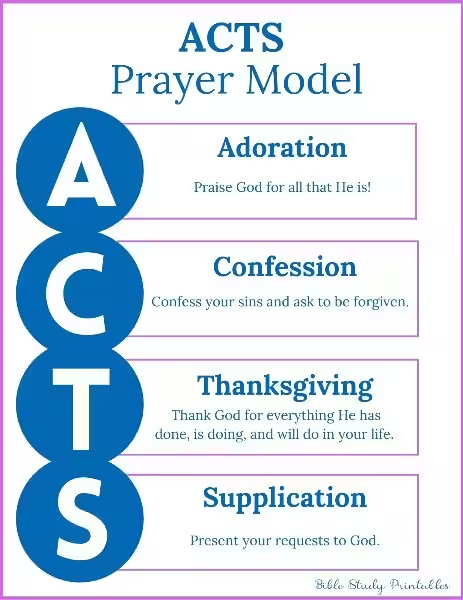
In the tapestry of human experience, few threads are as universally woven as the impulse to connect with something greater than ourselves. This connection often manifests as prayer, a deeply personal and often communal act that transcends mere words. It’s not just about asking for things; it’s about a dialogue, a communion, and ultimately, a catalyst for action. When we speak of acts of religion, we are frequently witnessing the tangible fruit of fervent prayer. This article will explore the profound relationship between prayer and the ways it inspires and underpins our religious practices and acts of faith.
The essence of prayer lies in its ability to shift our internal landscape. It’s a deliberate act of turning our attention, our hopes, our fears, and our gratitude towards a divine presence, an ultimate reality, or even the deepest wellspring of our own consciousness. This intentional focus can bring about a profound sense of peace, clarity, and purpose. Consider the simple act of waking up and offering a silent prayer of thanks for the new day. This seemingly small gesture can set a positive tone, influencing how we approach challenges and interact with the world around us for the next twelve hours.
Prayer as the Seed of Religious Action
Many of the outward expressions of religion – be it charity, service, or communal worship – find their genesis in the inward space of prayer. It is within this sacred dialogue that individuals often receive inspiration, conviction, and the spiritual strength needed to translate their beliefs into tangible acts. Without this foundational prayer, many religious acts could feel hollow, devoid of the deep meaning and divine connection that energizes them.
Think about the profound generosity often witnessed in faith communities. When a crisis strikes, whether a natural disaster or a personal tragedy affecting a member, prayer often precedes and accompanies the outpouring of support. People pray for guidance, for wisdom, and for the strength to help. This prayer isn’t passive; it’s an active invocation that prepares hearts and minds for compassionate action. It’s like planting a seed in fertile ground; the prayer is the seed, and the subsequent act of kindness is the flourishing plant. This prayer fuels the desire to “do good,” transforming abstract notions of faith into concrete gestures of love and support.
The Diverse Forms of Prayer in Religious Practice
Prayer is far from a monolithic practice. It manifests in a myriad of forms across different religions and even within denominations. From structured, liturgical prayers recited in unison to spontaneous, heartfelt whispers, each form serves to deepen the connection between the individual and the divine, and consequently, to inform their religious acts. Understanding this diversity helps us appreciate the broad spectrum of prayer’s influence on religious expression.
Liturgical Prayer: This involves set prayers, often found in books of worship, that are recited or sung by congregations. Examples include the Mass in Catholicism, the fixed daily offices in many monastic traditions, or the congregational prayers in Protestant services. These shared prayers foster a sense of unity and collective faith, often preceding communal acts of worship and service.
Meditative Prayer: Focuses on contemplation and inner reflection. This might involve repeating a sacred phrase (mantra), contemplating a scripture passage, or simply sitting in silent communion. This form of prayer cultivates inner peace and spiritual insight, which can then guide discerning responses to life’s situations.
Intercessory Prayer: This is prayer offered on behalf of others. It’s a powerful act of love and compassion, and it can directly lead to acts of service. When we pray for the sick, the poor, or those suffering, our prayer can inspire us to visit them, donate to their cause, or advocate for their needs.
Gratitude Prayer: Expressing thanks for blessings, big or small. This focus on appreciation can reorient our perspective, making us more aware of the abundance in our lives and the opportunities to share that abundance with others.
Prayer as a Catalyst for Social Justice and Compassion
The most profound acts of religion often stem from a deep, prayerful engagement with the world’s suffering. When individuals and communities pray for justice, for peace, and for the alleviation of poverty, these prayers are not meant to remain solely in the spiritual realm. They act as a powerful impetus for social action, driving individuals to become agents of change. The prayer becomes the fuel for the fight.
Consider the historical movements for civil rights and social justice. Many leaders and participants were deeply rooted in their faith traditions and relied heavily on prayer. They would pray for courage before protests, pray for understanding between opposing groups, and pray for the eradication of injustice. This prayer gave them the resilience to face adversity and the conviction to act even when the odds seemed overwhelming. For instance, a prayer for the marginalized might lead to volunteering at a soup kitchen, establishing a community outreach program, or advocating for policy changes. The prayer connects the heart to the plight of others, making the subsequent act of service feel not like an obligation, but a natural and necessary response.
Sustaining Faith Through Prayerful Action
The journey of faith is often a continuous cycle of prayer and action. Prayer sustains us when our deeds become arduous, and our acts reinforce the sincerity of our prayers. This dynamic interplay ensures that our religious expressions remain vibrant and impactful. Without this continuous nourishment, religious acts can become rote or lose their vital connection to the divine source.
When a community embarks on a significant project, such as building a new place of worship or establishing a charitable foundation, prayer is often a constant companion. Members will pray for success, for wisdom in decision-making, and for the well-being of all involved. This collective prayer builds unity and resolve. Furthermore, the very act of working together on these projects becomes a form of prayer in itself – a tangible expression of their shared faith and commitment. This symbiotic relationship between prayer and action ensures that religious endeavors are not just undertaken, but are imbued with purpose, love, and divine guidance. It’s a testament to the fact that the most meaningful acts of religion are those born from a heart that has first communed with the sacred through prayer.
Frequently Asked Questions about Prayer in Acts
What is prayer in the context of the book of Acts?
In Acts, prayer is presented as a vital and active element of the early Christian community’s life and ministry. It’s not just a private devotion but a communal act, a source of guidance, strength, and divine intervention. Prayers are offered for courage, for healing, for the release of apostles, and for the spread of the Gospel.
How often did the early Christians pray?
The book of Acts portrays prayer as a consistent and integral part of daily life for believers. They prayed at various times and in different settings: in private homes, in the temple, during moments of crisis, and as a regular part of their gatherings for fellowship and worship.
What are some common themes or purposes of prayer in Acts?
Common themes include:
Seeking God’s will and guidance (e.g., choosing new apostles).
Asking for boldness and perseverance in the face of opposition.
Praying for the sick and for miraculous healing.
Giving thanks and praise to God.
Intercession for others, including those who persecuted them.
Praying for the spread of the Gospel and the conversion of souls.
Can you give an example of a significant prayer in Acts?
A prominent example is the prayer offered by the apostles and the church in Jerusalem after Peter and John were arrested and threatened by the Sanhedrin (Acts 4:24-30). They prayed not for their own safety, but for God to grant them boldness to continue proclaiming His word and for God to stretch out His hand to heal and perform signs and wonders through the name of His holy servant Jesus.
Does the book of Acts show prayer as a response to specific events?
Yes, prayer is frequently depicted as a direct response to unfolding events. For instance, after Jesus’ ascension, the disciples prayed (Acts 1:14). When faced with opposition, they prayed (Acts 4:24). Upon the release of Peter and John from prison, the believers prayed (Acts 12:5). When the early church encountered new challenges or needed direction, prayer was their immediate recourse.
Who prayed in the book of Acts?
A wide range of individuals and groups are shown praying:
The apostles (Peter, John, Paul, Barnabas, etc.).
The disciples and believers as a whole community.
Specific individuals like Cornelius, Dorcas, and Lydia.
The early church in Jerusalem and other nascent Christian communities.
What can we learn about the effectiveness of prayer from Acts?
Acts emphasizes the power and effectiveness of prayer. It is consistently shown as a means by which God intervenes, provides, guides, and empowers His followers. Prayers are answered with miracles, boldness, deliverance, and the continued growth of the church.