The very bedrock of the Christian faith rests upon a singular, world-altering event: the resurrection of Jesus Christ. More than just a historical footnote, this event is the vibrant, pulsating heart of Christian belief, offering profound hope, transformative power, and an eternal perspective to believers across millennia. Understanding the Christ resurrection scripture is not merely an academic exercise; it’s an invitation to embrace a reality that reshapes our understanding of life, death, and the very nature of God. This article delves into the significance of these foundational scriptures, exploring their relevance to our everyday lives and the enduring message of redemption they carry.
The resurrection isn’t just about a past event; it’s a living reality that continues to impact and inspire millions. It’s the ultimate testament to God’s power over sin and death, a promise that extends far beyond the tomb. For those grappling with loss, despair, or the seemingly insurmountable challenges of life, the Christ resurrection scripture offers a beacon of unwavering hope, reminding us that the story does not end in tragedy.
Unveiling the Foundation: The Scriptural Witness to the Resurrection
The New Testament is replete with accounts that meticulously detail the events surrounding Jesus’ crucifixion and, crucially, his subsequent resurrection. These narratives, penned by eyewitnesses and those deeply connected to the early church, provide the cornerstone of our understanding. The Gospels, particularly Matthew 28, Mark 16, Luke 24, and John 20, offer independent yet harmonious testimonies of the empty tomb, the angelic pronouncements, and Jesus’ appearances to his disciples.
Consider the testimony of Mary Magdalene, often cited as the first to witness the risen Christ in John 20:11-18. Her initial confusion and grief transformed into ecstatic joy upon hearing Jesus call her name. This personal encounter, a direct encounter with the resurrected Lord, serves as a powerful illustration of how the resurrection can bring clarity and renewed purpose to those who are lost. Similarly, the accounts of the disciples on the road to Emmaus in Luke 24:13-35, where their eyes were opened to recognize Jesus in the breaking of bread, highlight the transformative power of encountering the risen Christ, even when he appears in unexpected ways.
The Empty Tomb: A Powerful Symbol of Victory
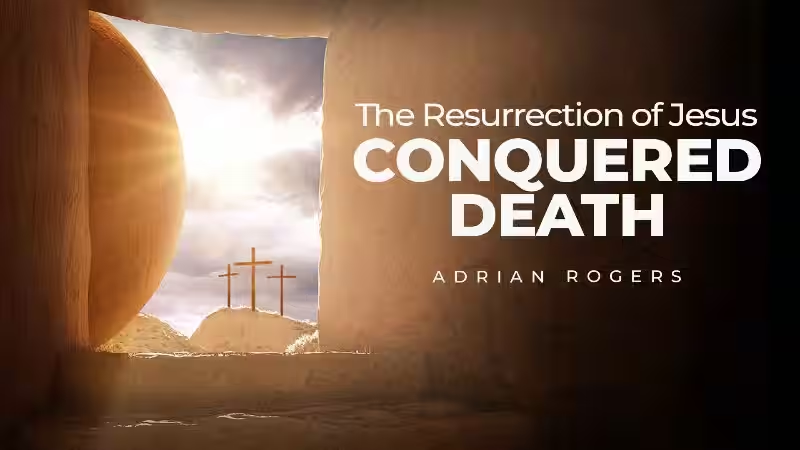
The empty tomb stands as one of the most compelling pieces of evidence for the resurrection. The Gospels consistently describe the stone rolled away, the tomb devoid of Jesus’ body, and the confusion that ensued among the guards and the religious authorities. This wasn’t a clandestine burial or a body smuggled away; it was a public, undeniable event that baffled those who sought to suppress the truth.
The discovery of the empty tomb, as documented in Matthew 28:2-4, wasn’t just a missing body; it was a divine declaration. An angel appeared, announcing, “He is not here; he has risen, just as he said.” This angelic confirmation, coupled with the disciples’ subsequent encounters with the risen Jesus, forms the indisputable proof that death had been overcome. Imagine a sealed vault, impossibly opened without a trace, signifying not an escape, but a triumph. This is the profound message of the empty tomb.
Post-Resurrection Appearances: Affirming the Reality
The Christ resurrection scripture is further solidified by the numerous accounts of Jesus appearing to his followers after his resurrection. These were not fleeting visions or hallucinations; they were tangible, interactive encounters that demonstrated the physical reality of his resurrected body. He ate with them, spoke with them, and even allowed them to touch him, as seen in John 20:27 when Jesus tells Thomas to “Reach here your finger, and see my hands; and reach here your hand and put it into my side. Do not be unbelieving, but believing.”
These appearances served a dual purpose: to reassure and commission his disciples. Jesus appeared to the disciples on the road to Emmaus, dispelling their doubts and rekindling their hope. He appeared to the eleven in the upper room, providing them with peace and the Great Commission to spread the Gospel (Matthew 28:18-20). These encounters were crucial in transforming a group of frightened, disillusioned followers into bold proclaimers of the resurrection. Their transformation, fueled by undeniable evidence, is a testament to the transformative power of the Christ resurrection scripture.
Theological Significance: What the Resurrection Means for Us
The resurrection of Jesus Christ is not merely a historical event; it carries immense theological weight that profoundly impacts our lives and our understanding of God. It’s the linchpin of Christian doctrine, offering redemption, reconciliation, and the promise of eternal life. Without the resurrection, the crucifixion would be a tragic end, not a victorious sacrifice.
The resurrection is the ultimate validation of Jesus’ claims to be the Son of God. It demonstrates his divine authority and his victory over the very forces that hold humanity captive: sin and death. As the Apostle Paul powerfully states in 1 Corinthians 15:17, “And if Christ has not been raised, your faith is futile; you are still in your sins.” This verse underscores the centrality of the resurrection to the entire Christian message.
Justification and Forgiveness: Redeemed Through His Sacrifice
One of the most significant implications of the resurrection is its role in securing our justification and forgiveness. Jesus’ death on the cross was a propitiatory sacrifice, paying the penalty for our sins. His resurrection signifies that this sacrifice was accepted by God, and its benefits are now available to all who believe.
The Christ resurrection scripture assures us that through Christ’s atoning work and his subsequent resurrection, we are declared righteous in God’s sight, not based on our own merit, but on Christ’s perfect obedience. Romans 4:25 states, “[Jesus] was delivered up for our trespasses and raised for our justification.” This means that the same power that raised Jesus from the dead is the power that empowers us to live a new life, free from the condemnation of sin. It’s like being given a clean slate, not because we earned it, but because someone else paid the debt we could never repay.
The Promise of Eternal Life: A Future Beyond the Grave
Perhaps the most comforting and hope-filled aspect of the resurrection is the promise of eternal life. Jesus’ victory over death opens the door for believers to share in that victory and to live eternally with God. The resurrection is not just about Jesus coming back to life; it’s about us having the potential to follow him into an unending existence.
The Christ resurrection scripture offers solace in times of grief and loss. The knowledge that death is not the end, but a transition to eternal life with God, provides a powerful antidote to despair. In 1 Corinthians 15:55-57, Paul exclaims, “O death, where is your victory? O death, where is your sting?” This triumphant declaration is possible because of the resurrection, which has disarmed death’s power and removed its sting. It’s the ultimate insurance policy, guaranteeing a future filled with joy and peace, far beyond our earthly existence.
Living in the Light of the Resurrection: Practical Implications
The Christ resurrection scripture is not meant to be confined to theological discussions or ancient texts; it has profound and practical implications for our daily lives. Embracing the truth of the resurrection empowers us to live with purpose, courage, and unwavering hope, regardless of the circumstances we face.
The resurrection transforms our perspective on suffering and adversity. Knowing that Jesus endured immense pain and ultimately triumphed over it gives us the strength to persevere in our own trials. It reminds us that our current struggles, however difficult, are not the final word.
Hope in Suffering and Adversity: A Resilient Faith Walk
Life inevitably presents us with challenges, from personal setbacks to global crises. In these moments, the Christ resurrection scripture serves as a powerful source of resilience and enduring hope. Jesus’ journey from agony in the garden to the empty tomb demonstrates that even in the darkest hours, God’s plan for redemption is at work.
When we face illness, loss, or injustice, we can draw strength from the knowledge that Jesus experienced these things and emerged victorious. His resurrection assures us that suffering is not the end of the story. As Peter writes in 1 Peter 1:3, “Praise be to the God and Father of our Lord Jesus Christ! In his great mercy he has given us new birth into a living hope through the resurrection of Jesus Christ from the dead.” This living hope empowers us to face difficulties not with despair, but with a steadfast belief in God’s ultimate triumph.
Empowerment for Living: A Transformed Life
The resurrection also provides the power to live a transformed life. It’s not just about believing in a past event; it’s about experiencing the renewing power of the Holy Spirit, who was poured out upon believers as a direct result of Christ’s ascension after his resurrection. This indwelling Spirit empowers us to live lives that are pleasing to God, to overcome sin, and to love others as Christ loved us.
The Christ resurrection scripture is the source of our spiritual rebirth. Just as Jesus was raised to new life, we too can experience a spiritual resurrection from our old, sin-filled ways. This transformation is an ongoing process, enabled by the dynamic power of the resurrection working within us. It allows us to move from simply existing to truly living, characterized by love, joy, peace, and purpose.
A Call to Witness: Sharing the Good News
Finally, the resurrection is the impetus for our mission. Jesus’ final command to his disciples, the Great Commission, was to go and make disciples of all nations, baptizing them and teaching them to obey everything he had commanded (Matthew 28:19-20). This commission is fueled by the certainty of the resurrection.
Our faith is not meant to be kept private; it is a message of transformative hope that the world desperately needs. Sharing the Christ resurrection scripture is an act of love and obedience, an opportunity to extend the promise of redemption and eternal life to others. When we share the story of the resurrection, we are not just recounting a historical event; we are proclaiming a living reality that has the power to change lives forever. The most compelling witness comes from lives transformed by the very power of the resurrection.
What is the primary scriptural basis for the resurrection of Jesus Christ?
The primary scriptural basis for the resurrection of Jesus Christ is found in the New Testament Gospels, particularly in the accounts of Matthew 28, Mark 16, Luke 24, and John 20. These passages describe the empty tomb and the appearances of the resurrected Jesus to his disciples. Additionally, the Apostle Paul’s letters, especially 1 Corinthians 15, provide a theological explanation and defense of the resurrection.
What does the resurrection of Christ signify within Christianity?
Within Christianity, the resurrection of Christ is a cornerstone doctrine. It signifies Christ’s victory over sin and death, validating his claims of divinity and his atonement for humanity’s sins. It offers believers the hope of eternal life and a transformed existence through faith in him. The resurrection is seen as the ultimate proof of God’s power and love.
Are there differing interpretations of the resurrection accounts within religious traditions?
While the core belief in the resurrection is central to orthodox Christianity, there can be differing interpretations regarding the specifics of the accounts. Some theological discussions focus on the nature of the resurrected body, the timeline of events, or the emphasis placed on different aspects of the post-resurrection appearances. However, these are generally within the framework of Christian belief and do not negate the fundamental doctrine.
How does the resurrection of Christ relate to other religious beliefs about life after death?
The Christian belief in the resurrection of Christ offers a unique perspective on life after death compared to many other religious traditions. While other religions may speak of reincarnation, spiritual realms, or the continuation of the soul, the resurrection emphasizes a corporeal, yet transformed, existence. It posits a definitive victory over death through divine intervention, offering a future hope of bodily resurrection for believers.
What are some key theological implications of Christ’s resurrection for believers?
Key theological implications of Christ’s resurrection for believers include:
* Justification: The resurrection is seen as God’s affirmation of Christ’s sacrifice, leading to the justification (being declared righteous) of those who believe in him.
* New Life: Believers are spiritually resurrected with Christ, enabling them to live a new life free from the bondage of sin.
* Hope: The resurrection provides the assurance of future resurrection for believers and the ultimate triumph of God’s kingdom.
* Empowerment: The Holy Spirit, poured out after the resurrection, empowers believers to live out their faith and spread the Gospel.