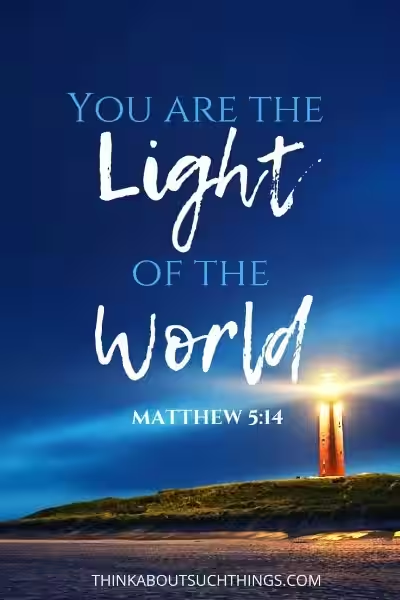
The concept of an unending, radiant presence, often referred to as the eternity light, has captivated human spirituality for millennia. It speaks to a fundamental human yearning for connection to something vaster, something that transcends the fleeting nature of our earthly existence. This celestial illumination isn’t just a metaphor; for many, it represents the divine, the ultimate source of truth, love, and peace that abides eternally. It’s the beacon that guides us through darkness, the whisper of hope in times of despair, and the promise of a reality beyond our present understanding.
Across diverse religious traditions, the idea of an incorruptible, ever-present light serves as a cornerstone of faith. Whether conceived as the uncreated light of God, the illuminating wisdom of enlightenment, or the enduring spirit of the departed, this eternity light offers solace and direction. It’s not a light that can be switched off, nor one that dims with age or circumstance. Instead, it’s a constant, unwavering source of being, a testament to the everlasting nature of the sacred. Understanding this concept can profoundly reshape our perspective on life, death, and our place within the grand cosmic design.
The Divine Radiance: God as the Source of Eternity Light
In many monotheistic religions, God is intimately associated with the concept of an eternity light. This isn’t a physical luminescence in the human sense, but rather a divine essence, an omnipresent spiritual energy that sustains all creation. Think of it like the sun: we can’t look directly at its blinding brilliance, but we experience its warmth and see its effects on everything around us. Similarly, the divine light is so potent and pure that it’s often described as beyond human comprehension, yet its presence is felt in the beauty of nature, the depth of love, and the inner stirrings of conscience. This divine radiance is the ultimate reality, the unshakeable foundation upon which all existence rests.
This divine light is also seen as the source of all truth and knowledge. When we seek understanding, when we strive for moral clarity, we are, in essence, turning towards this eternity light. It’s the inner compass that guides us toward righteousness and away from error. Religions often teach that through prayer, meditation, or adherence to sacred texts, individuals can attune themselves to this divine frequency, experiencing moments of profound insight and connection. The pursuit of spiritual wisdom is, therefore, a journey toward becoming more receptive to this ever-present, illuminating force, allowing its truth to dispel the shadows of ignorance and doubt within us.
Manifestations of the Eternal Glow in Scripture and Tradition
Throughout sacred scriptures, the eternity light is described in vivid imagery. The Bible speaks of God’s glory as a consuming fire and an unapproachable light. In the Quran, Allah is described as the Light of the heavens and the earth, a parable of His light is like a niche in which is a lamp, the lamp in a glass, the glass as it were a pearly white star lit from a blessed tree, neither of the east nor of the west, whose oil would almost glow even if no fire touched it. This celestial lamp symbolizes divine guidance and illumination accessible to all who seek it sincerely. These descriptions, while metaphorical, aim to convey the transcendent and infinitely powerful nature of the divine presence.
In Eastern traditions, particularly Buddhism, the concept of enlightenment itself is akin to experiencing an eternity light. The Buddha’s awakening brought forth a profound understanding of the nature of suffering and the path to liberation. This enlightenment is not a fleeting moment but a state of being that radiates wisdom and compassion, illuminating the path for others. The Bodhisattvas, enlightened beings in Mahayana Buddhism, embody this eternal light, dedicating themselves to guiding all sentient beings towards awakening. Their actions and teachings serve as beacons, reflecting the boundless light of compassion and understanding, demonstrating that this eternal glow is not just an abstract concept, but a lived reality accessible to all.
The Inner Light: Personal Experience of Eternity Light
Beyond grand theological pronouncements, the eternity light also resides within the individual human spirit. Many spiritual traditions emphasize that the divine spark, the essence of this eternal light, is present in each of us. It’s the quiet voice of intuition, the capacity for love and empathy, the innate sense of wonder and awe we experience when encountering something truly beautiful or profound. This inner light is not learned; it is inherent, a part of our very being, waiting to be recognized and nurtured. It’s the part of us that instinctively knows right from wrong, the part that yearns for connection and meaning beyond the material world.
Cultivating this inner eternity light often involves practices that quiet the external noise of daily life and allow for introspection. Meditation, mindful reflection, acts of selfless service, and deep contemplation of life’s mysteries are all pathways to this inner illumination. Imagine a lamp that’s been covered with dust for years; the light within is still there, but it needs to be cleaned to shine brightly. Similarly, our inner light can be obscured by worries, ego, and worldly distractions. By consciously practicing self-awareness and spiritual discipline, we can clear away the dust, allowing our innate divine radiance to shine forth, influencing our thoughts, actions, and interactions with the world.
In times of hardship, loss, or confusion, the belief in an eternity light offers a profound source of hope and resilience. When the path ahead seems dark and uncertain, this eternal beacon reminds us that we are not alone and that even in the deepest valleys, a guiding light persists. This isn’t about denying the reality of pain or suffering, but about finding a deeper perspective that transcends immediate circumstances. The eternal glow assures us that there is a larger, benevolent force at play, one that offers comfort and guidance through every trial. It’s the quiet assurance that the darkness is temporary, and the light is everlasting.
This understanding of the eternity light also informs our approach to death. Instead of viewing it as an ultimate end, many religions see it as a transition, a return to the source of that eternal light. The physical body may perish, but the spirit, the essence of our being, is believed to rejoin this luminous divine presence. This comforting belief provides solace to those grieving and offers a sense of peace regarding our own mortality. It transforms death from a terrifying void into a homecoming, a reunion with the boundless love and light that has always been, and will always be. The legacy of our lives, the impact we have, and the love we share, can be seen as reflections of this eternal glow, continuing to illuminate the world long after we are gone.
The Universal Call of Eternity Light
Regardless of specific religious doctrines, the underlying human experience of seeking meaning, connection, and enduring truth points towards the universal appeal of the eternity light. It’s the inherent human desire to understand our origins, our purpose, and our ultimate destiny. This quest for the eternal is a testament to our spiritual nature, our capacity to look beyond the immediate and to believe in something more profound and lasting. The very existence of diverse religious and spiritual paths can be seen as different human attempts to articulate and connect with this singular, overarching reality of the eternal light.
Ultimately, the concept of eternity light is an invitation. It invites us to look inward, to look outward, and to look upward. It challenges us to live lives of purpose, guided by love, truth, and compassion, knowing that these qualities are reflections of a reality that is eternal and unfailing. Whether we find it in the teachings of a holy book, the quiet of a meditation, or the shared experience of humanity, the eternal glow is there, a constant, unwavering source of hope and illumination, beckoning us towards a deeper understanding of ourselves and the universe we inhabit. It’s the promise of a light that never fades, a presence that never abandons, and a truth that endures forever.
Frequently Asked Questions about Eternity Light and Religion
What is Eternity Light?
Eternity Light, in a religious context, often refers to the concept of unending existence, divine illumination, or spiritual enlightenment that is believed to persist beyond physical death. It can be interpreted as the presence of God, a state of eternal peace, or the enduring nature of the soul.
How do different religions view Eternity Light?
Views vary significantly across religions. In Abrahamic religions (Judaism, Christianity, Islam), Eternity Light is often associated with the afterlife, God’s glory, and the divine presence. In Eastern religions (Buddhism, Hinduism), it might be linked to concepts like Nirvana, Moksha, or the ultimate reality beyond the cycle of rebirth, often achieved through spiritual practice and liberation. Some indigenous or spiritual traditions may see it as a primal force of creation or the interconnectedness of all life.
Is Eternity Light a literal place or a state of being?
This is a matter of theological interpretation. For some, it’s a literal heavenly realm or paradise. For others, it’s a metaphorical state of consciousness, spiritual union, or transcendence. The emphasis often lies on the quality of existence rather than a physical location.
How does one achieve or experience Eternity Light?
Practices such as faith, righteous living, prayer, meditation, devotion, selfless service, and seeking wisdom are commonly believed to lead towards an understanding or experience of Eternity Light. The specific path often aligns with the teachings and rituals of a particular religious or spiritual tradition.
Does Eternity Light imply immortality of the soul?
In many religious frameworks, Eternity Light is intrinsically linked to the belief in the immortality of the soul. The soul is seen as that aspect of a person which endures eternally, and Eternity Light is the realm or state it enters into after the physical body ceases to exist.
Can Eternity Light be understood through science?
Eternity Light, as a concept rooted in faith and spirituality, is generally considered beyond the scope of empirical scientific inquiry. Science primarily deals with the observable and measurable physical world, while Eternity Light addresses metaphysical and transcendental aspects of existence.
Are there any common themes regarding Eternity Light across religions?
Despite diverse interpretations, common themes often include the idea of a ultimate, transcendent reality, a state of ultimate peace or fulfillment, and a sense of enduring existence beyond the limitations of earthly life. There’s also a frequent emphasis on love, truth, and the divine as central components of this eternal state.