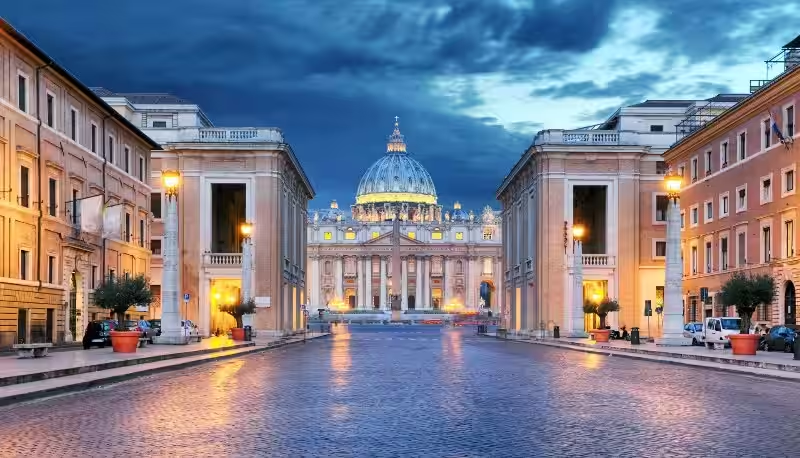
Imagine standing where gladiators once clashed, the roar of the crowd a phantom echo in the vast stone arena. Now, picture yourself gazing upon the artistic and spiritual heart of Catholicism, a place where centuries of devotion have culminated in breathtaking beauty. For many travelers, a journey to Rome is a quest for both historical immersion and spiritual contemplation, and the iconic Colosseum and the majestic Vatican stand as paramount landmarks on this pilgrimage. These experiences, seemingly disparate in their origins, are inextricably linked by the enduring influence of faith and the grand narratives of human endeavor.
Embarking on Colosseum tours offers a window into the immense power and spectacle of the Roman Empire, a civilization that, for centuries, shaped the Western world and eventually became the crucible for Christianity’s rapid spread. While the Colosseum itself is a testament to pagan might and entertainment, its very existence and the subsequent transformation of Rome are deeply intertwined with the rise of a faith that would ultimately redefine its destiny. Understanding this historical transition adds a profound layer of meaning to any visit, allowing us to see beyond the mere stones and into the evolving spirit of the city.
From Pagan Spectacle to Christian Symbolism: The Colosseum’s Evolving Narrative
The Colosseum, a colossal amphitheater that once hosted gladiatorial contests, animal hunts, and even mock naval battles, is a stark reminder of the Roman Empire’s penchant for grandeur and public spectacle. Commissioned by Emperor Vespasian in 70-72 AD and completed by his son Titus in 80 AD, this architectural marvel could accommodate an estimated 50,000 to 80,000 spectators. Its construction, funded by spoils from the Jewish War, speaks volumes about Roman military prowess and their desire to entertain and pacify the masses. Walking through its arches and imagining the vibrant, often brutal, events that unfolded within its walls is an exercise in historical empathy.
However, the Colosseum’s story doesn’t end with the fall of the Empire. Over time, as Christianity gained prominence, the arena began to be viewed through a different lens. It became a site associated with the martyrdom of early Christians, a narrative that, while historically debated in its specifics, profoundly shaped its perception for centuries. This shift in understanding transformed the Colosseum from a symbol of pagan excess to a solemn reminder of faith tested and enduring. Many Colosseum tours will touch upon these later interpretations, offering a more nuanced view of its historical significance and its eventual role in the Christian narrative of Rome.
The Layers of History: What to Expect on a Colosseum Tour
When you book a Colosseum tour, you’re not just getting a guided walk through an ancient ruin; you’re gaining access to a meticulously crafted historical experience. Expert guides bring the structure to life, explaining its ingenious engineering, the social hierarchies of the spectators, and the daily lives of those who performed within its confines. You’ll learn about the hypogeum, the underground network of tunnels and cages where gladiators and animals were held before being dramatically lifted into the arena. Many tours also include access to the Roman Forum and Palatine Hill, offering a comprehensive understanding of the heart of ancient Rome.
A good Colosseum tour will often weave in the development of the surrounding area and its connection to the burgeoning Christian community. You might hear about the nearby Arch of Constantine, a triumphal arch that visually bridges pagan and Christian symbolism, or the Basilica of San Clemente, a church built over pagan temples. These connections highlight how the spiritual landscape of Rome was in constant flux, with the Colosseum standing as a silent witness to these profound shifts. It’s a journey that requires an open mind, ready to absorb stories of both earthly power and spiritual resilience.
The Vatican: A Sanctuary of Faith and Artistic Masterpieces
Moving from the grandeur of imperial Rome to the spiritual heart of the Catholic world, the Vatican City presents an entirely different, yet equally captivating, experience. This independent city-state, the smallest in the world, is the spiritual and administrative center of the Roman Catholic Church, presided over by the Pope. It is a place of pilgrimage for millions, drawing visitors with its unparalleled collection of art, its profound religious significance, and its breathtaking architectural achievements. Vatican tours are designed to navigate this complex and overwhelming space, offering insights into its history, art, and faith.
The Vatican Museums, a labyrinth of galleries housing some of the world’s most iconic artworks, culminate in the awe-inspiring Sistine Chapel. This sacred space, with Michelangelo’s breathtaking frescoes adorning its ceiling and altar wall, is a testament to human artistic genius inspired by divine narratives. Beyond the museums, the magnificent St. Peter’s Basilica, a masterpiece of Renaissance architecture, stands as a monumental church and a focal point for papal ceremonies. The sheer scale and opulence of the Vatican are designed to inspire awe and devotion, serving as a tangible manifestation of centuries of faith.
Navigating the Sacred Spaces: Essential Vatican Tour Insights
Planning a visit to the Vatican requires careful consideration, and opting for Vatican tours is highly recommended to make the most of your time and gain a deeper understanding. These tours often provide skip-the-line access, a crucial benefit given the immense popularity of the Vatican. Beyond practicalities, knowledgeable guides illuminate the historical context of the collections, explaining the biblical stories depicted in the art, the lives of the artists, and the evolution of the Church’s power and influence. Small group tours can offer a more intimate and personalized experience, allowing for more questions and a closer connection to the guide’s insights.
A typical Vatican tour will cover the Vatican Museums, including the Raphael Rooms and the Gallery of Maps, before leading you into the Sistine Chapel. The experience of entering the Sistine Chapel is often described as overwhelming, with the sheer artistry and the profound religious narratives depicted captivating visitors. Following this, the tour usually proceeds to St. Peter’s Basilica, where you can marvel at Michelangelo’s Pietà and Bernini’s Baldacchino. Many tours also offer the option to climb to the top of St. Peter’s Dome for panoramic views of Rome, a truly unforgettable experience that connects the spiritual center to the secular city.
The Intertwined Threads of Religion, History, and Tourism
The Colosseum and the Vatican represent two monumental pillars of Rome’s identity, one rooted in imperial might and the other in spiritual leadership. Yet, their stories are not entirely separate. The Roman Empire’s embrace of Christianity, beginning in the 4th century, fundamentally altered the course of history, and Rome, the former heart of paganism, became the epicenter of this new faith. This transformation is palpable when you move between these iconic sites. You can almost feel the shift in spiritual and political power as you explore the ancient ruins and then step into the gilded halls of the Vatican.
For travelers seeking a meaningful experience, understanding this religious and historical context enriches both the Colosseum tours and the Vatican tours. It allows us to see how the grand narratives of empires and the quiet strength of faith have shaped the very fabric of the Eternal City. Whether you’re drawn by the architectural marvels, the artistic masterpieces, or the profound spiritual significance, Rome offers a journey that speaks to the enduring power of human beliefs and aspirations, a testament to the forces that have shaped our world.
Connecting the Dots: A Holistic Roman Experience
When planning your itinerary, consider how you can connect the dots between these seemingly distinct attractions. Perhaps a morning spent exploring the arena of the Colosseum, contemplating the struggles and triumphs of ancient Rome, can be followed by an afternoon of spiritual reflection and artistic wonder within the Vatican. This juxtaposition offers a powerful perspective on the evolution of human civilization and the enduring influence of faith. It’s a chance to witness firsthand how a pagan empire gave way to a spiritual powerhouse, and how these transitions are etched into the very landscape of Rome.
To truly appreciate the intertwined nature of Rome’s history, think about booking combined tours or structuring your days to allow for thoughtful transitions. For instance, learning about the early Christian martyrs at the Colosseum and then witnessing the artistic expressions of Christian faith at the Vatican can be a deeply moving experience. This approach transforms a typical tourist trip into a profound exploration of culture, history, and the enduring power of religion. It’s about understanding not just what you see, but the stories and beliefs that have shaped it all, making your Colosseum and Vatican tours an unforgettable pilgrimage.
Frequently Asked Questions: Colosseum & Vatican Tours and Religion
What is the significance of the Colosseum in relation to religion?
While the Colosseum is primarily known for its gladiatorial contests and public spectacles, it also holds some connection to early Christian martyrdom. However, historical evidence for widespread Christian executions within the Colosseum is debated and less substantial than often portrayed. Its significance leans more towards Roman imperial power and entertainment.
How does religious history play a role in Vatican tours?
The Vatican is the spiritual and administrative center of the Catholic Church, making religious history central to its tours. Visitors explore St. Peter’s Basilica, a major pilgrimage site, learn about the papacy, and see the Vatican Museums which house an immense collection of art and artifacts amassed by the Church over centuries, many with profound religious themes and historical importance.
Are Vatican tours suitable for non-Catholics?
Absolutely. Vatican tours are designed to be informative and engaging for everyone, regardless of their religious beliefs. They offer a rich historical and artistic experience, explaining the significance of the sites and artworks within their historical context, which can be appreciated by people of all faiths and no faith.
What religious artifacts can I expect to see on a Vatican tour?
You can expect to see a vast array of religious artifacts. This includes relics of saints (though not always explicitly displayed or accessible), sacred art depicting biblical scenes and figures like Jesus Christ, the Virgin Mary, and various saints, papal vestments, liturgical objects, and historical documents related to the Catholic Church’s history and teachings.
Do Colosseum tours often include religious elements?
While the Colosseum itself isn’t a religious site in the same way the Vatican is, tours might touch upon the religious context of Roman society at the time, including pagan rituals and the later emergence of Christianity within the Roman Empire. Discussions could include the persecution of early Christians, though the direct link to the Colosseum as a primary site for this is often nuanced.
Can I attend religious services while visiting the Vatican?
Yes, religious services are regularly held at the Vatican, most notably in St. Peter’s Basilica. Visitors are welcome to attend Mass and other liturgical celebrations, often presided over by clergy. It’s advisable to check the schedule beforehand for specific times and any dress code requirements.