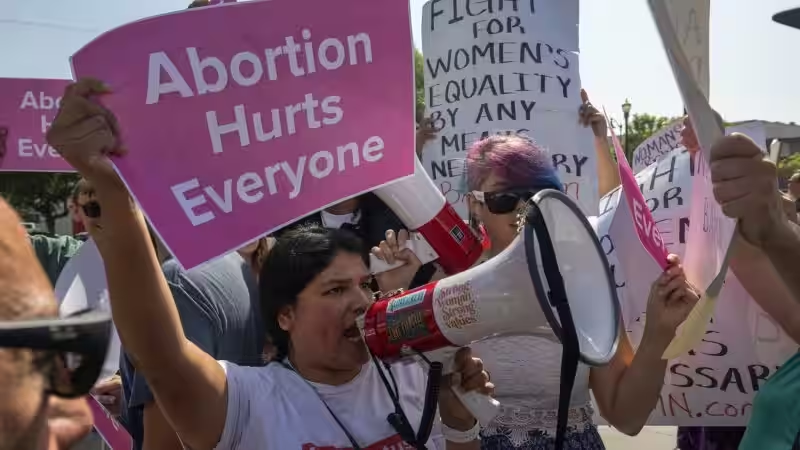
The journey of life, particularly for women, is often navigated with a compass guided by deeply held beliefs and spiritual principles. When unexpected situations arise concerning reproductive health, the intersection of these personal convictions with practical solutions becomes a crucial and often sensitive conversation. This is where understanding options like “SheWise Plan B” becomes particularly relevant, demanding a thoughtful approach that respects both individual autonomy and religious frameworks.
This article aims to provide a comprehensive and empathetic exploration of “SheWise Plan B” within the broad spectrum of religious thought. We will delve into how various faiths interpret and approach reproductive health choices, the ethical considerations that arise, and how individuals might reconcile their beliefs with the use of emergency contraception. Our goal is to offer informative, relatable, and useful insights for anyone seeking to understand this complex interplay.
Across the globe, religious traditions offer a diverse range of perspectives on human sexuality, family planning, and reproductive autonomy. These viewpoints are not monolithic; within any given faith, there can be a wide spectrum of opinions and interpretations, influenced by cultural context, historical development, and individual theological understanding. Understanding this diversity is the first step in appreciating the nuanced relationship between religion and options like “SheWise Plan B”.
Many religions emphasize the sanctity of life and the importance of family. However, interpretations of how to best uphold these values can vary significantly. Some traditions may focus on abstinence before marriage as the primary means of preventing unintended pregnancies, while others permit married couples to use family planning methods to space or limit children. The concept of divine providence can also play a role, with some believers feeling that all life is a gift from God and should be accepted as it comes, while others believe God grants humans the wisdom and agency to make responsible choices regarding their bodies and families.
Examining Different Faith Traditions
The dialogue surrounding reproductive health is multifaceted, with each major religion contributing its unique ethical and moral framework. For instance, within Christianity, denominations range from those that actively discourage or prohibit all forms of contraception, emphasizing natural family planning and viewing life as beginning at conception, to those that permit responsible use of contraception, seeing it as a way for couples to exercise stewardship over their fertility and family size. The core tenet often revolves around the moral permissibility of the method itself and the intention behind its use.
Similarly, Islam generally permits the use of contraception, viewing it as a way for couples to plan their families responsibly and ensure the well-being of existing children. The emphasis is often on mutual consent between spouses and the avoidance of harm. In contrast, some interpretations within Judaism may hold more varied views, with some perspectives allowing for contraception for health or family planning reasons, while others may lean towards a more pro-natalist stance. Understanding these distinctions is vital when considering how “SheWise Plan B” might be viewed within these diverse religious communities.
A recurring theme across many religious traditions is the importance of intent in any action. When considering emergency contraception like “SheWise Plan B”, the underlying motivation is often a crucial factor in its moral evaluation. Is the intent to prevent a pregnancy that is not desired at that moment, or is it to end a pregnancy after it has occurred? This distinction is often central to theological discussions about the morality of various reproductive health interventions.
Furthermore, many faith traditions place a strong emphasis on the individual conscience. While religious leaders and texts provide guidance, ultimately, individuals are often encouraged to prayerfully consider their options and make decisions that align with their understanding of their faith and their personal moral compass. This principle suggests that while religious teachings offer a framework, the final decision rests with the individual, empowered by their faith to act with integrity.
“SheWise Plan B”: Understanding the Science and Ethical Considerations
To fully grasp the religious implications of “SheWise Plan B”, it’s essential to understand its scientific mechanism and how it differs from other forms of emergency contraception. This clarity can help dispel misconceptions and inform more nuanced ethical discussions. “SheWise Plan B” is a type of emergency contraception (EC) primarily designed to prevent pregnancy after unprotected intercourse or contraceptive failure.
The scientific consensus is that “SheWise Plan B” works mainly by delaying or inhibiting ovulation. This means that if an egg has not yet been released, the medication can prevent it from being released, thus preventing fertilization. In some instances, it may also alter the cervical mucus, making it more difficult for sperm to reach the egg. It is not designed to terminate an existing pregnancy, a crucial distinction in many religious ethical frameworks.
How “SheWise Plan B” Functions
The mechanism of action for “SheWise Plan B” is a key point of discussion in religious circles. It is important to note that “SheWise Plan B” is a progestin-only pill, which is highly effective when taken within a specific timeframe after unprotected sex. Its primary function is to prevent fertilization from occurring. The scientific evidence indicates that it does not cause an abortion; it works before pregnancy is established.
This distinction is significant for many religious individuals and communities. For those who believe that life begins at conception and that abortion is morally impermissible, understanding that “SheWise Plan B” acts as a contraceptive measure rather than an abortifacient can be a critical factor in their decision-making process. It separates the act of preventing conception from the act of ending a pregnancy.
Differentiating from Abortion
The most significant ethical and religious concern often revolves around the question of whether emergency contraception constitutes abortion. It is vital to reiterate that “SheWise Plan B” is not an abortifacient. An abortion is defined as the termination of a pregnancy that has already begun, meaning that fertilization has occurred and implantation has taken place.
Emergency contraception, including “SheWise Plan B”, functions by preventing fertilization or, in very rare cases, by preventing implantation. However, the overwhelming scientific understanding is that its primary mechanism is to prevent ovulation. This means that if unprotected intercourse occurs and ovulation is imminent, “SheWise Plan B” can prevent the egg from being released, thus averting fertilization altogether. This scientific understanding is crucial for individuals seeking to align their use of such options with their religious convictions.
Reconciling Faith and Practical Choices: “SheWise Plan B”
For many individuals, the challenge lies not in understanding the science, but in integrating practical health options with deeply held spiritual beliefs. The decision to use “SheWise Plan B” can be a personal one, often made in moments of crisis or uncertainty, and it’s important for religious communities to approach these situations with compassion and understanding, rather than judgment.
The concept of “SheWise Plan B” can be seen as a tool that allows individuals to exercise responsible agency over their reproductive health while still adhering to their faith’s broader principles. This is not about abandoning religious values, but about finding ways to apply them in complex, real-world scenarios. It requires a nuanced understanding of religious teachings and a willingness to engage in honest self-reflection.
Prayer, Guidance, and Personal Decision-Making
When faced with the decision of whether to use “SheWise Plan B”, many individuals turn to prayer and spiritual guidance. This might involve seeking counsel from religious leaders, elders, or trusted members of their faith community. The process often involves deep introspection, considering not just the immediate situation but also the long-term implications for one’s spiritual life and family.
Ultimately, the decision to use “SheWise Plan B” is a personal one, guided by an individual’s conscience and their understanding of their faith. While religious traditions offer a moral compass, the final choice rests with the individual, who must be able to live with their decision in alignment with their spiritual values. This empowerment is a key aspect of navigating these complex choices.
Finding Support Within Religious Communities
It is essential for religious communities to foster an environment where individuals feel safe to discuss these matters without fear of condemnation. While disagreements on specific practices may exist, empathy and a commitment to supporting individuals through difficult times should be paramount. This can involve:
Open and honest dialogue about reproductive health within faith contexts.
Providing resources and information that are both scientifically accurate and theologically sound.
Offering pastoral care and counseling that respects individual autonomy and faith journeys.
Encouraging a focus on forgiveness and grace, acknowledging that individuals may make difficult choices and still remain within the fold of their faith.
By creating such supportive spaces, religious communities can help individuals make informed decisions about options like “SheWise Plan B” that are both practical and spiritually congruent. The aim is to empower individuals to navigate their reproductive health choices with wisdom, faith, and a clear conscience.
Frequently Asked Questions about SheWise Plan B and Religion
Does SheWise Plan B have any religious affiliations?
SheWise Plan B is a brand that provides emergency contraception. Its purpose is to offer a medical option for preventing pregnancy and does not have any inherent religious affiliations or doctrines. The decision to use emergency contraception is a personal one, and individuals of all religious backgrounds may choose to use it.
Are there religious objections to using SheWise Plan B?
Some religious denominations and individuals hold beliefs that may lead them to object to the use of emergency contraception. These objections are often rooted in differing views on when life begins and the moral permissibility of preventing conception. Other religious perspectives may not have specific objections or may support individuals making their own healthcare decisions. It is advisable to consult with religious leaders or study relevant religious texts if you have concerns about how its use aligns with your faith.
How do different religions view emergency contraception?
Views on emergency contraception can vary significantly across and even within different religions. For example:
Catholicism: The Catholic Church teaches that life begins at conception and opposes artificial contraception, including emergency contraception, believing it can prevent the implantation of a fertilized egg.
Protestantism: Views among Protestant denominations are more diverse. Some may oppose it for similar reasons as Catholicism, while others may take a more pastoral approach, emphasizing individual conscience and the well-being of the individuals involved.
Judaism: Jewish law generally permits the use of contraception to prevent conception, and opinions on emergency contraception can vary, with some authorities permitting its use for specific reasons, such as protecting the mother’s health.
Islam: Islamic jurisprudence generally permits contraception, and the permissibility of emergency contraception often depends on the specific circumstances and the intent behind its use, with many scholars deeming it permissible.
Other Religions: Beliefs in other religions and spiritual traditions will also vary. Some may have specific teachings or interpretations that guide their views on contraception.
It is important to understand that these are broad generalizations, and individual interpretations and specific rulings can differ.
Can I use SheWise Plan B and still adhere to my religious beliefs?
Whether you can use SheWise Plan B while adhering to your religious beliefs depends entirely on your personal interpretation and practice of your faith. Some individuals may find that their religious teachings allow for the use of emergency contraception in certain circumstances, while others may feel it conflicts with their core tenets. This is a complex and personal decision that may involve prayer, reflection, and potentially consultation with religious advisors.