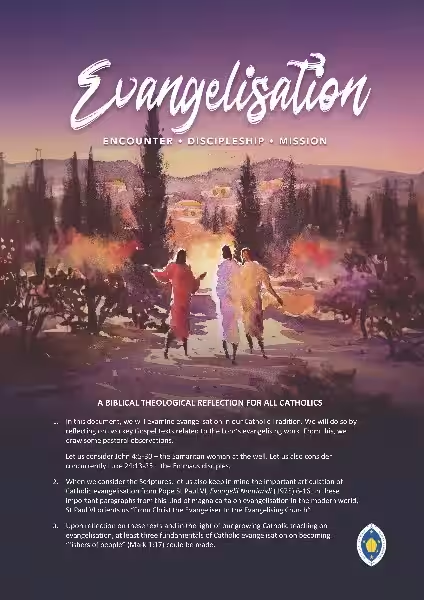
More Than Just Preaching: The Essence of Catholic Evangelisation
At its core, evangelisation Catholic practice isn’t merely about proclaiming doctrines or inviting people to join a church. It’s a deeply personal and communal calling, rooted in the very mission Jesus entrusted to his disciples: to share the Good News of salvation with all nations. This “Good News” is the transformative encounter with Jesus Christ, his life, death, and resurrection, and the promise of eternal life. For Catholics, this isn’t a historical event to be studied, but a living reality that continues to shape lives and communities. It’s about witnessing to the love of God, a love that is so profound it compels us to reach out to others, inviting them to experience that same transformative power.
Think of it like this: imagine discovering an incredible recipe that completely changed your cooking, making meals vibrant and delicious. You wouldn’t keep that secret to yourself, would you? You’d enthusiastically share it with friends and family, hoping they too could experience the joy of such wonderful food. Catholic evangelisation operates on a similar principle, but the “recipe” is the Gospel, the life-changing message of God’s love and redemption. It’s a sharing born out of genuine love and a desire for the well-being of others, not an obligation to fill pews, but a joyful overflowing of a heart touched by God’s grace.
Historical Roots and Enduring Mission
The seeds of evangelisation Catholic style were sown on the very day of Pentecost, when the Holy Spirit descended upon the Apostles, empowering them with boldness to proclaim Christ. From that moment onwards, the early Church, though small and often persecuted, embarked on a mission that would eventually spread across the known world. They didn’t have the benefit of modern technology or mass media; their primary tools were their lives, their words, and their unwavering faith. They lived out the Gospel in their daily interactions, demonstrating radical love, forgiveness, and service, which often proved more persuasive than any eloquent sermon.
Throughout history, the Church has consistently engaged in evangelisation Catholic communities worldwide. From the missionary journeys of saints like Paul and Francis Xavier to the establishment of schools, hospitals, and charitable organisations, the Church has sought to meet people’s needs – spiritual, physical, and emotional – as a tangible expression of Christ’s love. This holistic approach recognizes that true evangelisation addresses the whole person, acknowledging that a hungry stomach and a searching soul often go hand-in-hand. It’s about building bridges of understanding and offering hope in a world that often feels fractured and uncertain.
Modern Evangelisation: Adapting the Message, Not the Core
In the 21st century, the landscape of evangelisation Catholic has evolved, necessitating new approaches and creative methods. While the core message of Jesus Christ remains unchanging, the ways in which we communicate it must adapt to the realities of our modern world. This means embracing technology, engaging in dialogue with diverse cultures and beliefs, and understanding the unique challenges and opportunities that contemporary society presents. It’s about discerning how to best present the eternal truth of the Gospel in a way that resonates with contemporary ears and hearts, avoiding jargon and embracing clarity and authenticity.
Consider the power of social media. While once a tool solely for personal connection, it has become a significant platform for sharing ideas and faith. Catholic evangelisation initiatives are increasingly utilizing blogs, podcasts, YouTube channels, and social media campaigns to reach a wider audience. This isn’t about diluting the faith, but about meeting people where they are. A thoughtful post about a saint’s life, a video explaining a key Catholic teaching in simple terms, or a podcast discussing the relevance of faith in everyday struggles – these are all modern expressions of the age-old call to share the Good News. The goal remains the same: to invite others to encounter the love of God.
The Many Channels of Catholic Evangelisation
Evangelisation within the Catholic Church is a multifaceted endeavor, involving a variety of approaches and avenues. It’s not a one-size-fits-all operation, but a dynamic tapestry woven from many threads. One of the most fundamental ways evangelisation Catholic individuals engage is through personal witness. This means living a life that reflects the values of the Gospel, demonstrating kindness, compassion, forgiveness, and integrity in our daily interactions. Our actions can speak louder than words, shining a light that draws others to question the source of our peace and joy.
Beyond personal witness, there are numerous organized efforts. These include:
Parish ministries: From catechetical programs for children and adults to outreach initiatives and social justice committees, parishes are vital hubs for evangelisation Catholic communities.
Missionary work: Both local and international missionaries dedicate their lives to bringing the Gospel to remote areas and those who have not yet heard it.
Media and technology: As mentioned, websites, social media, radio, and television are increasingly used to spread the Catholic faith.
Sacramental life: The sacraments themselves are powerful instruments of evangelisation, offering grace and a tangible encounter with Christ.
Acts of charity: Feeding the hungry, clothing the naked, and caring for the sick are not just charitable acts; they are profound expressions of Christ’s love that can open hearts to the Gospel.
Each of these channels, while distinct, ultimately works towards the same ultimate goal: to lead others to a deeper, more meaningful relationship with Jesus Christ.
The Indispensable Role of the Laity
It is crucial to understand that evangelisation Catholic is not solely the responsibility of priests and religious. The laity, the vast majority of Catholics, play an absolutely indispensable role. In fact, Pope Francis has emphasized that every baptized Catholic is a disciple and missionary. We are all called to be “salt of the earth and light of the world,” bringing the transformative power of Christ into our families, workplaces, and social circles. This is where the mustard seed of faith often finds its fertile ground.
Think about your daily life. You encounter colleagues, neighbors, friends, and family members. These are your primary mission fields. Simply by being a good listener, offering encouragement, or sharing your faith authentically when appropriate, you are engaging in evangelisation Catholic practice. It’s about being present, being loving, and being willing to share the hope that you have in Christ. This doesn’t require theological expertise or grand gestures; it requires a willing heart and a reliance on the Holy Spirit to guide your words and actions. Every conversation, every act of kindness, can be an opportunity to plant a seed of the Gospel.
Navigating the Challenges of Modern Evangelisation
The journey of evangelisation Catholic is not without its obstacles. In a world often characterized by secularism, skepticism, and a plurality of beliefs, sharing the Gospel can feel like swimming against the current. Many people are indifferent to religion, while others may have had negative experiences with the Church. These are valid concerns that require sensitivity, patience, and a deep commitment to authentic dialogue. It’s not about confronting or condemning, but about building bridges of understanding and offering a compelling alternative based on love and truth.
One significant challenge is the fear of rejection or appearing judgmental. However, evangelisation Catholic principles teach us that our primary motivation should be love for God and love for our neighbor. This love compels us to share the truth about salvation, but it also calls for humility and respect for the freedom of others. We are called to sow seeds, and God will bring about the growth. This requires us to be resilient, to pray for those we seek to reach, and to trust in the power of the Holy Spirit to work in their hearts. It’s a marathon, not a sprint, and one that requires unwavering perseverance and faith.
Cultivating Fruitful Evangelisation
So, how can we, as Catholics, cultivate more fruitful evangelisation in our lives? It begins with a personal deepening of our own faith. The more we are nourished by prayer, the sacraments, and scripture, the more authentically we can share the love of Christ with others. A vibrant faith naturally overflows. Secondly, it requires a spirit of openness and a willingness to learn. Understanding the perspectives of others, even those who disagree with us, is crucial for effective dialogue. Genuine curiosity and a desire to understand are powerful tools.
Finally, evangelisation Catholic success is ultimately measured not by numbers, but by the transformation of hearts and lives. It’s about leading one person to a deeper relationship with Jesus. This can manifest in countless ways: a neighbor who starts attending Mass, a friend who finds solace in prayer, or even just a subtle shift in an individual’s outlook towards hope and love. The key is to be faithful to the call, to be authentic in our witness, and to trust that God is working through us, transforming the world one encounter at a time. The joy of seeing someone’s life touched by the Good News is a reward that far surpasses any earthly consideration.
Frequently Asked Questions about Evangelization in the Catholic Church
What is evangelization in the Catholic Church?
Evangelization, in the Catholic Church, is the sharing of the Good News of Jesus Christ with others. It is a core mission of the Church, inviting people to encounter Jesus, believe in Him, and live out His teachings.
What is the purpose of Catholic evangelization?
The primary purpose of Catholic evangelization is to lead individuals to a deeper relationship with God through Jesus Christ. It aims to announce the Gospel, invite conversion, and foster the growth of faith within communities, ultimately leading to salvation.
Who is responsible for evangelization in the Catholic Church?
All baptized Catholics are called to participate in evangelization. While priests, deacons, and consecrated religious often play a leading role, every layperson has a responsibility and unique gifts to share the faith in their daily lives.
What methods does the Catholic Church use for evangelization?
The Church employs a variety of methods, including preaching, teaching, personal witness, charitable works, the sacraments, prayer, and the use of media and technology. Evangelization can happen through formal programs, informal conversations, and acts of love and service.
Is Catholic evangelization about forcing people to convert?
No, Catholic evangelization is never about coercion. It is an invitation to freely accept the Gospel. The Church respects human freedom and emphasizes that conversion is a personal response to God’s grace.
What is the role of social justice in Catholic evangelization?
Social justice is an integral part of Catholic evangelization. By working for justice and peace, and by caring for the poor and marginalized, the Church demonstrates the transformative love of Christ, making the Gospel more credible and appealing.
How can I, as a Catholic, participate in evangelization?
You can evangelize by living your faith authentically, by being a good example, by praying for others, by engaging in conversations about your faith, by participating in parish ministries, and by supporting the evangelizing efforts of the Church.