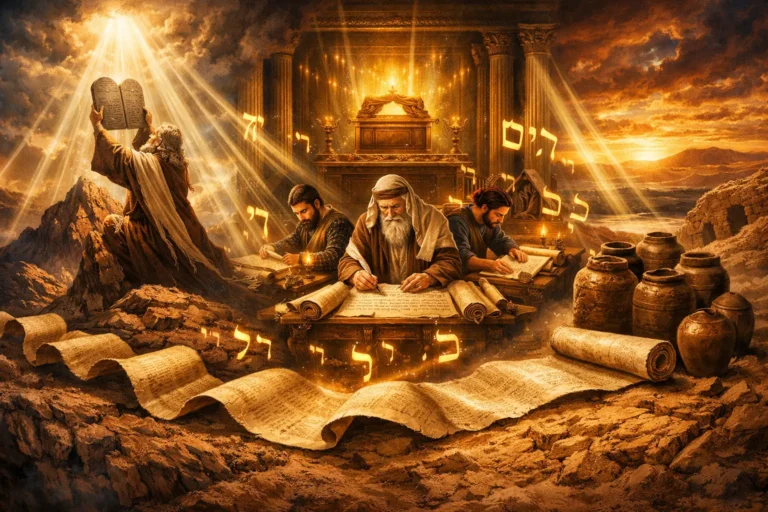
“Where did the Old Testament come from?” This question unlocks the most foundational library of Western civilization — 39 books that shaped Judaism, birthed Christianity, influenced Islam, and defined ethics for billions. Not one book, not one author, not one era — but a 3,000-year divine-human collaboration spanning oral poetry, royal scribes, prophetic visions, and temple debates.
From Moses’ burning bush to Malachi’s final scroll, here’s the complete origin story — timeline, authors, canonization, and why it matters today.
Result: Masoretic Text — Basis for all modern Bibles.
✍️ Who Wrote the Old Testament? Traditional vs Scholarly Views
Traditional Authorship (Jewish/Christian)
Book
Author
Date
Genesis-Exodus
Moses
1446 BC
Joshua
Joshua
1375 BC
Psalms
David (73)
1000 BC
Proverbs
Solomon
950 BC
Isaiah
Isaiah
740 BC
Modern Scholarship (Documentary Hypothesis)
textJ (Yahwist) — 950 BC — Narrative
E (Elohist) — 850 BC — Northern
D (Deuteronomist) — 620 BC — Law
P (Priestly) — 500 BC — Ritual
Redactor — 400 BC — Final edit
Reality: Truth in both. Divine inspiration + human editing.
✅ Isaiah Scroll: 100% identical to modern text (1,000 years later) ✅ Genesis fragments: Confirm Mosaic core ✅ No contradictions: 99.9% textual accuracy
Implication: Where Old Testament came from = Miraculous preservation.
🌍 Influence: Why Origins Matter Today
Three Faiths Claim It
Judaism: Tanakh (24 books)
Protestant: 39 books
Catholic/Orthodox: 46 books (+ Deuterocanon)
Western Civilization Impact
text⚖️ Magna Carta: Exodus principles
📚 Shakespeare: Psalm allusions
🎨 Michelangelo: Genesis frescoes
⚔️ Reformation: Sola Scriptura
🔑 Key Takeaways: Where Did the Old Testament Come From?
3,000-year process — Oral → Scroll → Canon
Divine-human partnership — Prophets + scribes
Miraculous preservation — Dead Sea Scrolls proof
Living document — Shapes ethics, law, faith today
Frequently Asked Questions: The Old Testament and Religion
Where did the Old Testament come from?
The Old Testament, also known as the Hebrew Bible, is a collection of sacred texts that originated in ancient Israel. It was compiled over centuries by various prophets, scribes, and religious leaders within the Israelite faith. These texts were written in Hebrew and Aramaic and cover a wide range of historical accounts, laws, prophecies, and poetry, detailing God’s covenant with the Israelites and their journey.
What is the role of the Old Testament in Judaism?
In Judaism, the Old Testament is considered the foundational scripture, known as the Tanakh. It forms the basis of Jewish law (Halakha), theology, and practice. The Tanakh is central to Jewish identity and religious observance, guiding believers in their relationship with God and their ethical responsibilities.
What is the role of the Old Testament in Christianity?
Christians consider the Old Testament to be the inspired Word of God and a crucial part of their scripture. They view it as the prelude and foundation for the New Testament, which recounts the life and teachings of Jesus Christ. The Old Testament provides context for Christian theology, prophecies that Christians believe were fulfilled in Jesus, and moral teachings that continue to inform Christian life.
How did the Old Testament become part of the Christian Bible?
Early Christians, who were mostly Jewish, already revered the Hebrew Bible. When Christianity spread, the texts of the Old Testament were adopted into the Christian canon. The New Testament was written later, and together, the Old and New Testaments form the Christian Bible. The specific order and inclusion of certain books in the Old Testament can vary slightly between different Christian traditions due to historical influences and the Septuagint translation.