The question of what happens after our final breath is a universal human inquiry, a tapestry woven into the fabric of every culture and belief system. For many, the concept of an afterlife is a cornerstone of faith, offering solace, hope, and a framework for understanding our existence. Within Judaism, this profound question is approached with a nuanced and evolving perspective, one that often emphasizes the importance of this life while acknowledging the mystery and potential of what lies beyond. Unlike some religions with a rigidly defined heaven and hell, Jewish thought on life after death is more fluid, focusing on the continuity of the soul and the eternal impact of our actions.
Understanding what do Jewish people believe about life after death requires delving into a rich tradition of texts, interpretations, and communal practices. It’s not a monolithic doctrine but rather a spectrum of ideas that have developed over millennia. The emphasis is often less on a detailed blueprint of the next world and more on the profound significance of living a righteous life in this one, believing that our deeds here have an everlasting resonance. This doesn’t negate the belief in a spiritual continuation, but rather frames it within the context of our earthly responsibilities and the ongoing relationship between humanity and the Divine.
At the heart of Jewish belief regarding life after death lies the concept of the neshamah, the soul. This is not merely a fleeting breath but an eternal spark of the Divine, an intrinsic part of our being that transcends the physical body. When life ends, the immediate fate of the neshamah is a subject of ongoing discussion and interpretation, with various traditions offering slightly different perspectives. However, a common thread runs through these beliefs: the soul continues its journey, unburdened by the physical limitations of mortality.
The notion of the soul’s survival is deeply rooted in Jewish scripture and tradition. Think of it like this: imagine a beautiful song you’ve heard. The physical performance, the voices and instruments, eventually cease. But the melody, the essence of the music, can be remembered, replayed in your mind, and even inspire new creations. Similarly, the neshamah is seen as the eternal melody of a person’s existence, an essence that continues long after the physical “performance” of life has concluded. This belief offers a powerful sense of continuity and the enduring impact of our spiritual selves.
Olam Ha-Ba: The World to Come
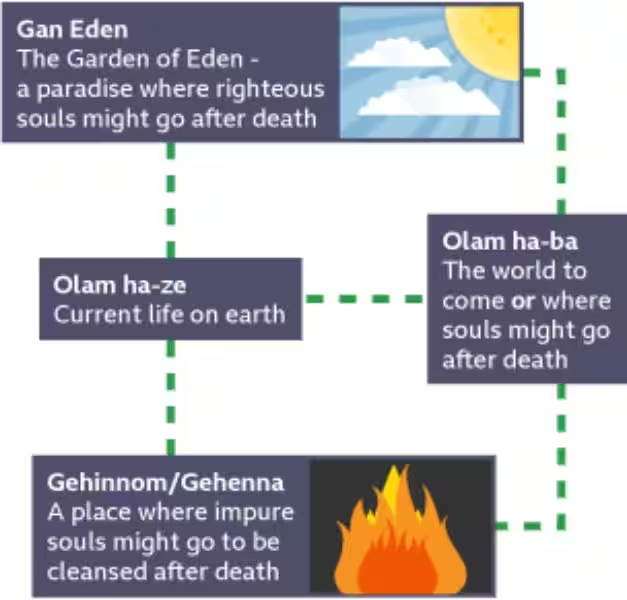
The most commonly discussed concept related to life after death in Judaism is Olam Ha-Ba, often translated as “The World to Come”. This is not a singular location like a physical heaven or hell, but rather a spiritual realm of ultimate closeness to God and a state of perfect justice and peace. For many Jewish thinkers, Olam Ha-Ba is a direct consequence of our actions in this life, a reward for living according to God’s will and fulfilling mitzvot (commandments). It represents a state of unhindered spiritual existence, where the soul can finally experience its full potential.
The exact nature of Olam Ha-Ba is often described in metaphorical and spiritual terms, rather than literal and physical ones. It’s a place where the limitations of human understanding are transcended, and where the soul experiences unadulterated joy and connection with the Divine. Think of it as a state of perfect understanding and fulfillment, where all questions are answered, and all injustices are rectified. This is not a place of reward for the body, but a spiritual homecoming for the soul, a return to its source. This concept provides a profound sense of purpose to our earthly endeavors, suggesting that our choices here have eternal implications.
Gan Eden and Gehinnom: Not What You Might Expect
When exploring what do Jewish people believe about life after death, the concepts of Gan Eden (Garden of Eden) and Gehinnom (a place of purification) often arise. However, it’s crucial to understand that these are generally interpreted differently than the traditional Christian notions of heaven and hell. Gan Eden is often envisioned not as a literal paradise with pearly gates, but as a state of spiritual bliss and profound connection with God. It’s a place of eternal spiritual nourishment, where the righteous soul experiences an unblemished closeness to the Divine.
Gehinnom, on the other hand, is not typically seen as a place of eternal damnation and fiery torment. Instead, it is understood as a temporary period of spiritual cleansing or purification for souls that require it. Imagine a blacksmith heating metal to reshape it; Gehinnom is a place where a soul might undergo a process to shed its earthly impurities and prepare for a higher spiritual existence. The duration and intensity of this purification are often seen as dependent on the individual’s actions and spiritual state, with the ultimate goal being spiritual refinement and eventual ascent. This perspective emphasizes God’s ultimate mercy and justice, suggesting that even periods of spiritual difficulty are ultimately for the soul’s betterment.
The Emphasis on This Life: Living a Meaningful Existence
While the contemplation of life after death is a natural human inclination, Jewish tradition places a paramount emphasis on the present life. The core of Jewish belief and practice is centered on living a meaningful and ethical existence here and now. The focus is on fulfilling God’s commandments (mitzvot), engaging in acts of chesed (loving-kindness), pursuing tzedek (justice), and contributing positively to the world. The understanding is that our actions in this life have an eternal reverberation, shaping not only our own spiritual destiny but also the world around us.
This strong emphasis on the present doesn’t diminish the belief in a spiritual continuation, but rather frames it. It suggests that the best way to prepare for the “World to Come” is to live fully and purposefully in this world. The tangible impact of our good deeds, our contributions to our communities, and our pursuit of knowledge are seen as having an enduring spiritual significance. This perspective offers a powerful call to action: to make the most of our earthly journey, knowing that every act of kindness, every moment of learning, and every effort towards justice contributes to an eternal legacy.
Mitzvot, the commandments given in the Torah and further elaborated in Jewish tradition, are not seen as mere ritualistic obligations but as pathways to spiritual growth and connection with the Divine. Each mitzvah, from acts of charity to observing the Sabbath, is believed to have a profound impact on the soul and its journey. By fulfilling these commandments, individuals are seen as cultivating their spiritual selves, becoming more aligned with God’s will, and thereby enhancing their readiness for the spiritual realms. Think of each mitzvah as a step on a staircase leading upwards; each one brings you closer to the Divine.
The collective impact of these actions also plays a significant role. When we consider what do Jewish people believe about life after death, it’s important to recognize the communal aspect. The righteous lives of individuals contribute to the spiritual well-being of the entire Jewish people and, by extension, the world. This understanding fosters a sense of shared responsibility and interconnectedness, where the spiritual growth of one can uplift many. The legacy of a life lived virtuously is not just personal; it is woven into the fabric of eternity.
The Importance of Memory and Legacy
In the absence of a universally defined afterlife, the memory and legacy of a person become profoundly significant in Jewish thought. The impact we have on others, the values we pass down to our children, and the good deeds we perform are seen as ways in which our influence continues to resonate beyond our physical demise. This is why traditions like kaddish, the memorial prayer recited by mourners, are so important. They are not just about remembering the deceased, but about affirming their enduring spiritual presence and influence.
Consider the impact of a beloved teacher or a wise elder. Even after they are no longer physically present, their teachings, their wisdom, and their example continue to shape the lives of those they touched. In a similar vein, Jewish tradition emphasizes that our actions create ripples that extend far into the future. This understanding encourages a focus on leaving a positive and lasting imprint on the world, ensuring that our lives have a meaningful and eternal continuation through the lives we have enriched.
Conclusion: A Life of Purpose and Perpetual Becoming
Ultimately, what do Jewish people believe about life after death is a tapestry woven with threads of mystery, responsibility, and enduring hope. While there isn’t a singular, dogmatic answer, the overarching theme is one of spiritual continuity and the profound significance of living a life guided by ethics, compassion, and a connection to the Divine. The focus remains firmly on the present, on the active pursuit of righteousness and the cultivation of a meaningful existence that will have an eternal echo.
The Jewish perspective on life after death encourages us to see our lives not as a finite journey with a definitive end, but as a process of perpetual becoming. Our actions, our intentions, and our spiritual growth contribute to an ongoing unfolding, a continuous journey of the soul. This understanding imbues our earthly existence with immense purpose and value, reminding us that every moment, every choice, and every act of kindness contributes to a legacy that transcends the boundaries of time and mortality.
Frequently Asked Questions: Jewish Beliefs About Life After Death
What is the Jewish concept of life after death?
Jewish tradition does not focus extensively on detailed descriptions of the afterlife, but rather emphasizes living a meaningful life in the present. However, there are general beliefs that include the existence of a soul that survives the death of the body, a concept of divine judgment, and a future messianic era.
What happens to the soul after death?
There is a general belief in the immortality of the soul. The soul is seen as distinct from the physical body and is believed to continue its existence after death. The precise nature of this continued existence is not universally defined, with various interpretations and mystical traditions offering different perspectives.
Do Jewish people believe in heaven and hell?
While the concepts of Gan Eden (Garden of Eden), often understood as a place of spiritual reward or closeness to God, and Gehenna (often translated as hell), as a place of temporary spiritual purification, exist in Jewish thought, they are generally not viewed as eternal destinations in the way they might be in other religions. The emphasis is more on the process of spiritual refinement and eventual redemption.
What is the Jewish view on resurrection?
The concept of resurrection of the dead is a significant belief in traditional Judaism, particularly as articulated in the Amidah prayer. It is often understood as a future event associated with the coming of the Messiah and the Messianic Age, when life will be renewed. Interpretations of what this resurrection entails vary, from a literal physical revival to a more spiritual or symbolic reawakening.
Are there differing views on afterlife within Judaism?
Yes, there is a spectrum of beliefs within Judaism regarding the afterlife. Orthodox Judaism generally adheres to more traditional interpretations of resurrection and divine judgment. More liberal movements, such as Conservative and Reform Judaism, may interpret these concepts in a more symbolic or philosophical manner, focusing on the spiritual legacy and impact of individuals rather than literal bodily resurrection.