The Vatican. The very name conjures images of gilded domes, Michelangelo’s masterpieces, and the spiritual heart of Catholicism. But beyond the awe-inspiring frescoes and the hushed reverence of St. Peter’s Basilica lies a hidden gem, a testament to human curiosity and the historical pursuit of understanding our world: the Vatican Map Museum. This isn’t just a collection of old parchments; it’s a journey through history, geography, and faith, all interwoven into a narrative that resonates deeply with our innate desire to explore and comprehend the religion that shaped civilizations.
The Cartographic Heart of the Vatican: A Realm of Exploration
Stepping into the Vatican Map Museum, officially known as the Gallery of Maps, is like entering a vast, illuminated scroll. The sheer scale of the room is breathtaking, its walls adorned with an astonishing series of terrestrial and celestial maps painted between 1580 and 1585. Commissioned by Pope Gregory XIII, these maps were intended to educate visitors and pilgrims about the geographical extent of the Catholic Church and the world as it was understood during the Renaissance. Imagine standing before a vibrant depiction of the known world, each coastline meticulously rendered, each mountain range a testament to the explorations and discoveries of the era.
These are not simply navigational tools; they are works of art and historical documents. The detail is astounding, showcasing not only the topography of continents and islands but also depictions of flora, fauna, and even mythical creatures that populated the imaginations of the time. It’s a visual encyclopedia of the world as seen through the lens of faith and burgeoning scientific inquiry. For anyone interested in geography, history, or the evolution of our understanding of the planet, the Vatican Map Museum offers an unparalleled, immersive experience.
A Legacy of Discovery and Devotion
The creation of these maps was a monumental undertaking, reflecting the Renaissance’s thirst for knowledge and the Church’s role in fostering such endeavors. Each frescoed map represents a specific region, meticulously researched and painstakingly painted by Ignazio Danti, a renowned mathematician, astronomer, and geographer. The Vatican Map Museum thus becomes a testament to the intellectual ferment of the period, where religion and science were not opposing forces but rather intertwined paths to understanding God’s creation.
Consider the map of Italy, a masterpiece of detail, showcasing the peninsula with remarkable accuracy for its time. You can almost trace the religious pilgrimage routes that crisscrossed the land, connecting sacred sites and fostering a unified religion across diverse communities. The very act of mapping was, in essence, an act of organizing and comprehending the divine order of the universe, a concept deeply embedded in the Catholic faith.
The Interplay of Faith and Cartography
The Vatican Map Museum is more than just a display of geographical accuracy; it offers profound insights into the relationship between religion and the act of mapping. For centuries, religious institutions were often the primary patrons of cartography, supporting explorers and scholars who sought to chart the known and unknown. These maps were not just about land and sea; they often incorporated religious symbolism, biblical narratives, and depictions of missionary endeavors, illustrating the Church’s global reach and its commitment to spreading the Gospel.
Think about the early maps that often featured illustrations of saints blessing voyages or depicting the spread of Christianity to new lands. The Vatican Map Museum captures this spirit, showcasing how cartography served as a visual language for faith, communicating the Church’s mission and its understanding of the world as a divinely governed entity. This symbiotic relationship highlights how religion provided both the motivation and the means for much of the early geographical exploration.
Mapping the Divine Narrative
The maps in the Vatican Map Museum are a visual representation of the world as understood within a religious framework. They were created at a time when the globe was still being extensively explored, and the Church played a significant role in these expeditions, both in terms of funding and in the spiritual guidance offered to explorers. The emphasis was not just on physical boundaries but also on the spiritual landscape, reflecting the Church’s expansive mission.
For example, the maps of the Holy Land are particularly poignant, detailing the sacred sites that are central to Christian religion. These depictions served as a constant reminder of the origins of Christianity and the enduring significance of these locations for believers worldwide. The Vatican Map Museum thus becomes a powerful tool for understanding how geography and faith have shaped each other, with each line and contour on the map telling a story of human endeavor and divine purpose.
A Living Testament to a Changing World
The Vatican Map Museum is not a static monument to a bygone era; it’s a dynamic testament to the ever-evolving understanding of our planet and our place within it. The maps, while capturing the knowledge of the Renaissance, also subtly hint at the future discoveries and explorations that would reshape our perception of the world. Standing amidst these magnificent frescoes, one can’t help but feel a connection to the generations of explorers, scholars, and faithful who gazed upon similar representations, piecing together the grand tapestry of existence.
The Vatican Map Museum invites us to contemplate the vastness of the world, the ingenuity of humankind, and the enduring power of religion to inspire exploration and foster a sense of shared humanity. It’s a place where the sacred and the scientific converge, offering a unique and enriching experience for anyone who seeks to understand the world, both geographically and spiritually. This remarkable collection continues to captivate visitors, bridging the gap between the physical and the spiritual, and reminding us of the profound ways religion has shaped our perception of home.
Frequently Asked Questions: Vatican Museums and Religion
What are the Vatican Museums?
The Vatican Museums are a complex of museums within Vatican City that display works from the immense collection amassed by the Catholic Church throughout centuries, including the famous Sistine Chapel.
What is the religious significance of the Vatican Museums?
The Vatican Museums hold immense religious significance as they house a vast collection of art and artifacts that reflect the history, theology, and artistic achievements of Christianity, particularly Catholicism. This includes sacred relics, depictions of biblical events, and works commissioned by popes.
Can I see religious artifacts in the Vatican Museums?
Yes, a significant portion of the Vatican Museums’ collection consists of religious artifacts. These range from ancient Christian sarcophagi and early Christian mosaics to Renaissance masterpieces depicting biblical scenes and portraits of popes.
Is the Sistine Chapel a religious site?
Yes, the Sistine Chapel is a highly significant religious site within the Vatican Museums. It serves as the chapel of the Apostolic Palace and is the location where the papal conclave, the process by which a new pope is elected, takes place. Its walls and ceiling are adorned with frescoes by master artists, including Michelangelo’s iconic Last Judgement and the Creation of Adam.
Do I need to be Catholic to visit the Vatican Museums?
No, the Vatican Museums are open to visitors of all faiths and backgrounds. While the art and artifacts have deep religious significance, the museums welcome everyone to appreciate their historical and artistic value.
Are there specific areas within the Vatican Museums related to the Bible or religious history?
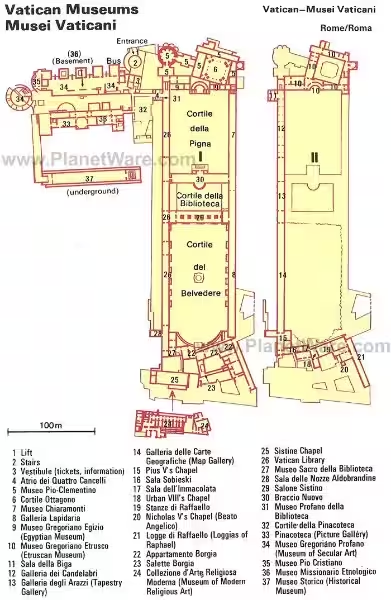
Yes, the Vatican Museums contain numerous galleries and rooms dedicated to biblical history and Christian art. This includes the Pio-Clementino Museum (housing ancient sculptures that often depict mythological and sometimes religious themes), the Gallery of Maps (which illustrates religious geographical significance), and various rooms dedicated to Renaissance and Baroque paintings with religious subjects.
What is the role of art in the religious context of the Vatican Museums?
Art plays a crucial role in conveying religious narratives, theological concepts, and the history of the Catholic Church. The masterpieces within the Vatican Museums are not merely decorative; they are intended to inspire faith, educate believers, and serve as a testament to the enduring power of religious devotion.