The very name “Mezquita Santa Sofía” evokes a sense of profound historical weight and architectural grandeur. More than just a building, it represents a living testament to the ebb and flow of civilizations and the complex interplay of different religions across centuries. This iconic structure, standing sentinel in Istanbul, Turkey, has worn many hats, each one adding a layer to its rich and often contested identity. Its story is not simply one of stone and mortar, but of transformations, spiritual aspirations, and the enduring human need to connect with the divine.
Understanding the Mezquita Santa Sofía requires delving into its multifaceted past. What began as a monumental basilica, the spiritual heart of the Byzantine Empire, eventually transitioned into a mosque following the Ottoman conquest, and more recently, served as a museum before its reconversion to a mosque. Each of these phases reflects dominant religious and political ideologies of its time, leaving indelible marks on its architecture, iconography, and the very atmosphere it emanates. To truly grasp its significance, we must embark on a journey through its religious evolution, appreciating the layers of faith that have shaped its soul.
The Genesis: A Christian Basilica and the Heart of Byzantium
Originally consecrated as the Hagia Sophia in the 6th century CE, this magnificent edifice was built under the patronage of Emperor Justinian I. It was intended to be the grandest cathedral in Christendom, a symbol of the Byzantine Empire’s power and piety. The sheer ambition behind its construction was astounding, employing the most skilled architects and artisans of the era. Imagine the awe of the early worshippers, stepping into a space so vast, so illuminated, and so unlike anything they had ever experienced. The domed ceiling, seemingly floating above, was a feat of engineering and a powerful metaphor for the heavens.
For nearly a thousand years, the Hagia Sophia served as the epicenter of Eastern Orthodox Christianity. It witnessed coronations, imperial ceremonies, and countless religious services that shaped the spiritual life of millions. The mosaics adorning its walls and domes, depicting Christ, the Virgin Mary, saints, and emperors, were not merely decorative; they were sacred images, designed to instruct the faithful and inspire devotion. These artistic treasures offered a visual narrative of Christian theology, acting as windows to the divine for a largely illiterate populace. The very air within its walls was believed to be imbued with a sacred presence.
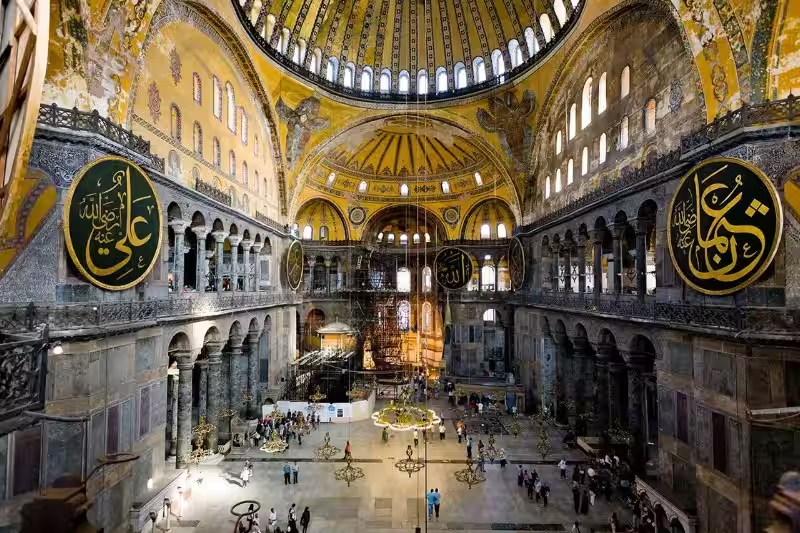
The architectural genius of the Hagia Sophia cannot be overstated. Its massive central dome, supported by pendentives, was an innovation that allowed for an unprecedented sense of open space and light. This design was not accidental; it was meant to symbolize the celestial vault, a direct connection between the earthly realm and the divine. The way light streams through the numerous windows, illuminating the interior, creates a transcendent experience, a feeling of being in the presence of something far greater than oneself.
Beyond the dome, the basilica’s intricate design was rich with symbolic meaning. The nave, leading towards the altar, represented the journey of the believer towards salvation. The apse, housing the altar, was considered the most sacred part of the church, symbolizing the divine presence. Every element, from the layout of the columns to the placement of the icons, was carefully considered to guide the worshipper’s spiritual journey and reinforce core Christian tenets. It was a holistic environment designed for spiritual immersion.
The Transformation: From Church to Mosque
The year 1453 marked a pivotal moment in the history of the Mezquita Santa Sofía. The conquest of Constantinople by the Ottoman Sultan Mehmed II brought with it a significant religious and cultural shift. The Hagia Sophia, the grandest church in the Byzantine world, was transformed into a mosque, a testament to the new Islamic rule. This conversion was not merely symbolic; it involved architectural modifications and the addition of distinctly Islamic features. Minarets were erected, symbolizing the call to prayer, and the Christian mosaics were largely covered over or plastered, though many remain hidden beneath.
This transition was a profound statement of religious and political dominance. The once-dominant Christian symbols made way for Islamic calligraphy, mihrabs (prayer niches indicating the direction of Mecca), and minbars (pulpits). The call to prayer, echoing from the newly added minarets, would have replaced the Christian liturgy, fundamentally altering the soundscape and the spiritual rhythm of the city. While the physical structure remained, its purpose and the faith it served had fundamentally changed, marking a new chapter in its long and complex existence as the Mezquita Santa Sofía.
Adapting and Enduring: Islamic Art and Architecture
While the Hagia Sophia was converted into a mosque known as the Ayasofya Mosque, the Ottomans did not demolish its original structure. Instead, they skillfully adapted and enhanced it, integrating their own architectural and artistic styles. The addition of the four towering minarets, a hallmark of Ottoman mosque architecture, dramatically altered its skyline and its visual identity. These minarets, reaching towards the heavens, became integral to the silhouette of Istanbul.
Inside, the covering of the Christian mosaics with plaster was a common practice when converting churches to mosques, as the depiction of human figures in Islamic art is generally discouraged (though not strictly forbidden in all contexts). However, the Ottomans also introduced magnificent examples of Islamic art and architecture, such as the giant calligraphic roundels bearing the names of Allah, Muhammad, and the first four caliphs. These additions created a new layer of spiritual significance, overlaying the ancient Christian foundations with Islamic devotion and artistry, further enriching the Mezquita Santa Sofía’s visual and spiritual narrative.
The Modern Era: Museum to Mosque and Ongoing Dialogue
In the 20th century, after centuries as a functioning mosque, the Mezquita Santa Sofía was secularized and converted into a museum in 1935. This decision, under the leadership of Mustafa Kemal Atatürk, aimed to present the structure as a shared heritage of humanity, a place where the artistic and historical achievements of both Christianity and Islam could be appreciated without religious affiliation. It became a symbol of secular Turkey and a global tourist attraction, drawing millions who came to marvel at its architectural splendor and historical significance.
More recently, in 2020, the decision was made to reconvert the Mezquita Santa Sofía back into a mosque. This move has sparked considerable debate and discussion on a global scale, touching upon issues of religious freedom, cultural heritage, and political identity. For some, it represents a reclamation of a sacred Islamic site; for others, it raises concerns about the preservation of its multi-layered historical and artistic legacy. The ongoing dialogue surrounding the Mezquita Santa Sofía highlights its enduring power as a symbol and a subject of deep cultural and religious significance.
Preserving a Legacy: The Future of Mezquita Santa Sofía
The question of how best to preserve and present the Mezquita Santa Sofía for future generations is a complex one. Its history as both a church and a mosque means it embodies two distinct religious traditions and artistic expressions. The challenge lies in finding a way to acknowledge and respect all facets of its past while fulfilling its current role as a place of worship. Balancing preservation with active use is a delicate act that requires careful consideration and a commitment to safeguarding its unique heritage.
The ongoing discussions about the Mezquita Santa Sofía underscore its irreplaceable value as a cultural and religious landmark. Whether viewed as a testament to Byzantine ingenuity, Ottoman architectural prowess, or a symbol of modern Turkey’s identity, its importance is undeniable. Its story is a constant reminder of how religion has shaped civilizations, influenced art and architecture, and continues to resonate in the hearts and minds of people across the globe. The Mezquita Santa Sofía, in its magnificent complexity, offers a profound reflection on our shared human history and the enduring power of faith.
Frequently Asked Questions: Religion at Hagia Sophia
Is Hagia Sophia a mosque?
Hagia Sophia is currently functioning as a mosque. It was originally built as a cathedral in the Byzantine Empire, later converted into a mosque after the Ottoman conquest, then secularized and turned into a museum, and most recently reconverted into a mosque.
What is the religious significance of Hagia Sophia?
Hagia Sophia holds immense religious significance for both Christianity and Islam. For Christians, it was the principal church of the Byzantine Empire and a major center of Eastern Orthodoxy for centuries. For Muslims, it became a symbol of Islamic conquest and a significant imperial mosque for the Ottoman Empire. Its architecture and history reflect its dual religious heritage.
Can people of all religions visit Hagia Sophia?
As Hagia Sophia is now a functioning mosque, visitors of all religions are welcome to enter and observe. However, respectful attire is required, and visitors should be mindful of prayer times. During prayer times, non-Muslim visitors may be asked to wait or use designated areas.
Are there any restrictions for non-Muslims visiting Hagia Sophia?
Non-Muslim visitors are generally permitted to enter Hagia Sophia. However, they are expected to dress modestly, covering their shoulders and knees. Women are required to cover their heads. Visitors should also refrain from disruptive behavior, such as loud talking or taking photographs during prayer times.
What are the main religious features visible inside Hagia Sophia?
Inside Hagia Sophia, visitors can see a blend of Christian and Islamic religious elements. Remnants of Christian mosaics, depicting figures like Jesus Christ and the Virgin Mary, are still present, although some have been covered or altered. Islamic calligraphy, including verses from the Quran and the names of Allah and the Prophet Muhammad, adorns the walls and domes, often placed alongside or over existing Christian iconography. Large Islamic calligraphic roundels are a prominent feature.