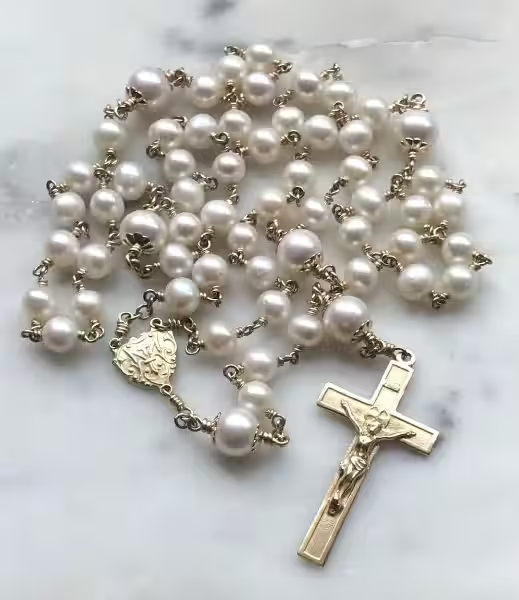
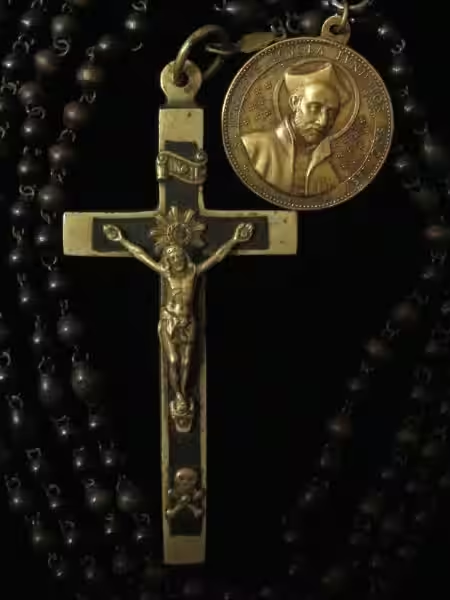
In the tapestry of religious devotion, certain practices stand out for their enduring appeal and profound spiritual impact. Among these, the recitation of the rosary holds a special place, particularly for those within the Catholic tradition. But what exactly is the “crown rosary,” and why does it continue to resonate with so many believers today? This article aims to illuminate the beauty and power of the crown rosary, exploring its origins, its structure, and its transformative potential for the modern spiritual seeker. Far from being a mere rote repetition of prayers, the crown rosary offers a rich, contemplative journey, a pathway to a deeper relationship with the divine, and a source of comfort and strength in a world often filled with uncertainty.
The term “crown rosary” is often used interchangeably with the traditional rosary, emphasizing the idea of a spiritual garland or a crown of prayers offered to God and the Blessed Virgin Mary. It is a meditative prayer that recounts key events in the lives of Jesus and Mary, known as the Mysteries. The physical rosary beads themselves serve as tactile aids, guiding the devotee through the sequence of prayers and allowing the mind to focus on the spiritual content. Whether you are new to this practice or a seasoned practitioner seeking a renewed understanding, exploring the intricacies of the crown rosary can unlock new layers of spiritual insight and personal growth.
Understanding the Crown Rosary: More Than Just Beads
At its core, the crown rosary is a devotional practice centered on meditating upon the life of Jesus Christ, as seen through the eyes of his mother, Mary. It is not simply about reciting prayers; it is about entering into a contemplative space where the Gospels come alive. Each bead represents a prayer, but more importantly, it signifies a moment in salvation history. The faithful are encouraged to ponder the events of Christ’s life, his teachings, his suffering, and his glorious resurrection, finding in these moments a profound reflection of God’s love and mercy. This meditative aspect is what elevates the crown rosary from a simple prayer to a deeply personal encounter.
The structure of the crown rosary is designed to facilitate this contemplation. It typically begins with the Apostles’ Creed, followed by the Our Father, three Hail Marys (for an increase in faith, hope, and charity), and a Gloria Patri. Then, the devotee proceeds to meditate on a series of five Mysteries, each associated with a specific set of prayers. These Mysteries are categorized into the Joyful, Luminous, Sorrowful, and Glorious. For example, when meditating on the Annunciation, the first of the Joyful Mysteries, one might reflect on Mary’s humble acceptance of God’s will and consider how they, too, can embrace God’s plan in their own lives. The repetition of the prayers, far from being monotonous, allows the mind to quiet down, creating space for deeper reflection and spiritual engagement with each Mystery.
The Mysteries of the Crown Rosary: A Journey Through Salvation History
The heart of the crown rosary lies in its contemplation of the Mysteries. These are not arbitrary events but pivotal moments that reveal the unfolding story of God’s love for humanity. The Joyful Mysteries, traditionally prayed on Mondays and Saturdays, focus on the early life of Jesus. They include the Annunciation, the Visitation, the Nativity, the Presentation of Jesus in the Temple, and the Finding of Jesus in the Temple. Meditating on these Mysteries can inspire feelings of wonder, humility, and joy, reminding us of the Incarnation and the humble beginnings of our Lord’s mission. Imagine Mary, a young woman, saying “yes” to God’s extraordinary plan – this act of faith is a powerful example for us all.
The Luminous Mysteries, introduced by Pope John Paul II and prayed on Thursdays, draw attention to key moments in Jesus’ public ministry. These include his Baptism in the Jordan, his Wedding at Cana, his Proclamation of the Kingdom of God, his Transfiguration, and his Institution of the Eucharist. These Mysteries highlight Jesus’ divine nature and his mission to reveal God’s love to the world. Contemplating the Transfiguration, for instance, can offer a glimpse of divine glory and inspire us to seek moments of spiritual illumination in our own lives, perhaps through prayer or acts of selfless service. The Wedding at Cana serves as a beautiful reminder that Jesus brings joy and blessing to ordinary human events.
The Sorrowful Mysteries, prayed on Tuesdays and Fridays, delve into the Passion and death of Jesus. They encompass the Agony in the Garden, the Scourging at the Pillar, the Crowning with Thorns, the Carrying of the Cross, and the Crucifixion. These Mysteries call for deep reflection on Christ’s immense suffering for our sins. They can foster repentance, a profound sense of gratitude for his sacrifice, and a renewed commitment to living a life worthy of his love. Reflecting on the Carrying of the Cross, we are invited to consider our own burdens and how we can offer them up with faith and trust in God’s plan. This is where the concept of a “crown rosary” can feel particularly poignant, as we contemplate the thorny crown placed upon Jesus’ head.
Finally, the Glorious Mysteries, prayed on Wednesdays and Sundays, celebrate the triumph of Christ and his mother. They include the Resurrection, the Ascension, the Descent of the Holy Spirit (Pentecost), the Assumption of Mary, and the Coronation of Mary as Queen of Heaven and Earth. These Mysteries offer hope, promise, and a glimpse of our ultimate destiny in heaven. The Resurrection is the cornerstone of our faith, assuring us of victory over death and the promise of eternal life. Meditating on Mary’s Assumption and Coronation reminds us of her unique role in salvation history and her powerful intercession for us.
The Practical Application of the Crown Rosary in Daily Life
Integrating the crown rosary into your daily routine doesn’t require extensive free time or a specific location. Many find solace and spiritual connection by praying the crown rosary during their commute, while performing household chores, or during a quiet moment before sleep. The beauty of the practice lies in its adaptability. Even a few minutes dedicated to contemplating a single Mystery can be profoundly impactful. The key is intentionality: approaching the prayer with a heart open to God’s presence and a desire to grow in faith.
For those struggling with anxiety, stress, or difficult life circumstances, the crown rosary can be a powerful anchor. The repetitive nature of the prayers, coupled with the focused meditation on the life of Christ, can create a calming effect, drawing the mind away from worries and towards divine peace. The Mysteries offer a framework for understanding suffering and hope, reminding us that even in our darkest moments, we are not alone. Think of it as building a personal “crown of prayers” that surrounds you with spiritual protection and comfort, a tangible reminder of God’s unwavering love and Mary’s gentle intercession. This spiritual armor can be invaluable.
The communal aspect of the crown rosary is also significant. Many parishes and faith communities offer opportunities to pray the rosary together, either in person or virtually. Praying as a group amplifies the collective spiritual energy and fosters a sense of unity and shared faith. This can be particularly encouraging when facing personal challenges, as it reminds individuals that they are part of a larger spiritual family. Whether prayed alone or in a group, the crown rosary remains a potent tool for spiritual growth, offering a timeless path to a deeper connection with God and a more profound understanding of the Christian faith. It is a journey that nourishes the soul, strengthens the spirit, and brings us closer to the heart of God.
Frequently Asked Questions: The Crown Rosary
What is the Crown Rosary?
The Crown Rosary, also known as the Chaplet of Divine Mercy, is a devotion prayed using a standard Rosary or a specially designed chaplet. It is centered on the Passion of Jesus Christ and the mercy of God.
What is the prayer for the Crown Rosary?
The primary prayer of the Crown Rosary is: “Eternal Father, I offer You the Body and Blood, Soul and Divinity of Your dearly beloved Son, our Lord Jesus Christ, in atonement for our sins and those of the whole world. For the sake of His sorrowful Passion, have mercy on us and on the whole world.” This prayer is repeated on the beads.
The devotion of the Crown Rosary was given to St. Faustina Kowalska by Jesus in visions she experienced in the 1930s. She recorded these visions and prayers in her diary.
What are the specific prayers at the beginning of the Crown Rosary?
The Crown Rosary typically begins with the Sign of the Cross, followed by the Our Father, the Hail Mary, and the Apostles’ Creed.
How do you pray the Crown Rosary on the beads?
The chaplet consists of a crucifix, a medal, and five groups of ten beads (decades). You pray the “Our Father” on the large bead, then three “Hail Marys” on the next three small beads. After that, you move to the first decade and pray the “Eternal Father” prayer on each of the ten small beads, and the “For the sake of His sorrowful Passion” on the large bead. This is repeated for all five decades.
What is the significance of the medal at the beginning of the Crown Rosary?
The medal at the beginning of the chaplet, often an image of the Divine Mercy, serves as a reminder of the devotion’s focus on God’s mercy.
What are the Promises associated with praying the Crown Rosary?
Jesus promised St. Faustina that this prayer would be effective in obtaining graces, especially mercy for sinners and the dying. He said, “By this chaplet you will obtain everything you ask for” and “I am giving them the last hope of salvation; that is, the grace of conversion and even the grace of martyrdom, if it be God’s will.”
Can anyone pray the Crown Rosary?
Yes, the Crown Rosary is a devotion open to all Christians, particularly Catholics, who wish to implore God’s mercy for themselves and for the world.
What is the best time to pray the Crown Rosary?
The Crown Rosary can be prayed at any time. However, it is particularly recommended to pray it at 3:00 PM, the “Hour of Great Mercy,” which commemorates the time of Jesus’ death on the cross.
Does the Crown Rosary replace the traditional Rosary?
No, the Crown Rosary is a distinct devotion and does not replace the traditional Rosary, which focuses on the mysteries of the lives of Jesus and Mary. They can be prayed in addition to each other.