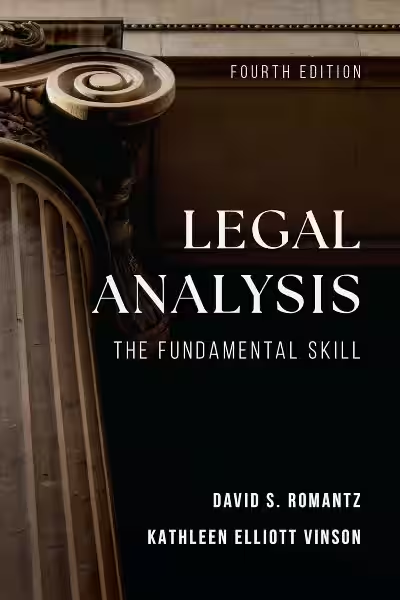
At its core, understanding the law is about dissecting arguments, evaluating evidence, and drawing logical conclusions. This legal analysis, a skill as essential to a courtroom as it is to a boardroom, surprisingly finds deep resonance within the realm of religion. Whether you’re a seasoned legal professional or simply a curious individual grappling with life’s complexities, recognizing the parallels between legal reasoning and religious interpretation can unlock a deeper appreciation for both. This article will explore how the fundamental skill of legal analysis is not just applicable, but crucial for navigating the intricate doctrines, historical texts, and community practices that form the bedrock of religious life.
Think of any significant legal dispute. It involves examining statutes, case precedents, the intent of lawmakers, and the specific facts of the situation. Similarly, religious traditions often rely on sacred texts, historical interpretations from esteemed scholars, the context of their creation, and the lived experiences of their adherents. To truly grasp a religious principle, one must engage in a form of legal analysis, albeit one focused on theological and ethical frameworks rather than civil codes. This isn’t about equating secular law with divine revelation, but rather about appreciating the universal nature of critical thinking and argument construction that underpins both.
Unpacking Sacred Texts: A Lawyer’s Approach to Scripture
When a lawyer approaches a contract or a statute, their first step is often to deconstruct the language. They look for ambiguity, define key terms, and consider the plain meaning of words. This meticulous approach is strikingly similar to how many theologians and religious scholars interpret sacred texts. Take, for instance, the Sermon on the Mount in Christianity. A legal analyst would break down Jesus’s pronouncements on “blessedness,” examining the specific conditions for each blessing and considering their rhetorical purpose. This involves asking: What does “meek” truly mean in this context? What are the implied obligations of being a “peacemaker”?
This textual analysis extends beyond individual verses. It involves understanding the broader narrative, historical context, and authorial intent – much like a lawyer would research the legislative history of a bill. For example, understanding the historical circumstances under which the Ten Commandments were delivered to Moses provides crucial context for interpreting their meaning and application across different eras. Without this analytical rigor, religious texts can be misconstrued, leading to superficial understanding or even harmful interpretations. The application of interpretive rules is a common thread, whether one is deciphering a legal precedent or a prophetic utterance.
The Role of Precedent and Interpretation in Religious Law
Just as legal systems rely on precedent – previous court decisions that guide future rulings – many religions have established a body of interpretations and scholarly consensus that informs contemporary understanding. The Talmud in Judaism, for example, is a vast compilation of rabbinic discussions and legal rulings, representing centuries of legal analysis applied to the Torah. When a modern rabbi or scholar addresses a contemporary ethical dilemma, they often refer back to these established interpretations, weighing them against the original scriptural texts and the specifics of the current situation.
Consider the concept of religious freedom. In many legal systems, this is a fundamental right, but its boundaries are constantly being debated and redefined through legal analysis in courts. Similarly, within religious communities, questions about how to balance tradition with evolving societal norms require a similar analytical process. How should certain religious laws be applied in a secular society? What constitutes a legitimate adaptation versus an abandonment of core principles? These are questions that demand careful consideration, reasoned argumentation, and an understanding of both historical context and present realities, mirroring the very essence of legal reasoning.
Navigating Religious Disputes: The Art of Argumentation
Religious communities, like any human organization, can experience disputes. These can range from disagreements over theological doctrine to conflicts over leadership or the allocation of resources. The skills honed through legal analysis are remarkably effective in navigating these challenges. The ability to clearly articulate one’s position, to support it with evidence (whether scriptural, historical, or experiential), and to anticipate counterarguments is paramount.
Imagine a congregational meeting where a significant decision needs to be made. Different factions may present their cases, drawing on different interpretations of scripture, denominational tradition, or practical considerations. A person skilled in legal analysis can help facilitate a more productive discussion by encouraging participants to define their terms, identify the core issues, and evaluate the logical soundness of each proposal. This is about more than just winning an argument; it’s about reaching a just and reasoned outcome that respects the diverse perspectives within the community. The principles of due process and fair hearing, fundamental in law, also have echoes in ensuring that all voices are heard and considered in religious decision-making.
The Application of Logic and Reason in Faith
While faith is often characterized by belief beyond empirical proof, the practice of religion is rarely devoid of logic and reason. The development of complex theological systems, the articulation of ethical frameworks, and the creation of community governance structures all rely on analytical thinking. For instance, the concept of a divine attribute like omnipotence can be explored through philosophical and theological arguments that involve intricate logical analysis. Questions like “Can God create a stone so heavy that He cannot lift it?” are not just rhetorical; they engage with the very nature of logical possibility.
Furthermore, the application of religious principles to daily life requires a constant process of reasoned judgment. When faced with a moral quandary, individuals often engage in a form of ethical analysis, weighing the potential consequences of their actions against the tenets of their faith. This involves identifying relevant principles, considering competing values, and making a reasoned choice. This is not so different from a judge applying a legal standard to a specific set of facts to reach a decision. The skill of discerning relevance and drawing sound inferences is a cornerstone of both legal and religious practice.
Conclusion: A Universal Skill for Deeper Understanding
The fundamental skill of legal analysis is far more than a tool for lawyers. It is a powerful framework for critical thinking, reasoned argumentation, and deep understanding that can enrich our engagement with almost any aspect of life, including our spiritual journeys. By approaching religious texts, doctrines, and community practices with an analytical mindset, we can move beyond superficial interpretations and gain a more profound appreciation for the wisdom, history, and ethical guidance they offer.
Whether you are contemplating the intricacies of a sacred text, seeking to resolve a disagreement within your faith community, or simply striving to live a more principled life, the fundamental skill of legal analysis provides a valuable lens. It empowers us to ask the right questions, to evaluate evidence rigorously, and to construct coherent arguments, ultimately leading to more informed decisions and a richer understanding of ourselves and the world around us. Embracing this skill is not about diminishing faith, but about strengthening our capacity to engage with it meaningfully and intelligently.
Frequently Asked Questions: Legal Analysis as a Fundamental Skill
What is legal analysis?
Legal analysis is the process of examining legal rules, facts, and precedents to determine the legal implications of a situation or to predict the outcome of a legal dispute. It involves identifying the relevant legal principles, applying them to the specific facts at hand, and drawing logical conclusions.
Why is legal analysis a fundamental skill?
Legal analysis is fundamental because it underpins all legal practice and understanding. Whether you are a lawyer, a judge, a law student, or even a citizen seeking to understand their rights, the ability to analyze legal issues is crucial for making informed decisions, advocating effectively, and upholding the rule of law.
What are the key components of legal analysis?
Key components typically include:
Issue Spotting: Identifying the legal questions that arise from a set of facts.
Rule Identification: Locating and understanding the relevant laws, statutes, regulations, and case law.
Rule Application: Connecting the identified legal rules to the specific facts of the case.
Analysis/Reasoning: Explaining how the rules apply to the facts and why a particular conclusion is reached.
Conclusion: Stating the likely legal outcome or answer to the identified issue.
Improving legal analysis skills requires practice and a systematic approach. This includes extensive reading of legal texts and cases, engaging in hypothetical problem-solving, seeking feedback on your analysis, and developing strong critical thinking and logical reasoning abilities.
Is legal analysis only for legal professionals?
No, legal analysis is a valuable skill for anyone navigating the complexities of law. Citizens can use it to understand contracts, disputes, or their rights. Businesses use it for compliance and risk management. Even in academic fields outside of law, analytical skills are transferable and beneficial.
Frequently Asked Questions: Religion
What is religion?
Religion is a complex and multifaceted phenomenon that generally involves a set of beliefs, practices, and rituals concerning the nature of the universe and humanity’s place within it. It often includes a belief in a higher power or powers, moral codes, and a sense of community among adherents.
How many religions are there in the world?
There are thousands of distinct religions worldwide, though some are much larger and more influential than others. Major world religions include Christianity, Islam, Hinduism, Buddhism, Sikhism, and Judaism, each with numerous denominations and branches.
What are the common elements found in most religions?
Common elements often include:
Belief in the sacred or divine: A concept of something transcendent or supernatural.
Practices and rituals: Ceremonies, prayers, meditation, or other actions performed by adherents.
Moral or ethical codes: Guidelines for behavior and living a virtuous life.
Sacred texts or stories: Written or oral traditions that convey core beliefs and narratives.
Community and social structure: A gathering of believers who share common practices and beliefs.
What is the difference between a religion and a philosophy?
While both deal with fundamental questions about life, existence, and values, religion typically involves belief in the supernatural or divine, while philosophy relies primarily on reason and logic. Many philosophies can inform religious thought, and vice versa, but the presence of a supernatural element is a key differentiator.
Is religion declining in prevalence?
The prevalence of religion varies significantly by region and demographic. While some studies indicate a decline in traditional religious affiliation in certain Western countries, religious adherence remains strong or is growing in many parts of the world. The forms and expressions of religiosity are also evolving.