In the tapestry of the Catholic faith, prayer is not merely a ritual; it’s a vibrant, living connection to the Divine. Among the many forms of prayer, Catholic petition prayers stand out as a deeply personal and profoundly effective means of communicating our needs, hopes, and deepest desires to God. These prayers are an acknowledgement of our reliance on a higher power, a testament to our faith, and a powerful tool for spiritual growth and tangible intervention in our lives. Whether you are facing a daunting challenge, seeking guidance, or simply desire to express gratitude for blessings received, understanding and engaging in petitionary prayer can be a transformative experience.
The beauty of Catholic petition prayers lies in their universality and accessibility. They are not confined to specific circumstances or reserved for those with exceptional piety. Every Catholic, from the newest convert to the most seasoned believer, is invited and encouraged to approach God with their petitions. This act of speaking our hearts to the Father, through Jesus Christ, and with the intercession of the Holy Spirit and the saints, is a fundamental expression of our relationship with the Trinity. It’s about entering into a dialogue, a sacred conversation where we pour out our hearts, knowing that we are heard and loved. This article will explore the essence of Catholic petition prayers, their significance in our spiritual journey, and how you can effectively incorporate them into your daily life.
Understanding Catholic Petition Prayers: What They Are and Why They Matter
At its core, a Catholic petition prayer is a prayer where we ask God for something. This “something” can be incredibly varied, encompassing spiritual, temporal, and even intercessory needs. We might pray for personal strength to overcome a temptation, for the healing of a loved one, for wisdom in making a difficult decision, or for peace in a troubled world. These prayers are rooted in the belief that God is not a distant, indifferent force, but a loving Father who desires to care for His children. As Jesus Himself taught in the Gospel of Matthew, “Ask and it will be given to you; seek and you will find; knock and the door will be opened to you” (Matthew 7:7). This promise is a cornerstone of petitionary prayer, encouraging us to be bold and persistent in our requests.
The importance of petition prayers in the Catholic life cannot be overstated. They are a practical application of our faith, moving us from passive belief to active engagement. When we present our petitions, we are not just passively hoping for a good outcome; we are actively participating in God’s providence. This doesn’t mean that God will always grant our requests exactly as we envision them, but rather that He will respond according to His perfect will and infinite love. For instance, if you are praying for a specific job opportunity, a petition prayer might be: “Dear Lord, I humbly ask for Your guidance and wisdom as I seek new employment. Please open the right doors for me and grant me the strength and clarity to discern Your will in this matter.” This prayer acknowledges God’s sovereignty while also expressing a clear desire, trusting in His ultimate plan.
The Biblical Foundation and Theological Roots of Petitionary Prayer
The practice of asking God for needs is deeply embedded in Scripture, providing a rich foundation for Catholic petition prayers. From the Old Testament, we see figures like Moses interceding for the Israelites, King David pouring out his heart in lament and supplication, and the prophets calling upon God in times of crisis. The Psalms, in particular, are a treasure trove of petitionary prayers, offering eloquent expressions of human vulnerability and dependence on God. Consider Psalm 27:7: “Hear, O Lord, when I cry aloud; be gracious to me and answer me!” This verse encapsulates the very essence of petitionary prayer – a cry for help addressed to a loving and responsive God.
The New Testament further illuminates the significance of petitionary prayer through the teachings and example of Jesus. He consistently encouraged His disciples to pray for their needs and the needs of others. The Lord’s Prayer itself, often referred to as the “Our Father,” is a profound model, containing elements of adoration, thanksgiving, and crucially, petition: “Give us this day our daily bread” (Matthew 6:11). This simple yet powerful request for sustenance is a clear example of asking God for our immediate needs. Furthermore, Jesus’ parables, such as the Parable of the Persistent Widow (Luke 18:1-8), emphasize the importance of persistence in prayer, encouraging us not to give up but to continue bringing our petitions before God with unwavering faith and hope.
Types of Catholic Petition Prayers and Their Applications
Catholic petition prayers can be broadly categorized, though the lines often blur as our prayers become more intimate and comprehensive. One primary category is prayers for personal needs. These are the prayers we offer for ourselves, seeking strength, healing, guidance, or even forgiveness. For example, if you are struggling with anxiety, a personal petition prayer might be: “Heavenly Father, I come before You with a heavy heart, weighed down by worry. Please grant me Your peace, which surpasses all understanding, and ease my anxious thoughts. Help me to trust in Your loving care.” This prayer is direct, vulnerable, and seeks a specific spiritual comfort.
Another vital category is intercessory prayers. These are prayers where we petition God on behalf of others. This is a powerful expression of Christian love and solidarity. We can pray for family members, friends, the sick, those who are suffering, or even for our leaders. The Catholic Church also encourages the intercession of the saints, believing that they, being in the presence of God, can pray for us and present our needs before the throne of grace. A common intercessory prayer might be: “Most Sacred Heart of Jesus, have mercy on [Name of person], especially on [mention specific need]. We entrust them to Your infinite love and mercy. Amen.” This prayer acknowledges our role in praying for others, and the profound belief in the Communion of Saints.
Prayers for Spiritual Growth and Virtues
Beyond immediate temporal needs, many Catholic petition prayers focus on our spiritual development and the cultivation of virtues. We can ask God to help us grow in faith, hope, and charity; to become more patient, humble, or courageous. These prayers are about transforming our character to better reflect Christ. For instance, if you find yourself easily angered, you might pray: “Lord Jesus, giver of all grace, imbue my heart with Your gentle spirit. Help me to respond with patience and understanding, rather than with impatience and frustration. Grant me the virtue of meekness.” This type of prayer focuses on internal change and alignment with God’s will for our character.
These prayers for virtue are not about demanding perfection but about earnestly seeking God’s assistance in becoming the best versions of ourselves, as intended by our Creator. They recognize that spiritual growth is a lifelong journey, often marked by stumbles and setbacks, and that God’s grace is essential for progress. Another example could be praying for deeper faith: “Holy Spirit, divine source of all light, inflame my heart with a stronger faith. Help me to believe more fully in Your promises, to trust in Your unfailing love, and to see Your hand in all the events of my life.” These petitions are about deepening our relationship with God and allowing His grace to work within us.
Prayers for Temporal Needs and Guidance
Our earthly lives are filled with practical concerns, and Catholic petition prayers are a fitting way to bring these before God. This includes prayers for health, financial stability, safe travel, success in our endeavors, and guidance in making important life decisions. These are not selfish prayers, but rather a recognition that all good things come from God and that He is concerned with every aspect of our lives. For example, when facing a significant decision, one might pray: “O God, source of all wisdom, I stand at a crossroads and seek Your divine direction. Enlighten my mind and guide my heart to choose the path that aligns with Your holy will. Grant me the courage to follow where You lead.” This prayer seeks not a predetermined answer, but God’s wisdom in the decision-making process.
It’s also important to remember that prayers for temporal needs are often intertwined with spiritual aspirations. For instance, praying for financial provision is not just about accumulating wealth, but about having the resources to live a dignified life, support our families, and contribute to the needs of the Church and the poor. A prayer for provision could be: “Loving Father, I entrust my financial concerns to You. Provide for my needs and the needs of my family, and grant me the wisdom to be a good steward of the resources You provide, so that I may always be generous to others.” These prayers reflect a holistic approach, bringing all aspects of our lives into relationship with God.
The effectiveness of Catholic petition prayers is not solely dependent on the words we use, but on the disposition of our hearts. Faith is paramount. We must believe that God hears us and that He is capable of answering our prayers, even in ways we might not expect. As Hebrews 11:6 states, “And without faith it is impossible to please God, because anyone who comes to God must believe that he exists and that he rewards those who earnestly seek him.” Cultivating a deep and unwavering faith is the bedrock of powerful prayer.
Another crucial element is trust. Even when the answer to our prayer isn’t immediately apparent or doesn’t unfold as we hoped, we must maintain trust in God’s perfect plan. This involves surrendering our will to His, acknowledging that His ways are higher than ours. This doesn’t mean we stop praying, but rather that we pray with an attitude of humble acceptance. The Serenity Prayer, often adapted in a Catholic context, captures this beautifully: “God, grant me the serenity to accept the things I cannot change, courage to change the things I can, and wisdom to know the difference.” This reflects a deep trust in divine providence.
The Role of Humility and Contrition
Humility is an essential virtue in approaching God with petitions. It means recognizing our dependence on Him and acknowledging that we are not entitled to His blessings but receive them through His boundless grace. A humble prayer is one that doesn’t demand but requests, not with arrogance but with reverence. For example, instead of saying, “God, you owe me this,” a humble petition would be: “Lord, if it be Your will, I ask for this favor, knowing that my worthiness comes only from Your grace.” This attitude safeguards us from pride and opens our hearts more fully to God’s mercy.
Contrition, or sorrow for our sins, also plays a significant role. While God’s mercy is infinite, our unconfessed sins can sometimes act as a barrier to our spiritual openness and our ability to receive grace. Before or during our petitionary prayers, it is beneficial to engage in an act of contrition, asking for forgiveness and resolving to amend our lives. A simple act of contrition can be: “My God, I am heartily sorry for having offended You, and I detest all my sins because of the punishment they deserve, but most of all because they offend You, my God, who are all good and deserving of all my love. I firmly resolve, with the help of Your grace, to sin no more and to avoid the near occasion of sin.” This prepares our hearts to receive God’s blessings more fully.
Persistence and the Power of the Rosary
Jesus Himself encouraged persistent prayer, as seen in the Parable of the Persistent Widow. This means not giving up when we don’t see immediate results. It’s about continuing to bring our petitions before God with faith and hope, trusting that He is working in His own time and in His own way. This persistence can involve praying the same petition repeatedly, or it can mean diversifying our prayer life to include different forms of devotion. Persistence in prayer is a testament to our unwavering belief in God’s power and love.
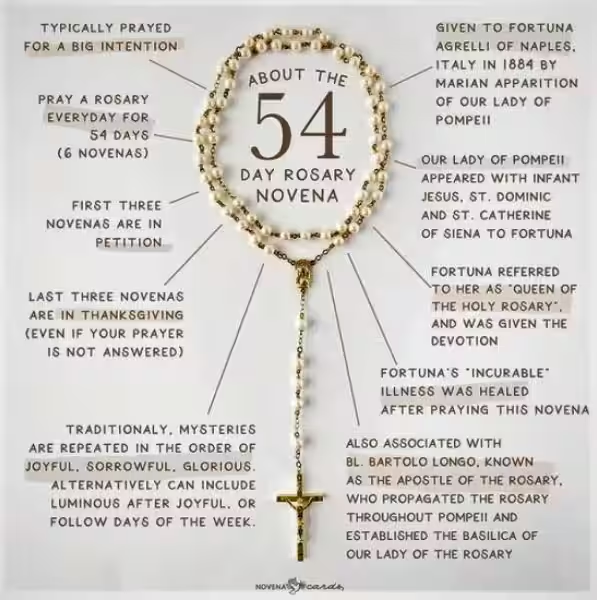
The Rosary is a particularly powerful and beloved form of Catholic prayer that incorporates petitionary elements. As we meditate on the mysteries of Christ’s life, we are invited to offer specific intentions with each decade. The Hail Mary prayers, interwoven with the Our Father and Glory Be, allow for the seamless integration of our petitions. For example, while praying the Sorrowful Mysteries, you might offer a decade for the healing of a sick friend, silently or mentally voicing: “For the healing of [Name of friend], through the intercession of Our Lady of Sorrows, we pray to the Lord.” The repetitive nature of the Rosary, combined with contemplative meditation, fosters a deep connection with Mary and, through her, with Jesus, making it an exceptionally potent vehicle for petitionary prayer.
Conclusion: Embracing the Gift of Catholic Petition Prayers
In conclusion, Catholic petition prayers are an integral and beautiful aspect of our faith journey. They are a divine invitation to engage in a personal and intimate dialogue with God, to share our deepest concerns, hopes, and dreams with the One who loves us most perfectly. These prayers are not about manipulation or demanding outcomes, but about fostering a deeper relationship with God, built on faith, trust, and humility. They remind us that we are not alone in our struggles and that a loving, omnipotent God is always ready to hear us.
By understanding the biblical roots, theological significance, and practical applications of Catholic petition prayers, we can empower ourselves to approach God with confidence and a renewed sense of hope. Whether you are praying for personal strength, interceding for loved ones, or seeking spiritual growth, remember the promise that God hears you and desires to respond according to His perfect will. Embrace the gift of petitionary prayer, and allow it to transform your relationship with the Divine, bringing you closer to Him and to the fulfillment of His loving plans for your life.
A Catholic petition prayer is a type of prayer where a Catholic asks God, through Jesus Christ and in the power of the Holy Spirit, for something they need or desire. This can include spiritual benefits, worldly necessities, help for others, or intercession from saints.
What is the purpose of petition prayers?
The purpose of petition prayers is to draw closer to God, express trust in His providence, and acknowledge our dependence on Him. It’s a way to communicate our needs and desires to the divine and to seek His will in our lives.
Who can be the recipient of a petition prayer?
The primary recipient of any prayer, including petition prayers, is God (the Father, Son, and Holy Spirit). Catholics also pray for the intercession of the Blessed Virgin Mary and the saints, asking them to join their prayers to ours and present them to God.
Are petition prayers effective?
Catholics believe that petition prayers are effective because they are directed to a loving and all-powerful God who desires to answer the prayers of His children according to His divine will. The effectiveness is not always measured by the immediate granting of the request, but by God’s response, which may be different from what we ask for, but always in our ultimate good.
What are some examples of things Catholics petition for?
Catholics petition for a wide range of things, including:
Spiritual growth and virtues (e.g., faith, hope, charity, patience)
Guidance and wisdom in decisions
Healing from physical or emotional ailments
Strength in times of trial or temptation
The well-being of family and friends
Peace in the world
Salvation and eternal life
What is the difference between petition and intercessory prayer?
Petition prayer is when you pray for yourself or your own needs. Intercessory prayer is when you pray for the needs of others. Often, these two forms of prayer are intertwined, as we may petition God for our own needs and also ask Him to help specific individuals. Catholics also engage in intercessory prayer by asking Mary and the saints to pray for us.
Does God always grant what is asked in a petition prayer?
No, God does not always grant petition prayers exactly as we request them. He answers all prayers, but His response is always guided by His perfect wisdom and love, and what is truly best for us and for His greater glory. Sometimes, the answer might be “no,” or “wait,” or something entirely different from what we envisioned.
How should one approach petition prayer?
Petition prayers should be approached with faith, humility, and trust in God’s plan. It’s important to pray with a sincere heart, acknowledging God’s sovereignty and being open to His will. The “Our Father” prayer, for example, is a model that includes petition: “Give us this day our daily bread; and forgive us our trespasses, as we forgive those who trespass against us; and lead us not into temptation, but deliver us from evil.”
Can I petition for material things?
Yes, Catholics can petition for material things, such as financial assistance, help with work, or a safe journey. However, the emphasis is generally on seeking God’s will and recognizing that spiritual goods often take precedence over material ones. The “daily bread” in the Our Father can be understood to include both spiritual and temporal necessities.