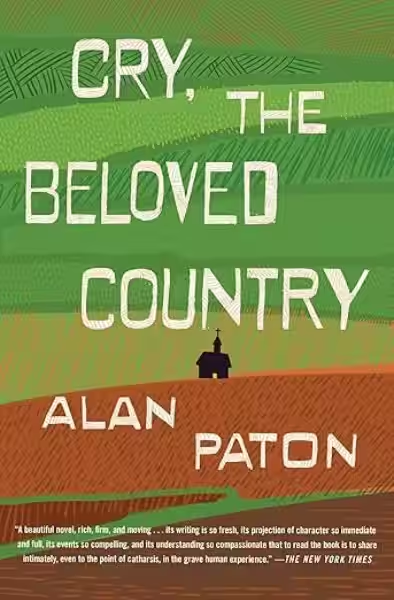
Alan Paton’s enduring masterpiece, Cry, the Beloved Country, is far more than a historical novel; it’s a deeply resonant narrative that grapples with the very essence of faith, the corrosive nature of prejudice, and the enduring possibility of redemption. Set against the breathtaking backdrop of South Africa, the full book immerses readers in a world torn apart by racial injustice and societal upheaval. Through the journey of its central character, Stephen Kumalo, a humble Zulu minister, Paton masterfully weaves a tapestry where religious conviction confronts stark reality, offering a compelling and timeless meditation on what it means to be human in a world that often denies our inherent dignity.
The novel’s power lies in its ability to connect the spiritual struggles of its characters with the tangible suffering of a nation. While the narrative unfolds with the gripping tension of a personal quest for reconciliation, the underlying current is one of profound religious inquiry. Paton, himself a man of deep faith, doesn’t shy away from the complexities of belief when faced with overwhelming despair. He presents a vision of faith not as a passive acceptance of fate, but as an active, often agonizing, pursuit of understanding and love, even in the face of unimaginable loss. This article will delve into the multifaceted ways religion shapes the narrative of Cry, the Beloved Country, exploring its role in the characters’ lives, its impact on the societal landscape, and its ultimate message of hope.
The Burden of Faith: Stephen Kumalo’s Pilgrimage of the Soul
At the heart of Cry, the Beloved Country‘s religious narrative is the arduous journey of Reverend Stephen Kumalo. His initial departure from his ancestral village of Ndotsheni is driven by a desperate search for his son, Absalom, who has disappeared into the sprawling, dehumanizing city of Johannesburg. This physical journey mirrors a far more significant spiritual pilgrimage. Kumalo, a man deeply rooted in the traditions and teachings of his church, carries the weight of his parishioners’ hopes and his own personal anxieties. His faith is tested at every turn, from the harsh realities of urban poverty that he encounters to the devastating news of his son’s transgression.
Kumalo’s faith is not presented as an unwavering shield against hardship; rather, it is a constant struggle for understanding and resilience. He grapples with the silence of God amidst suffering, the apparent injustice of the world, and the profound disappointment in his son. Yet, it is precisely through these trials that his faith deepens and transforms. He learns that true religion is not about avoiding pain, but about finding the strength to endure it and to seek forgiveness and reconciliation. His conversations with other characters, his prayers, and his quiet reflections all underscore the profound internal wrestling that defines his spiritual path throughout the full book.
The church, in various forms, plays a pivotal role in the fabric of Cry, the Beloved Country. For the Zulu community, the church, often established by missionaries, represents both a connection to a spiritual realm and a source of solace in a world that offers them little comfort or opportunity. Reverend Kumalo’s church is a sanctuary, a place where the community gathers to share joys and sorrows, to celebrate life, and to seek guidance. It is a testament to their enduring spirit and their capacity for faith, even when their earthly lives are marked by hardship and discrimination.
However, the novel also subtly critiques the limitations of organized religion when it fails to adequately address the systemic injustices of apartheid. While Kumalo’s faith is deeply personal and transformative, the broader religious institutions often struggle to bridge the chasm between the white and black communities. The arrival of missions in South Africa, while bringing spiritual teachings, also brought a complex history of colonialism and cultural imposition. Paton, through the nuanced portrayal of different religious figures and congregations, invites readers to consider how faith can be both a force for good and, at times, a tool that inadvertently perpetuates societal divides. The full book encourages us to examine the true meaning of Christian love and its application in the face of deeply entrenched prejudice.
Forgiveness and Reconciliation: The Core of Christian Love
The central theme of forgiveness, deeply intertwined with religious tenets, permeates Cry, the Beloved Country. The climactic events of the novel, particularly Absalom’s trial and subsequent fate, present a profound challenge to this ideal. Kumalo’s personal anguish is immense, yet his capacity for forgiveness, even towards those who have wronged his son and his people, is a testament to the transformative power of his faith. This theme extends beyond Kumalo, as the novel explores the possibility of reconciliation between the races, a seemingly insurmountable task.
The relationship between Reverend Kumalo and John Harrison, the father of the young white man who was killed by Absalom, becomes a focal point for this exploration. Their initial encounters are fraught with tension and grief. However, through shared pain and a gradual understanding of their mutual loss, a fragile bridge begins to form. This process, guided by a nascent sense of shared humanity and perhaps a divine intervention, offers a glimmer of hope for a fractured South Africa. The full book suggests that true reconciliation, rooted in the principles of Christian love and compassion, is not only possible but essential for the nation’s healing.
While Cry, the Beloved Country is not a political tract, it is undeniably a novel deeply concerned with social justice, viewed through a spiritual lens. Reverend Kumalo’s journey is not just about finding his son; it’s about confronting the systemic inequalities that have driven young men like Absalom to despair and crime. His prayers are often pleas for justice, for a world where his people are not subjected to the indignity of segregation and economic exploitation.
The novel illustrates that for many oppressed people, their faith becomes a source of strength and a framework for understanding their struggle. It provides a moral compass and a hope for a future where righteousness will ultimately prevail. The full book presents a compelling argument that the pursuit of justice is not merely a secular endeavor, but a deeply spiritual imperative. The characters’ faith informs their actions, their resilience, and their unwavering belief that a better world, guided by love and equity, is attainable, even in the direst of circumstances.
The Enduring Legacy of Faith in the Face of Despair
The enduring power of Cry, the Beloved Country lies in its unflinching portrayal of human suffering and its equally powerful assertion of the indomitable nature of the human spirit, fueled by faith. The novel concludes not with a triumphant resolution, but with a quiet, profound sense of hope. Reverend Kumalo, having endured immense hardship and loss, begins the arduous task of rebuilding his community and his own life. His return to Ndotsheni, and his efforts to teach the children and restore the land, are acts of faith in the future.
The full book leaves the reader with a powerful message: that even in the darkest of times, the light of faith, compassion, and the pursuit of reconciliation can guide us towards healing and redemption. The beauty of the South African landscape, once a backdrop to pain, becomes a symbol of renewed hope and the potential for renewal. Cry, the Beloved Country continues to resonate because it reminds us that the spiritual journey, though often fraught with difficulty, is ultimately the most profound path we can take, offering us the strength to face adversity and to strive for a more just and loving world.
Frequently Asked Questions: Religion in *Cry, the Beloved Country*
How is religion depicted in Cry, the Beloved Country?
Religion is a significant force in the novel, primarily represented by the Christian faith. It serves as a source of both solace and moral guidance for characters, particularly for Stephen Kumalo. The novel explores how different interpretations and practices of Christianity exist within South Africa, reflecting the societal divisions of the time.
What role does Stephen Kumalo’s faith play in the story?
Stephen Kumalo’s deep Christian faith is central to his character and his journey. It sustains him through immense personal tragedy, including the loss of his son and the breakdown of his family and community. His faith fuels his desire for reconciliation and his belief in the inherent goodness of people, even in the face of profound injustice and suffering.
How does the novel contrast Christian beliefs with the realities of apartheid?
The novel highlights the stark contrast between the Christian ideals of love, forgiveness, and equality and the brutal reality of apartheid, which is based on racial segregation, oppression, and hatred. Many characters, including Stephen, grapple with this dissonance, questioning how a society founded on Christian principles can simultaneously practice such inhumanity.
Are there different forms of Christianity presented in the book?
Yes, the novel presents various facets of Christianity. There is the traditional Zulu Christianity that Stephen embodies, emphasizing community and spiritual guidance. There is also the Christianity of the white missionaries and settlers, which is often shown to be intertwined with or complicit in the colonial and apartheid systems. The “new” churches that attract some of the township dwellers represent a different expression of faith, sometimes seen as more vibrant but also potentially more superficial or even exploitative.
How does religion influence the concept of hope in the novel?
Religion is a primary source of hope in Cry, the Beloved Country. Despite the bleakness of the social and political landscape, Stephen Kumalo’s unwavering faith allows him to believe in the possibility of redemption, healing, and a better future. His ability to forgive and his commitment to rebuilding his community are deeply rooted in his religious convictions.
Does the novel suggest that religion is a solution to South Africa’s problems?
The novel doesn’t present religion as a simple, immediate solution. Instead, it portrays religion as a vital force for individual moral strength, empathy, and the long-term pursuit of justice and reconciliation. It suggests that genuine Christian principles, when lived out authentically, can guide individuals toward positive change and inspire collective action for a more just society, even if systemic change is slow and arduous.