The Book of Revelation, the final and arguably most enigmatic book of the New Testament, often conjures images of fire, brimstone, and impending doom. For many, its verses are a cryptic code, a source of fear and speculation rather than a beacon of hope. However, a closer, more grounded examination reveals that the “revelations verses” offer profound insights and promises relevant to our daily lives, not just the distant future. It’s a message that speaks to the enduring struggle between good and evil, the resilience of faith, and the ultimate triumph of love and redemption. This article aims to unpack some of these powerful verses, demonstrating their usefulness and relatability in navigating the complexities of our modern existence.
Beyond the dramatic imagery of beasts and judgments, the core message of Revelation is one of divine sovereignty and ultimate victory. It’s a narrative designed to strengthen the faith of believers facing persecution and to offer a vision of a renewed creation where injustice is vanquished. Instead of solely focusing on the apocalyptic, let’s explore how these verses can serve as a source of comfort, guidance, and encouragement for us all, regardless of our individual religious beliefs or the specific interpretations we hold.
Life, even in our technologically advanced era, is rarely without its challenges. We face personal struggles, societal upheavals, and anxieties about the unknown. It’s in these moments that the whispers of hope found within Revelation’s verses can be particularly potent. Consider the promise in Revelation 1:3 (NIV): “Blessed is the one who reads aloud the words of this prophecy, and blessed are those who hear it and take to heart what is written in it, because the time is near.” This isn’t just a statement about the book itself; it’s an invitation to engage with a message that brings blessing and strength. The “time is near” can be understood not just as a prediction of an end, but as an urgency to embrace the present with faith and purpose.
Think of a time you felt overwhelmed by a personal crisis, perhaps a job loss or a difficult relationship. The feeling of helplessness can be profound. Revelation, in its own way, addresses this by assuring us that God’s plan is in motion, even when we can’t see it. The comfort derived from understanding divine oversight can be immense. It’s like knowing that even in a turbulent storm, a competent captain is at the helm of your ship, guiding you towards a safe harbor. The book consistently emphasizes that God is in control, a reassuring thought when the world around us seems chaotic.
The “beasts” described in Revelation are often interpreted as symbols of oppressive powers and insidious forces that seek to dominate and deceive. While we may not see literal dragons or seven-headed creatures, we certainly encounter their modern-day equivalents. These can manifest as corrupt systems, manipulative ideologies, pervasive misinformation, or even our own internal struggles with greed and envy. The verses that describe the conflict between these forces and the faithful offer a framework for understanding and resisting them. For example, Revelation 13:7 (NIV) speaks of the beast being allowed to make war on the saints and to conquer them. This can be relatable to anyone who has felt marginalized or attacked for their beliefs or values.
Instead of succumbing to despair when faced with these “beasts,” Revelation encourages steadfastness and discernment. It’s a call to recognize the tactics of deception and to stand firm in our convictions. Imagine a journalist who uncovers a widespread conspiracy. The pressure to remain silent or to alter the truth can be immense. Revelation’s message empowers individuals to speak truth to power and to resist the allure of compromise when it means abandoning core principles. The promise of ultimate vindication for those who remain faithful is a powerful motivator.
The Symphony of Worship and the Song of Victory
One of the most uplifting aspects of Revelation is the recurring imagery of heavenly worship and celebration. We see scenes of saints singing songs of praise, casting their crowns before the throne, and rejoicing in God’s victory. This isn’t just about a future event; it’s a portrayal of true joy and fulfillment. The verses describing this ultimate worship, such as Revelation 19:1 (NIV) which exclaims, “Hallelujah! Salvation and glory and honor and power belong to our God,” paint a picture of unadulterated joy and profound gratitude. It’s a reminder of what we are striving for – a state of being in perfect harmony with the divine.
This vision of heavenly worship can inspire us to cultivate a spirit of gratitude and praise in our everyday lives. Even amidst difficulties, finding moments to acknowledge the good, to express thankfulness, and to connect with something larger than ourselves can transform our perspective. Consider the simple act of singing a song that uplifts your spirit or expressing appreciation to someone who has helped you. These small acts echo the larger symphony of worship described in Revelation. It’s about recognizing that even in this life, there are glimpses of the divine joy that awaits.
The Lamb Who Was Slain: A Symbol of Unconditional Love
At the heart of Revelation’s narrative is the figure of the Lamb who was slain, a powerful symbol of sacrifice, redemption, and unconditional love. The repeated references to the Lamb in verses like Revelation 5:12 (NIV), which states, “In a loud voice they sang: ‘Worthy is the Lamb, who was slain, to receive power and wealth and wisdom and strength and honor and glory and praise!’ speak to the transformative power of self-sacrificial love. This isn’t an abstract theological concept; it’s a profound principle that can guide our interactions and shape our character.
How does this apply to our modern lives? It’s about understanding that true strength often lies in vulnerability and compassion. It’s about choosing empathy over judgment, forgiveness over resentment, and service over self-interest. Think of a parent tirelessly caring for a sick child, or a volunteer dedicating their time to a cause they believe in. These are earthly echoes of the Lamb’s sacrifice. The message of Revelation, through the Lamb, reminds us that love, in its purest form, is the ultimate conquering force, capable of overcoming even the deepest wounds and divisions.
A New Heaven and a New Earth: The Promise of Restoration
Perhaps the most inspiring revelation within the book is the vision of a new heaven and a new earth, a state of perfect restoration and renewal. The verses describing this ultimate hope, such as Revelation 21:1 (NIV): “Then I saw ‘a new heaven and a new earth,’ for the first heaven and the first earth had passed away, and there was no longer any sea,” offer a powerful promise of healing and redemption. This isn’t just about escaping this world; it’s about the transformation and perfection of all that is. It’s a vision that transcends our current limitations and offers the ultimate hope for a world free from suffering, pain, and death.
This promise of restoration can be a powerful source of motivation for positive change in our own lives and in the world around us. It encourages us to work towards a better future, to heal broken relationships, and to strive for justice and peace. While we may not witness the complete fulfillment of this vision in our lifetime, the hope it provides can fuel our efforts to create a more just, compassionate, and sustainable world. It’s the belief that even in the face of destruction and decay, new life and renewed hope are always possible, a testament to the enduring power of creation and redemption.
In conclusion, the verses of Revelation are far more than just a collection of prophecies. They are revelations of enduring truths, offering comfort, guidance, and an unwavering message of hope for believers and seekers alike. By looking beyond the sensationalism and focusing on the core themes of divine sovereignty, steadfast faith, sacrificial love, and ultimate restoration, we can find profound usefulness and relatability in these ancient, yet eternally relevant, verses. They are a testament to the promise that even in the darkest of times, light and hope will ultimately prevail.
Frequently Asked Questions: Revelation Verses and Religion
What is the Book of Revelation?
The Book of Revelation is the final book of the New Testament in the Christian Bible. It is an apocalyptic text, meaning it contains symbolic visions and prophecies about the end times, the ultimate triumph of good over evil, and the establishment of God’s kingdom. It is attributed to the apostle John.
What are “revelations verses” in a religious context?
“Revelations verses” typically refers to specific passages from the Book of Revelation that are often cited in discussions about eschatology (the study of end times), divine judgment, the return of Christ, and the nature of God’s plan for humanity and the universe. These verses are often interpreted in various ways by different religious denominations and individuals.
How is the Book of Revelation understood in different religions?
The Book of Revelation is primarily a Christian text. While it holds significant theological weight within Christianity, it is not considered scripture by Judaism or Islam. In Christianity, interpretations vary widely. Some view it as literal prophecy, others as symbolic of spiritual struggles, and still others as a message of hope and encouragement to persecuted early Christians.
Are there specific verses in Revelation that are frequently discussed in relation to religion?
Yes, many verses are discussed. Some prominent examples often debated include:
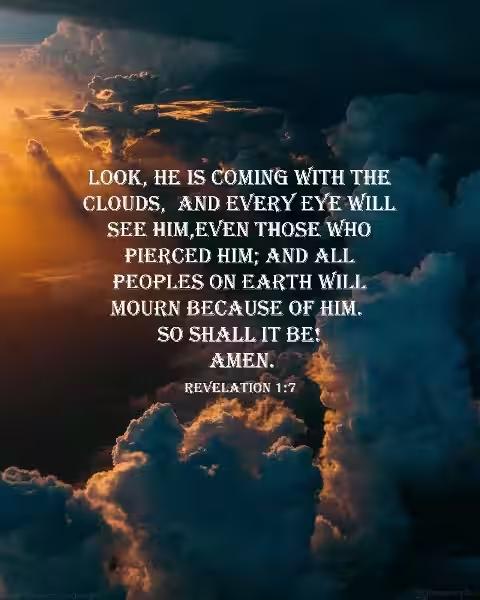
* Revelation 1:7: “Look, he is coming with the clouds, and every eye will see him, even those who pierced him; and all peoples on earth will mourn because of him. So shall it be! Amen.” (Often cited in discussions about the Second Coming of Christ.)
* Revelation 13: Describes the “beast” and the “mark of the beast,” which are subjects of much speculation and varied interpretation regarding their meaning and application.
* Revelation 21: Describes a “new heaven and a new earth” and the New Jerusalem, offering a vision of ultimate redemption and eternal peace.
* Revelation 22:18-19: Contains warnings against altering the words of the prophecy, emphasizing the importance of the text.
How do different interpretations of Revelation verses affect religious beliefs?
Interpretations of Revelation verses can profoundly shape religious beliefs and practices. For instance, differing views on the timing and nature of Christ’s return can influence a religion’s eschatological outlook, its views on current events, and its sense of urgency regarding evangelism or societal engagement. Some interpretations may foster a sense of imminent divine intervention, while others may focus on the spiritual and moral implications for believers in their present lives.