Imagine sitting around a crackling campfire, the stars a scattered blanket above you. You ask, “Where did all this come from?” For millennia, humanity has grappled with this fundamental question, seeking answers in the grand narratives that stitch together our understanding of existence. The book of Genesis, the very first book of the Hebrew Bible and a foundational text for Judaism, Christianity, and Islam, offers not one, but two distinct, yet profoundly complementary, accounts of creation. These aren’t just ancient myths; they are rich tapestries woven with theological insights, offering timeless wisdom about God, humanity, and our place in the cosmos. Understanding these two creation stories in Genesis unlocks a deeper appreciation for the very foundations of our religious and cultural heritage.
These narratives, penned by different authors and likely reflecting different theological concerns, speak to us across the ages, revealing different facets of the divine creative act. They are not contradictory in a way that invalidates them, but rather, they illuminate each other, providing a more comprehensive picture of a God who is both transcendent and intimately involved in His creation. By exploring these accounts side-by-side, we can gain a more nuanced understanding of the purpose of creation, the nature of humanity, and the enduring relationship between the Creator and the created.
Our journey into the origins begins with a sweeping, majestic panorama: the first creation story, found in Genesis 1:1 through 2:3. This account presents a God who is powerful, orderly, and deliberate. It’s a grand, almost cosmic, performance where God, referred to as “Elohim” (a Hebrew plural noun often understood as signifying majesty and fullness), speaks the universe into existence. The structure is remarkably rhythmic, following a pattern of divine command, execution, observation, and pronouncement of goodness. This systematic approach highlights the inherent order and rationality of God’s creation. Think of it like a master builder meticulously designing and constructing a magnificent structure, step by painstaking step.
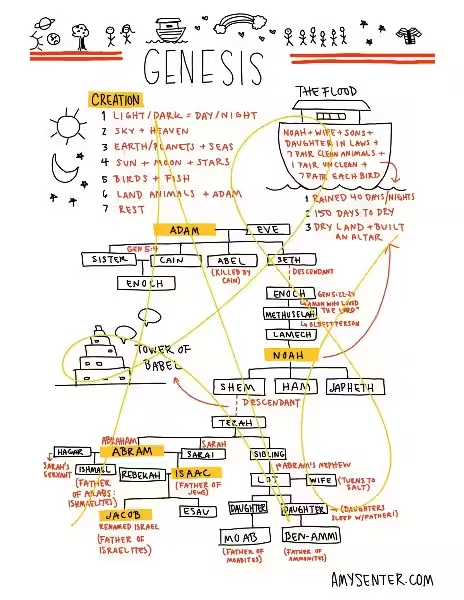
This narrative unfolds over six days, each marked by a specific act of creation. On day one, light is separated from darkness, establishing the fundamental rhythm of day and night. Day two sees the firmament dividing waters, creating the sky. Day three brings forth dry land and vegetation, the very foundation of life on Earth. Day four adorns the heavens with the sun, moon, and stars, regulating time and seasons. Day five fills the waters and skies with creatures, and day six culminates in the creation of land animals and, significantly, humanity. Each stage is met with God’s affirmation: “And God saw that it was good.” This repetition underscores the inherent value and perfection of everything God made. The seventh day is then set apart as a day of rest, establishing the principle of Sabbath and signaling the completion and divine approval of the entire project.
The Divine Image and Dominion
Within this grand cosmic framework, the creation of humanity stands out. Genesis 1:26-28 declares, “Then God said, ‘Let us make mankind in our image, in our likeness, so that they may rule over the fish in the sea and the birds in the sky, over the livestock and all the wild animals, and over all the creatures that move along the ground.'” This statement is profoundly significant. It suggests that humanity is not merely another creature but holds a unique and special place in God’s design. The concept of being made “in the image of God” implies that we reflect divine qualities, such as reason, morality, creativity, and the capacity for relationship. It’s like a king commissioning a portrait that captures the essence of his regality; we are intended to reflect aspects of God’s own character.
Furthermore, humanity is given dominion over creation. This isn’t a license for exploitation but a call to responsible stewardship. We are appointed as caretakers, tasked with managing and nurturing the Earth and its inhabitants. This concept is vital for understanding our ethical obligations towards the environment and other living beings. The narrative emphasizes a hierarchical yet harmonious relationship, where humanity, as the pinnacle of creation, is entrusted with the care of the rest. This responsibility, while a privilege, also carries the weight of accountability for our actions in the world. The divine mandate is clear: to reflect God’s goodness and order through our governance of the earth.
The Gardener in the Garden: Genesis 2:4b-25
Shifting our focus, we encounter the second creation story, beginning in Genesis 2:4b and continuing to verse 25. This account, often attributed to a different author (sometimes referred to as the “J” or Yahwist source), presents a more intimate and anthropomorphic portrayal of God. Here, God is referred to as “Yahweh Elohim” (the Lord God), emphasizing a personal, relational aspect. This narrative is less about the grand cosmic sweep and more about the creation of the first man and woman and their initial environment. The focus shifts from the orderly, spoken universe to the intimate, terrestrial details of the Garden of Eden. It’s like moving from a panoramic landscape painting to a detailed close-up of a vibrant garden.
This story begins with the formation of the earth and heavens, but quickly zooms in on the creation of the first human, Adam. Unlike the first account where humanity is formed en masse, here we see a more hands-on approach. God is depicted as molding Adam from the dust of the ground and breathing life into him. This imagery of God’s direct involvement and the physical connection between the Creator and the created is powerful. The narrative then describes the planting of the Garden of Eden, a place of abundance and perfection, and the appointment of Adam to “work it and take care of it.” This echoes the stewardship motif from the first account but with a more pastoral flavor.
The Need for Companionship and the Mystery of Unity
A significant development in this second narrative is the observation that “it is not good for the man to be alone.” God recognizes Adam’s need for companionship, a crucial aspect of human flourishing. To address this, God brings all the animals to Adam to be named, a task that highlights Adam’s intelligence and his role in categorizing and understanding the world. However, among all the creatures, “no suitable helper was found for him.” This underscores the unique nature of human relationship and the idea that our deepest needs cannot be met by other species.
The creation of Eve from Adam’s rib is a pivotal moment. This act symbolizes a profound unity and interdependence between man and woman. The text states, “bone of my bones and flesh of my flesh,” signifying a deep, intrinsic connection. The subsequent declaration, “a man will leave his father and mother and be united to his wife, and they will become one flesh,” lays the foundation for the institution of marriage and the concept of familial bonds. This narrative emphasizes that humanity is created for relationship, both with God and with one another, and that this relational aspect is essential to our very being. The mystery of unity born from distinct individuals is central to this story’s message.
Complementary Visions: Bridging the Two Accounts
It’s easy to fall into the trap of seeing these two creation stories as contradictory, but a closer examination reveals their profound complementarity. The first creation account (Genesis 1) provides the grand theological framework, emphasizing God’s transcendent power, the orderly nature of creation, and humanity’s elevated status as being made in God’s image with a mandate for dominion. It answers the “what” and “how” of creation on a cosmic scale. The second creation account (Genesis 2) offers a more intimate and pastoral perspective, focusing on the specific creation of humanity, their immediate environment, and the foundational importance of relationship and companionship. It answers the “why” and “for whom” of human existence.
Think of it like this: the first story is the architect’s blueprint of a magnificent city, detailing the overall plan, the infrastructure, and the purpose of each district. The second story is like walking through a bustling marketplace within that city, observing the interactions between people, the details of their lives, and the establishment of homes and families. Both are true, both are essential, and together they paint a richer, more complete picture of God’s creative heart. The two creation stories in Genesis are not competing narratives but rather two lenses through which we can view the same incredible event, each revealing a unique facet of the divine artistry and profound love that brought all things into being.
The Enduring Relevance of Genesis’s Origins
The creation stories in Genesis continue to resonate because they speak to fundamental aspects of the human experience. They grapple with our origins, our purpose, and our relationship with the divine. The Genesis 1 account instills a sense of awe at God’s power and the intricate order of the universe, reminding us that we are part of something vast and divinely orchestrated. It provides a basis for scientific inquiry by suggesting an ordered reality, while simultaneously asserting that this order originates from a divine source. The Genesis 2 account grounds us in the importance of human connection, the necessity of meaningful work, and the profound gift of companionship and love. It offers a foundational understanding of human dignity and the sanctity of relationships.
These narratives, though ancient, offer profound insights into the human condition. They address questions about our identity, our responsibilities, and our place in the grand scheme of existence. The religion that stems from these foundational texts offers a framework for understanding suffering and redemption, but at its core, Genesis reminds us that we are creatures born out of divine intention and love. By studying and reflecting on these two creation stories in Genesis, we can gain a deeper appreciation for the enduring legacy of these foundational texts and their continuing ability to shape our understanding of ourselves and the world around us.
Frequently Asked Questions: Two Creation Stories in Genesis
What are the two creation stories in Genesis?
The Bible’s book of Genesis contains two distinct accounts of creation. The first, found in Genesis 1:1 through 2:4a, presents a structured, seven-day creation narrative with God speaking the universe into existence. The second, located in Genesis 2:4b through 2:25, offers a more intimate and anthropomorphic portrayal, focusing on the creation of Adam and Eve in the Garden of Eden.
Why are there two creation stories?
Scholars generally believe these two accounts originated from different ancient Israelite traditions and were later compiled into the book of Genesis. They may have been preserved because each offers a unique theological perspective on God, humanity, and the created order.
Are these stories meant to be literal scientific accounts?
Most religious scholars and theologians do not interpret these creation stories as literal, scientific descriptions of how the universe and life originated. Instead, they are understood as theological narratives that convey profound truths about God’s power, the goodness of creation, humanity’s relationship with God, and the nature of sin.
How do these stories relate to the concept of “religion”?
These creation stories are foundational to Judaism and Christianity, two major religions. They establish core beliefs about God as the sovereign Creator, the inherent value of humanity, and the ordered nature of the cosmos. They provide a framework for understanding God’s will and humanity’s place within it, which are central tenets of religious faith.
Do different religions have similar creation stories?
While details vary significantly, many religions across cultures share common themes in their creation narratives. These often include a divine being or beings as the source of creation, a process of bringing order out of chaos, and the formation of humanity with a special purpose. These shared themes suggest universal human questions about origins and meaning.
How should I understand the differences between the two Genesis accounts?
The differences are often seen as complementary rather than contradictory. The first account emphasizes God’s transcendent power and the cosmic order, while the second highlights God’s immanent relationship with humanity and the personal nature of creation. Together, they offer a fuller picture of God’s creative activity.