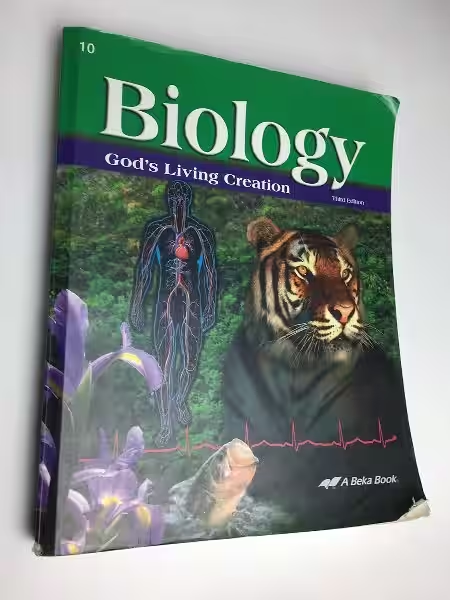
The intricate world of biology, from the single-celled marvels to the grand ecosystems, has long been a source of profound wonder and contemplation. For many, the sheer complexity, the elegant design, and the breathtaking diversity found within life itself point towards a divine architect. This perspective views biology not merely as a scientific discipline, but as a window into God’s living creation, a testament to a power and intelligence far beyond our own understanding. It’s a viewpoint that bridges the seemingly disparate realms of science and religion, inviting us to explore the profound connections between the observable natural world and the spiritual truths that resonate within our hearts.
When we delve into the study of biology, we are, in essence, unraveling the secrets of existence, the very fabric of life that breathes and grows all around us. This exploration can be both intellectually stimulating and deeply enriching, offering a unique lens through which to appreciate the grandeur of God’s living creation. It’s a journey that encourages us to ask fundamental questions: Is there an underlying purpose to this remarkable order? Does the intricate balance of nature suggest a guiding hand? These are questions that have echoed through human history, pondered by philosophers, theologians, and scientists alike, and they find a powerful resonance within the field of biology.
The Microscopic Wonders: Building Blocks of God’s Design
At the heart of biology’s living creation lie the microscopic wonders, the fundamental units of life that operate with astonishing precision. Consider the humble bacterium, a single cell capable of reproduction, metabolism, and adaptation. Within its minuscule confines, a complex machinery whirs, a miniature factory orchestrating a symphony of biochemical reactions. This level of organization, the sheer elegance of cellular processes, from DNA replication to protein synthesis, often leaves scientists in awe. It’s a testament to a design that is both robust and incredibly efficient, hinting at a master plan far exceeding human ingenuity, a cornerstone of God’s living creation.
Think about the intricate dance of molecules within a cell. The double helix of DNA, a blueprint for life, contains an astonishing amount of information, encoded in sequences of just four chemical bases. The way this information is transcribed, translated into proteins, and then folded into specific three-dimensional structures to perform vital functions is nothing short of miraculous. This intricate molecular ballet, happening billions of times every second within every living organism, serves as a powerful argument for a divine intellect behind biology’s living creation. It’s a level of detail and precision that suggests purpose, a deliberate act of creation rather than random chance, further solidifying our understanding of God’s living creation.
The Symphony of Ecosystems: Interconnectedness and Divine Harmony
Moving beyond the cellular level, biology unveils the breathtaking complexity of ecosystems, where countless organisms interact in a delicate and interconnected web of life. From the towering redwood forests to the vibrant coral reefs, each ecosystem is a testament to the grand scale of God’s living creation. The predator-prey relationships, the symbiotic partnerships, the nutrient cycles – all these elements work in concert, creating a self-sustaining and dynamic system. This intricate balance, where the survival of one species is often dependent on another, speaks to a profound harmony, a carefully orchestrated masterpiece of God’s living creation.
Consider the simple example of pollination. Bees, birds, and bats, each playing a crucial role, flit from flower to flower, ensuring the reproduction of countless plant species. In return, these plants provide nectar and pollen, a vital food source for these pollinators. This mutualistic relationship, a cornerstone of many ecosystems, demonstrates an incredible interdependence that is a hallmark of biology’s living creation. It’s a cycle of giving and receiving, a beautiful illustration of how different parts of God’s living creation are designed to support and sustain one another, reflecting a divine intention for flourishing and continuity.
Evolutionary Marvels: Adaptation as a Divine Process
The concept of evolution, often presented as a purely scientific phenomenon, can also be viewed through the lens of God’s living creation. Rather than contradicting faith, evolution can be understood as the remarkable process through which God’s living creation has diversified and adapted over vast stretches of time. The incredible ability of organisms to change and evolve in response to their environments – a process of natural selection – can be seen as a divinely endowed mechanism for resilience and continued existence. This adaptation, this ongoing refinement of life forms, showcases the dynamic and ever-evolving nature of God’s living creation.
Think about the finches of the Galapagos Islands, studied by Darwin. Their distinct beak shapes, perfectly suited to the specific food sources available on each island, are a classic example of evolutionary adaptation. This specialization, this fine-tuning of form and function, didn’t happen overnight. It’s a testament to the power of subtle changes accumulating over generations, guided by environmental pressures. From a religious perspective, this incredible adaptive capacity within biology’s living creation can be seen as evidence of God’s foresight and wisdom, an ingenious way to ensure the survival and propagation of life in a constantly changing world, a profound aspect of God’s living creation.
The Human Element: A Spark of the Divine in Biology’s Creation
Within the grand tapestry of God’s living creation, humanity holds a unique position. Our capacity for consciousness, for reason, for creativity, and for love sets us apart. The biological basis of these extraordinary traits – the complex neural networks of the brain, the intricate interplay of hormones and neurotransmitters – is a source of ongoing scientific inquiry. Yet, many find in these very capacities a reflection of the divine, an echo of the creator within ourselves. It’s this inherent humanness, this capacity for connection and understanding, that truly elevates our place within biology’s living creation.
The very fact that we can study biology’s living creation, that we possess the intellect to unravel its mysteries and the capacity to appreciate its beauty, is itself remarkable. This ability to observe, to question, and to discover can be interpreted as an invitation from the divine to engage with the world. Our quest for knowledge, our drive to understand our origins and our place in the universe, can be seen as a spiritual journey, a deep yearning to connect with the source of all God’s living creation. This innate curiosity is a powerful testament to the profound relationship between our inner spiritual lives and the outward manifestations of God’s living creation.
Conclusion: Biology as a Sacred Text of God’s Living Creation
In conclusion, the study of biology offers a profound and multifaceted perspective on God’s living creation. It reveals an astonishing level of detail, complexity, and interconnectedness that inspires awe and wonder. From the microscopic world of cells to the vast expanse of ecosystems, the evidence for intelligent design and divine purpose is abundant for those who choose to see it. Religion and science, far from being mutually exclusive, can converge in our appreciation of life’s intricate dance, enriching our understanding of both the natural world and our spiritual selves.
Therefore, let us approach the study of biology with an open heart and an inquisitive mind, recognizing that in every leaf, every creature, and every biological process, we are encountering the profound artistry of God’s living creation. It is a sacred text, written in the language of life itself, inviting us to a deeper understanding of the divine and our own place within this magnificent, living universe. This is the ultimate beauty of biology’s living creation – it constantly invites us to look beyond the superficial and find the divine in the everyday miraculous.
Frequently Asked Questions: Biology, God’s Living Creation, and Religion
What is the relationship between biology and the concept of God’s living creation?
Biology is the scientific study of life. When viewed through the lens of faith, the intricate and diverse forms of life studied in biology can be seen as evidence of a divine creator, often referred to as God. Religious perspectives may interpret biological processes and the existence of species as manifestations of God’s design and will.
How do religious beliefs interpret the diversity of life studied in biology?
Different religions offer various interpretations. Some see the vast array of species as a testament to God’s creativity and power. Others may view specific biological phenomena, such as evolution, as part of a divine plan or process guided by God. Core tenets often emphasize that life, in all its forms, originates from and is sustained by a divine source.
Are there conflicts between biological science and religious views on creation?
Potential conflicts can arise depending on how literal or metaphorical religious texts are interpreted and how scientific findings are understood. Some religious interpretations may not align with scientific theories like evolution or the age of the Earth. However, many individuals and religious traditions find ways to reconcile scientific understanding with their faith, viewing science as a tool to explore the wonders of God’s creation and religion as providing meaning and purpose to that existence.
How does the concept of “God’s living creation” influence religious practices?
The belief that life is God’s creation often motivates religious practices aimed at stewardship of the environment, compassion towards all living beings, and gratitude for the gift of life. Many religions have ethical guidelines that encourage respect for nature and its inhabitants, seeing them as sacred and entrusted to human care by the Creator.
Can biology inform religious understanding of life?
Yes, biological discoveries can deepen religious awe and wonder at the complexity and beauty of the natural world, which some may see as further illuminating the nature of the divine. Understanding the mechanisms of life, from cellular processes to ecological systems, can inspire contemplation on the profoundness of existence and the intelligence or power attributed to a Creator.