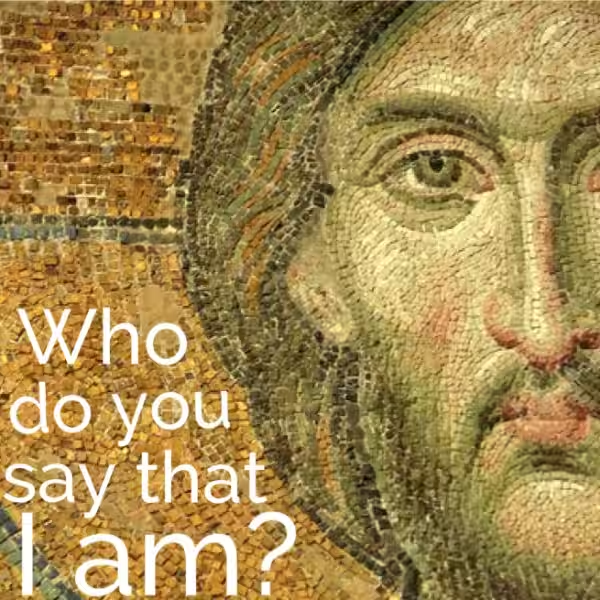
The question, “Who do you say that I am?” is far more than a philosophical curiosity; it’s a foundational inquiry that lies at the heart of every spiritual and religious journey. It echoes through ancient scriptures, whispers in personal prayers, and sparks passionate debates in theological circles. For centuries, individuals have grappled with this profound question, seeking to understand their own identity, their place in the cosmos, and their connection to the divine. Religion, in its myriad forms, offers frameworks, narratives, and practices designed to guide us towards an answer, an answer that often reveals as much about the seeker as it does about the sought.
This exploration isn’t about arriving at a singular, definitive declaration. Instead, it’s about the ongoing process of self-discovery, shaped by our beliefs, our experiences, and the traditions we inherit or forge. The answer to “Who do you say that I am?” is rarely static; it evolves, deepens, and sometimes transforms as we navigate life’s complexities and encounter new perspectives within the vast landscape of religion.
The Divine Mirror: How Religions Shape Our Self-Perception
Religions provide powerful lenses through which we can view ourselves. They offer cosmological narratives that place us within a grander scheme, suggesting our origins, our purpose, and our ultimate destiny. Whether we are seen as creations of a benevolent God, sparks of universal consciousness, or beings on a cyclical path of reincarnation, these stories profoundly influence how we understand our own existence.
Consider the Abrahamic religions – Judaism, Christianity, and Islam. Here, the concept of being created in the “image of God” (Genesis 1:27) is a cornerstone. This doesn’t necessarily imply a physical likeness, but rather a shared capacity for reason, creativity, love, and moral agency. This belief imbues believers with an inherent dignity and worth, suggesting that “Who do you say that I am?” is, at its core, someone endowed with divine potential. This understanding can foster a sense of responsibility and a call to live a life that reflects these divine attributes, striving for righteousness and compassion.
Beyond Doctrine: Personal Revelation and the Inner Voice
While religious doctrines provide structure, the deepest answers to “Who do you say that I am?” often emerge from personal revelation and inner experience. Mystics, saints, and everyday practitioners throughout history have reported profound encounters with the divine that transcend dogma. These experiences, often characterized by intense love, awe, or a sense of oneness, can fundamentally alter one’s self-understanding.
For instance, in Buddhism, the concept of “anatta” or no-self challenges the idea of a fixed, independent ego. Through meditation and mindful practice, individuals are encouraged to observe the impermanent nature of thoughts, feelings, and physical sensations. The realization that the “self” is a constantly shifting collection of phenomena can be liberating, leading to a profound shift in identity. Instead of asking, “Who do you say that I am?” in terms of a solid entity, the question might transform into, “What is this experience of being?” This shift can alleviate suffering rooted in attachment to a rigid sense of self.
Experiencing the Divine Within
Many spiritual traditions emphasize the presence of the divine within the individual. In Hinduism, the concept of Atman, the eternal self, being identical with Brahman, the universal consciousness, suggests an inherent divinity within all beings. The path of yoga and meditation is often seen as a means to realize this unity, to shed the illusion of separation and recognize the true self.
This inner experience can manifest in various ways: a deep sense of peace, an unshakeable feeling of connection, or a profound understanding of universal truths. When someone asks, “Who do you say that I am?” in this context, it’s not about external validation but about an internal knowing, a quiet whisper of the soul that resonates with the divine. This is why religious practices often encourage introspection and solitude, creating space for these inner dialogues to unfold.
The Role of Community and Shared Faith
While personal revelation is crucial, the answer to “Who do you say that I am?” is also deeply influenced by the community of faith. Religious traditions provide shared narratives, rituals, and moral codes that shape how individuals understand themselves in relation to others and to the divine. Being part of a religious community offers a sense of belonging and a framework for living out one’s faith.
In Christianity, for example, the concept of being part of the “body of Christ” (1 Corinthians 12:27) signifies an interconnectedness with other believers. Individuality is affirmed, but it is understood within the context of a larger, unified spiritual body. This shared identity helps individuals understand their role and their gifts within the community, as well as their shared humanity and their collective journey towards God. The communal affirmation of faith can reinforce a positive self-image, reminding individuals that they are loved, valued, and part of something larger than themselves.
Navigating the Nuances: Challenges and Transformations
The journey to answer “Who do you say that I am?” is not always smooth. Religious dogma can sometimes feel constricting, and personal interpretations can lead to conflict or doubt. The very question of identity can become a source of profound questioning and even crisis.
When Beliefs Are Challenged
Life events, exposure to different cultures, or intellectual inquiry can challenge deeply held religious beliefs. When foundational understandings of the divine or of one’s place in the world are shaken, the question “Who do you say that I am?” becomes particularly urgent. This can be a period of intense struggle, but it can also be a catalyst for deeper spiritual growth.
Consider someone who has always identified as a devout follower of a particular faith, only to experience a personal tragedy that seems to contradict their understanding of a loving God. In such moments, the question shifts from “What does my religion say about me?” to “What do I believe about myself and the divine, given this experience?” This often leads to a recalibration of faith, a more nuanced understanding, and a more resilient sense of self.
The Evolving Self: A Lifelong Dialogue
Ultimately, the question “Who do you say that I am?” is a lifelong dialogue. Religion provides the initial vocabulary, the guiding principles, and the supportive community, but the authentic answer is one that is continually discovered and refined through lived experience. It’s about embracing the dynamic nature of identity, recognizing that we are always in process, always learning, and always becoming.
The answers we find are not static pronouncements but rather evolving understandings. They are shaped by our acts of kindness, our moments of reflection, our struggles and triumphs, and our ongoing engagement with the sacred. The beauty of the religious quest lies in its invitation to perpetually ask, explore, and discover the ever-unfolding truth of who we are.
Frequently Asked Questions About “Who Do You Say That I Am?” and Religion
What is the core question of “Who do you say that I am?” in a religious context?
This question, famously posed by Jesus in the Gospels, is a profound inquiry into one’s identity and relationship with the divine. In a religious context, it’s an invitation to explore who God is, who Jesus is (for Christians), and how that understanding shapes one’s own sense of self and purpose within their faith.
How do different religions answer the question “Who do you say that I am?”
Different religions offer a vast spectrum of answers. For Christians, the answer often centers on Jesus being the Son of God, the Messiah, and the savior. For Jews, the answer might focus on the oneness of God and the covenant relationship. In Islam, the answer is that God (Allah) is the one and only deity. Other traditions might identify divinity within nature, ancestors, or personal spiritual experience. The answer is deeply tied to the specific theology and cosmology of each faith.
Does “Who do you say that I am?” imply a personal relationship with the divine?
Yes, in many religious traditions, the question strongly implies a personal relationship. It’s not just about intellectual assent to doctrines, but about a lived experience of faith, love, devotion, and trust in the divine. The answer one gives often reflects the depth and nature of their personal connection to God or the ultimate reality.
Can the answer to “Who do you say that I am?” change over time?
Absolutely. A person’s understanding of their faith and their relationship with the divine is often a journey of growth and discovery. Experiences, study, prayer, and community can all contribute to a deepening or evolving understanding, leading to a refined or even significantly different answer to this question throughout one’s life.
Is there a “correct” answer to “Who do you say that I am?” in a religious sense?
From a theological standpoint within a particular faith, there may be a “correct” or orthodox answer that aligns with the core tenets of that religion. However, for an individual, the most meaningful answer is the one that is genuinely held and lived out in their personal faith journey. The emphasis is often on sincerity and the transformation that comes from that personal conviction.