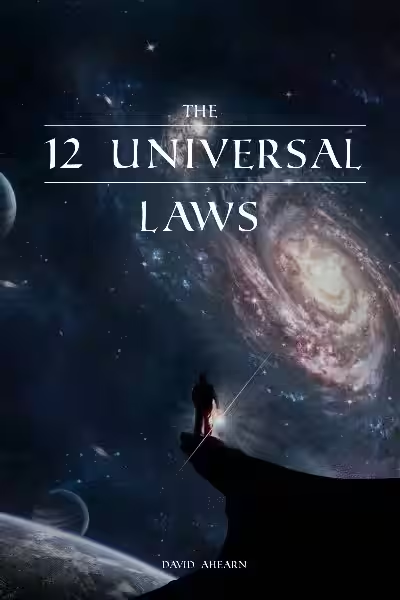
Have you ever felt a strange sense of connection to something larger than yourself, a feeling that the universe operates on principles far beyond human comprehension? This intuition is not a fleeting fancy; it’s a resonance with what many traditions call universal laws. These are fundamental truths, invisible forces that govern everything from the smallest atom to the grandest galaxy, and surprisingly, they find profound echoes within the sacred texts and spiritual practices of diverse religions. Understanding these universal laws, often explored in universal law books, can offer a richer, more profound understanding of both the cosmos and our own spiritual journeys.
Across cultures and throughout history, humanity has sought to decipher these underlying principles. While often shrouded in metaphor and allegory, religious scriptures implicitly or explicitly speak to concepts like cause and effect, balance, harmony, and the interconnectedness of all things. These are not mere philosophical musings; they are potent forces that, when understood and applied, can lead to a more fulfilling and purposeful life, bridging the gap between the secular fascination with universal laws and the deeply personal quest for spiritual meaning.
The Unseen Architects: Principles of Universal Law
Imagine the universe as a vast, intricate machine, perfectly calibrated and perpetually in motion. Universal laws are the blueprints, the operating instructions that ensure its smooth functioning. They are not dictated by any single entity but are inherent to existence itself. Think of gravity, a universal law that pulls objects towards each other; it doesn’t need to be commanded, it simply is. Similarly, other universal laws, though less tangible, exert their influence on our lives every single moment.
These laws are often presented in various forms, from philosophical treatises to practical guides, often found within extensive collections of universal law books. They speak to fundamental truths like the law of attraction, suggesting that like attracts like – our thoughts and feelings draw similar experiences into our reality. Another is the law of vibration, positing that everything in the universe is in constant motion, vibrating at a specific frequency, and that we can consciously influence our own vibration. These concepts, while sounding abstract, are deeply embedded in the human experience and have fascinating parallels in religious thought.
Cause and Effect: The Echo of Karma and Divine Justice
Perhaps the most universally recognized universal law is the law of cause and effect, often referred to as karma in Eastern traditions. This principle states that for every action, there is an equal and opposite reaction. What you sow, you shall reap. This isn’t a punitive judgment but a natural consequence, a cosmic balancing act. If you consistently spread kindness, you are likely to receive kindness in return. Conversely, actions rooted in negativity tend to attract negative outcomes, not as punishment, but as the natural unfolding of events.
Religious traditions have long incorporated this understanding into their doctrines. In Hinduism and Buddhism, karma is a central tenet, shaping the cycle of rebirths and the quality of future lives. Christianity speaks of “reaping what you sow” and the concept of divine justice, where actions have consequences, either in this life or the next. Islam emphasizes accountability for one’s deeds, with the belief that every action, no matter how small, is witnessed and will be accounted for. The principle of cause and effect, as illuminated in universal law books, provides a framework for understanding these religious narratives of accountability and moral consequence.
The Law of Vibration: Resonance and Spiritual Frequency
Every particle, every thought, every emotion vibrates at a particular frequency. This is the law of vibration. It suggests that we are like tuning forks, emitting our own unique energetic signature. If we vibrate at a high frequency – with love, joy, and gratitude – we attract experiences and people that resonate with those positive vibrations. Conversely, if we dwell in low-frequency emotions like fear, anger, or despair, we tend to draw more of the same into our lives.
While not always explicitly named “law of vibration,” many religions speak of cultivating inner purity, attaining spiritual elevation, and aligning oneself with the divine. The concept of spiritual frequency is central to practices like prayer, meditation, and chanting. By focusing their minds and hearts on divine qualities, devotees aim to raise their own vibration to connect with the supreme being or cosmic consciousness. This aligns perfectly with the insights offered in various universal law books, which emphasize the power of conscious thought and emotional regulation in shaping one’s reality.
The Law of Polarity: Embracing the Duality of Existence
Everything in the universe exists in pairs of opposites. Light and dark, hot and cold, good and evil, joy and sorrow – these are not separate entities but two poles of the same spectrum. The law of polarity teaches us that these apparent opposites are, in fact, different intensities of the same fundamental energy. Without darkness, we wouldn’t appreciate light; without sadness, joy would lose its profound meaning.
Religious narratives often explore this duality. The Abrahamic religions, for instance, present a cosmic struggle between good and evil, a battle for the soul. Yet, within this struggle, there’s an inherent understanding of balance. The existence of suffering, for many faiths, is an opportunity for growth, for the development of compassion and resilience. Embracing the duality of existence allows us to see the interconnectedness of seemingly opposing forces, a concept that resonates deeply with the teachings found in comprehensive universal law books, encouraging a more integrated and holistic view of life.
Universal Law Books and Religious Texts: Converging Wisdom
It’s remarkable how the fundamental principles outlined in countless universal law books resurface in the sacred texts of virtually every major religion. These ancient scriptures, often passed down through generations, were not just collections of stories and commandments; they were profound explorations of the human condition and the underlying order of the universe. They recognized that understanding these laws was not just an intellectual pursuit but a pathway to spiritual enlightenment and a well-lived life.
The modern proliferation of universal law books often presents these principles in more accessible, often scientifically-tinged language. However, the core wisdom remains the same. Whether you are reading about the law of correspondence in a New Thought text or exploring the concept of “as above, so below” in ancient Hermetic philosophy, you are encountering the same fundamental truths that are woven into the fabric of religious teachings. This convergence offers a powerful opportunity for individuals seeking to deepen their spiritual understanding, regardless of their chosen faith tradition.
The Law of Divine Purpose: Finding Your Soul’s Mission
Every star, every blade of grass, every human being has a unique purpose. This is the law of divine purpose. The universe is not chaotic; it is imbued with intention. Recognizing and aligning with your individual purpose is a key aspect of a fulfilling existence. This doesn’t mean a grand, world-changing destiny for everyone, but rather a unique contribution that only you can make, a specific way in which your unique gifts and talents can serve the greater good.
Religious traditions are replete with narratives of individuals answering a divine call to service. Prophets, saints, and spiritual leaders throughout history have often spoken of a profound sense of soul’s mission. They felt guided, compelled by an inner knowing to fulfill a specific role. Understanding your purpose, as explored in numerous universal law books, can provide a compass for your life, helping you make decisions that are aligned with your highest potential and contribute meaningfully to the world. This alignment is often the very essence of spiritual fulfillment.
The Law of Oneness: Interconnectedness and Universal Love
Perhaps the most profound universal law is the law of oneness. It states that everything is interconnected; there is no true separation. We are all part of a single, unified consciousness or cosmic energy. This means that what affects one, affects all. Extending compassion and love to others is not just an altruistic act; it is an recognition of our shared reality and a way to uplift the entire collective.
This principle is the heart of many spiritual teachings. The concept of universal love is central to Christianity, often expressed through the commandment to “love your neighbor as yourself.” Buddhism speaks of interconnectedness and the illusion of the separate self, encouraging empathy and compassion for all sentient beings. In Hinduism, the concept of Brahman suggests an all-pervading divine essence that underlies all existence. The profound wisdom found in universal law books about oneness echoes the deepest spiritual truths, reminding us that we are all threads in the same magnificent tapestry of existence.
Whether you are a devout follower of a particular religion, a seeker of spiritual truths, or simply someone curious about the workings of the cosmos, the study of universal laws offers a compelling and enriching perspective. By exploring the insights found in universal law books and reflecting on their resonance within your own faith tradition, you can gain a deeper appreciation for the intricate order of existence and your place within it.
Ultimately, the pursuit of understanding universal laws is not about dogma or adherence to rigid rules. It is about cultivating awareness, fostering personal growth, and living in greater harmony with the natural rhythms of the universe. The wisdom of these laws, whether gleaned from ancient scriptures or modern explorations, offers a powerful roadmap for navigating life with greater purpose, peace, and profound connection. Embrace these universal whispers, and you may just find the divine in the everyday.
Frequently Asked Questions About Universal Law and Religion
What are universal laws?
Universal laws are principles that are believed to govern the operation of the universe and human existence, often considered to be inherent and immutable. These can range from physical laws like gravity to metaphysical laws concerning cause and effect, attraction, and consciousness.
How do universal laws relate to religion?
Many religions incorporate or recognize principles that align with what are often termed universal laws. For instance, the concept of karma in some Eastern religions, or the Golden Rule found in many faiths, can be seen as expressions of universal principles of cause and effect and reciprocal respect. Religious texts and teachings often offer frameworks for understanding and living in accordance with these perceived universal truths.
Are universal laws a religious concept?
While the interpretation and belief in universal laws are often intertwined with spiritual and religious frameworks, they are not exclusively a religious concept. Philosophers, scientists, and individuals from diverse backgrounds explore and discuss universal laws from various perspectives, some of which may not be tied to organized religion.
Can one believe in universal laws without subscribing to a specific religion?
Yes, it is entirely possible to believe in and live by principles that are considered universal laws without adhering to any particular religious doctrine. Many people find these principles to be self-evident, logically consistent, or observable through personal experience, independent of religious faith.
How do different religions view universal laws?
Different religions may interpret and articulate universal laws in unique ways, often through parables, commandments, or spiritual practices. While the terminology might differ, the underlying concepts of interconnectedness, moral responsibility, and the consequences of actions are frequently present across various religious traditions.