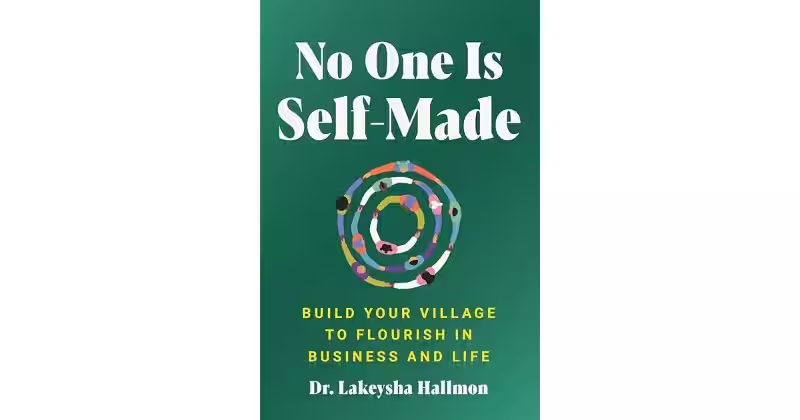
We live in a culture that often glorifies the “self-made” individual. We hear stories of entrepreneurs who started with nothing and built empires, artists who single-handedly revolutionized their fields, and athletes who defied all odds through sheer grit and determination. These narratives, while inspiring on the surface, often paint a picture of solitary achievement, implying that success is a product of independent will and relentless personal effort. However, this widely held belief often overlooks a fundamental truth, a truth that is profoundly explored in the book No One Is Self-Made: that every single one of us, regardless of our accomplishments, is deeply interwoven with a tapestry of influences, support systems, and inherited advantages.
From the moment we are born, we are beneficiaries. We are nurtured by parents, educated by teachers, and shaped by the societies we inhabit. We benefit from the accumulated knowledge of generations, the infrastructure built by countless hands, and the ethical frameworks established by those who came before us. To believe we are truly “self-made” is to engage in a form of self-deception, a denial of the vast network of human connection and historical legacy that underpins our very existence. The journey of life is not a solo expedition; it is a collaborative venture, even if we don’t always consciously acknowledge it.
Religion: A Foundation of Interdependence
The concept that No One Is Self-Made resonates deeply within the core tenets of many religious traditions. These faiths, in their very essence, often highlight our inherent dependence, not just on each other, but on a higher power or a divine order. They speak of a creation narrative, a universal origin that predates any individual’s existence, suggesting that our lives are not accidental but part of a grander design. This perspective directly challenges the notion of the solitary achiever, instead emphasizing humility and gratitude for the gifts received.
Consider the concept of grace in Christianity, the idea of divine favor that is freely given and not earned. This is a powerful testament to the fact that our spiritual well-being, and often our material blessings, are not solely the result of our own striving but are bestowed upon us. Similarly, in Buddhism, the doctrine of dependent origination (pratītyasamutpāda) illustrates how all phenomena arise in dependence on other phenomena. This interconnectedness is a cornerstone of Buddhist philosophy, a constant reminder that no one is self-made in the truest sense. Even the most enlightened beings are seen as products of their karma and the teachings passed down through a lineage of masters.
Religious communities themselves are prime examples of how interdependence fuels growth and resilience. Think about the early Christian church, where believers shared their resources, supported each other through persecution, and collectively spread their message. This was not the work of a few exceptional individuals acting in isolation; it was a movement built on mutual aid and shared purpose. The very act of communal worship, prayer meetings, and charitable endeavors underscores the principle that no one is self-made, but rather that we thrive and flourish when we are part of something larger than ourselves.
In Judaism, the concept of tikkun olam (repairing the world) emphasizes our collective responsibility to improve society. This isn’t a task for individuals to tackle alone; it requires the concerted efforts of the entire community. Similarly, Islamic teachings on zakat (charity) are not merely acts of altruism but are considered a fundamental pillar of the faith, reinforcing the idea that the wealth of the affluent is, in part, a trust held for the benefit of the less fortunate. These religious frameworks, by their very structure and purpose, actively dismantle the myth of the self-made person, promoting a vision of humanity as a deeply interconnected and mutually supportive entity.
Beyond the Individual: The Gifts We Inherit
The insights from No One Is Self-Made extend to understanding the unearned advantages we receive. This isn’t just about material wealth or social standing, though those are significant factors. It encompasses the language we speak, the cultural norms we absorb, and the very genetic makeup we inherit from our ancestors. Our parents provided us with a foundation, our societies offered us opportunities (or limitations), and the accumulated knowledge of humanity served as our intellectual inheritance.
Imagine a scientist developing a groundbreaking cure for a disease. While their individual brilliance and hard work are undeniable, they stand on the shoulders of giants. They utilize established scientific principles, benefit from the research of countless predecessors, and are educated in institutions built and maintained by others. To attribute their success solely to their own efforts would be a disservice to the rich intellectual legacy that enabled their discovery. This is why the message of No One Is Self-Made is so crucial; it encourages us to acknowledge these foundational elements and express genuine gratitude for the vast, often invisible, support system that allows us to reach our potential.
The persistent narrative of the “self-made” individual can foster a sense of isolation and unhealthy competition. It can lead to feelings of inadequacy for those who struggle, as if their difficulties are a personal failing rather than a consequence of complex societal factors and the inherent challenges of life. Recognizing that no one is self-made can be liberating. It allows us to be more compassionate towards ourselves and others, understanding that success and struggle are often shaped by forces beyond our immediate control.
Furthermore, this understanding can lead to a more collaborative and empathetic approach to life. When we acknowledge our interdependence, we are more likely to extend a helping hand, to share our resources, and to advocate for systems that create more equitable opportunities for everyone. The book No One Is Self-Made serves as a powerful reminder that our individual journeys are inextricably linked to the journeys of others, and that true fulfillment often lies in recognizing and nurturing these connections, much like the interconnectedness emphasized in spiritual and religious traditions.
Embracing Gratitude and Shared Responsibility
Ultimately, the truth that No One Is Self-Made invites us to cultivate a profound sense of gratitude. Gratitude for the sacrifices of our ancestors, for the support of our communities, for the knowledge we inherit, and for the opportunities we are given. This gratitude, in turn, can fuel a sense of shared responsibility. If we are not solely responsible for our own success, then we also have a role to play in the well-being and advancement of others.
Religion, by its nature, often provides a framework for this gratitude and responsibility. It encourages us to look beyond our immediate needs and desires, to acknowledge our place within a larger cosmos, and to act with kindness and compassion towards our fellow human beings. The message that no one is self-made is not a diminishment of individual effort, but rather an elevation of the human spirit, highlighting our capacity for connection, our shared humanity, and the beautiful, intricate web of existence that sustains us all.
Frequently Asked Questions: No One Is Self-Made and Religion
Is the book “No One Is Self-Made” about religion?
No, the book “No One Is Self-Made” is not primarily about religion. Its focus is on the interconnectedness of individuals and society, exploring how external factors, relationships, and societal structures contribute to our achievements and identities, rather than a religious framework.
Does the book discuss religious perspectives on individual achievement?
While the book doesn’t center on religious doctrines, it may touch upon how different cultural and societal norms, which are often influenced by religion, shape our understanding of success and individual agency. However, the core argument is based on sociological and psychological principles.
Can understanding the book’s message help in discussing religion and self-reliance?
Yes, the book’s central thesis that no one is truly self-made can offer a valuable lens through which to examine concepts of individual responsibility and divine intervention often discussed in religious contexts. It encourages a broader perspective on how external forces, including potentially faith and community, play a role in life paths.
Does the book argue against any religious beliefs regarding creation or destiny?
The book does not engage in theological debates or aim to disprove religious beliefs. Its arguments are secular and focus on observable societal influences and the inherent interdependence of human beings, regardless of their religious affiliations or lack thereof.
How does the interconnectedness discussed in the book relate to religious community?
The book’s emphasis on interdependence can resonate with the concept of religious community, where shared faith, support systems, and collective action are often integral. It highlights how belonging to groups, whether secular or religious, is fundamental to individual development and success.