The book of Daniel, nestled within the Old Testament, stands as a compelling testament to faith amidst adversity. More than just a collection of ancient tales, it offers profound revelations that have shaped religious thought and practice for millennia. Its narratives of courage, divine intervention, and prophetic visions continue to resonate deeply, providing guidance, hope, and a framework for understanding the unfolding of history through a spiritual lens. For believers and scholars alike, the Daniel revelations offer a rich tapestry of interwoven themes, from the personal struggles of a faithful exile to sweeping cosmic pronouncements about the future.
The enduring power of Daniel’s message lies in its ability to speak to the human condition across different eras. Whether confronting the pressures of assimilation in a foreign land or pondering the grand sweep of empires and divine sovereignty, the book empowers readers to find meaning and purpose in their own lives. It’s a journey into the heart of faith, demonstrating that even in the face of overwhelming odds, divine truth and ultimate justice prevail. This article will explore the core revelations within the book of Daniel, examining their historical context, their theological significance, and their continuing impact on religious understanding and practice today.
One of the most striking aspects of Daniel’s revelations involves his prophetic visions concerning the rise and fall of empires. These visions, often presented through vivid imagery and symbolism, paint a picture of history unfolding according to a divine plan. Daniel’s interpretation of these visions offers a theological perspective on political power, emphasizing that earthly kingdoms are ultimately subject to a higher, eternal authority. This understanding provides a crucial counterpoint to the often overwhelming power of secular rulers, offering solace and a sense of ultimate victory to the faithful.
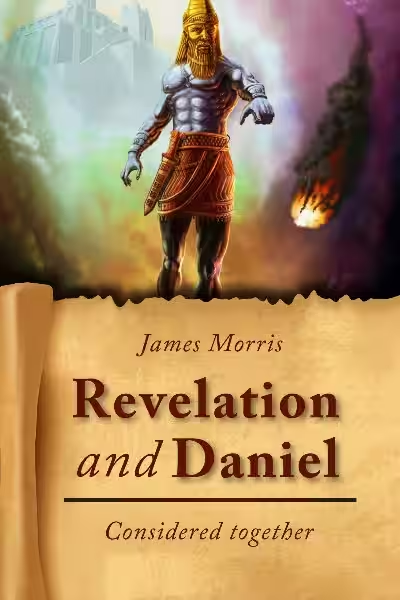
Consider Daniel’s famous vision of the great statue in chapter two. This colossal image, with its head of gold, chest of silver, belly and thighs of bronze, legs of iron, and feet of iron mixed with clay, represents a succession of world empires. Nebuchadnezzar, the Babylonian king, saw this statue in a dream, and it was Daniel who, through divine revelation, not only interpreted the dream but also revealed its content to the king. The Daniel revelations here highlight the transient nature of earthly power. The gold of Babylon would give way to the silver of the Medes and Persians, followed by the bronze of the Greeks, and finally the iron of Rome. The mixed feet, however, signify a division and weakness that would plague the final empire, a state that eventually gives way to something entirely new – the Kingdom of God. This prophetic timeline has been a cornerstone for interpreting historical events and anticipating future developments within religious frameworks.
This concept of divinely ordained succession and eventual replacement of human empires by a divine kingdom is a recurring theme throughout the Daniel revelations. The book doesn’t just predict the fall of empires; it points towards the establishment of a permanent, unshakeable kingdom that will supersede all others. This promise offers immense hope to those who feel marginalized or oppressed by prevailing powers. It assures them that their faith is not in vain, and that a future of righteousness and justice, governed by God, is not merely a pious wish but a prophetic certainty. This underlying message of divine sovereignty over all earthly powers provides a foundational element for understanding the religious worldview presented in Daniel.
The Ram and the He-Goat: A Cosmic Battle
Beyond the grand sweep of empires, Daniel also receives more specific prophetic visions that delve into what appears to be a cosmic battle for influence and dominion. The vision of the ram and the he-goat in chapter eight is a prime example, detailing a conflict between symbolic animals that represent powerful nations and their leaders. The Daniel revelations here use rich symbolism to communicate complex geopolitical and theological realities, offering a glimpse into the unseen forces at play in human history. Understanding these visions requires careful attention to the symbolic language employed, which has been the subject of extensive theological and historical interpretation.
The ram, with its two horns, is interpreted as the kings of Media and Persia. The fierce he-goat with its notable horn represents the kingdom of Greece, and its breaking signifies the rise of Alexander the Great. The shattering of this horn and the emergence of four horns from its place represent the division of the Greek empire among Alexander’s generals. This intricate prophecy, detailed in the Daniel revelations, demonstrates a remarkable accuracy in foretelling historical events with striking precision. It underscores the idea that even the seemingly chaotic shifts of power on the world stage are part of a larger, divinely orchestrated narrative. This provides believers with a profound sense of divine order in a world that often appears to be in disarray.
The implications of these prophetic battles extend beyond mere historical record. They speak to a spiritual warfare that underpins earthly conflicts. The Daniel revelations suggest that the struggles for power between nations are not simply the result of human ambition but are intertwined with spiritual forces. This understanding can be deeply comforting for individuals facing personal struggles or societal injustices; it implies that there is a higher purpose at play, and that divine intervention is a constant factor. The ultimate triumph of God’s kingdom, as foreshadowed in these visions, offers a powerful message of endurance and ultimate victory for the faithful.
The Seventy Weeks: A Prophetic Calendar
Perhaps the most discussed and debated of Daniel’s revelations are the seventy weeks of years detailed in chapter nine. This prophecy provides a remarkably precise timeline, dividing history into distinct periods leading up to a significant future event. The intricate calculations and the detailed breakdown of these weeks have been a focal point for religious scholars seeking to understand God’s timing and purpose in history, particularly concerning the coming of a Messiah. The precision of this prophecy is often cited as evidence of its divine origin, offering a divine roadmap for understanding the unfolding of God’s plan.
The prophecy begins with a decree to restore and build Jerusalem and outlines a period of sixty-nine weeks, after which an anointed one (often interpreted as the Messiah) will be cut off. The seventieth week is then set apart, often understood as a period of covenant confirmation and subsequent desolation. The Daniel revelations here offer a profound insight into divine timing and the covenantal relationship between God and his people. The meticulous nature of this prophecy suggests that God has a specific and detailed plan for human history, with key moments marked out in advance. This can instill a deep sense of assurance and anticipation for believers, knowing that God is actively working out his purposes.
The interpretation of these seventy weeks has been a cornerstone of eschatological (end-times) study within many religious traditions. While the exact timing and fulfillment of the final week remain subjects of ongoing discussion and diverse theological viewpoints, the prophecy itself offers a framework for understanding the flow of redemptive history. It encourages believers to remain vigilant and to discern the signs of the times, trusting that God’s promises will ultimately be fulfilled. This prophetic calendar, revealed through Daniel, serves as a powerful reminder that history is not random but is guided by a divine hand towards a conclusive and glorious end.
Faith and Resilience in the Face of Persecution
Beyond grand prophetic visions, the book of Daniel also offers deeply personal and relatable narratives of faith, courage, and resilience in the face of extreme persecution. The stories of Daniel and his three friends – Shadrach, Meshach, and Abednego – living in Babylonian exile serve as powerful examples of how to maintain one’s religious convictions when surrounded by opposing ideologies and oppressive rulers. The Daniel revelations here are not just about future events but are also about present-day faithfulness and the strength of character that comes from unwavering trust in God.
The iconic story of Shadrach, Meshach, and Abednego refusing to bow down to Nebuchadnezzar’s golden image is a vivid illustration of principled defiance. Faced with the threat of a fiery furnace, they declared their unwavering allegiance to their God, stating, “If it is so, our God whom we serve is able to deliver us from the furnace of blazing fire; and he will deliver us out of your hand. But if not, be it known to you, O king, that we will not serve your gods and we will not worship the golden image that you have set up.” This courageous stand, as presented in the Daniel revelations, demonstrates that true faith is not merely a passive belief but an active commitment that can lead to extraordinary acts of bravery. Their miraculous deliverance from the furnace, where they were found unharmed, served as a powerful testament to the power of God and the consequences of defiance against divine will.
Daniel himself faces his own trials, particularly his experience in the lions’ den. Accused of violating a royal decree against praying to any god or human for thirty days, Daniel deliberately continued his prayer life, knowing the severe penalty. The Daniel revelations emphasize his steadfastness: “When Daniel knew that the document had been signed, he went to his house where he had windows in his upper room that opened toward Jerusalem. He knelt down on his knees three times a day and prayed and gave thanks before his God, as he had done previously.” His subsequent miraculous survival in the lions’ den, again attributed to divine intervention, reinforces the message that fidelity to God can lead to divine protection even in the most dire circumstances. These narratives provide immense inspiration and practical guidance for individuals navigating their own challenges and seeking to live out their faith authentically.
Living Out Faith in a Hostile World
The experiences of Daniel and his friends offer invaluable lessons for how to live out one’s faith in a world that may not always be welcoming or understanding. Their time in Babylon required them to navigate a culture that was vastly different from their own, yet they managed to maintain their religious identity and integrity. The Daniel revelations highlight their commitment to religious practices, such as dietary laws and prayer, even when it presented challenges. This underscores the importance of personal discipline and intentionality in maintaining spiritual well-being amidst external pressures. They did not assimilate into the Babylonian culture to the point of compromising their core beliefs.
A key element of their success was their ability to discern between what was permissible and what was not, according to their religious convictions. When presented with the king’s rich food, Daniel asked for a period of testing with vegetables and water, demonstrating a thoughtful approach to maintaining their purity. This ability to make wise choices, even in small matters, allowed them to preserve their spiritual strength. The Daniel revelations implicitly teach that faithfulness in the small things prepares one for greater challenges. It’s about making conscious decisions to honor God in every aspect of life, from personal diet to public prayer.
Ultimately, the stories in Daniel are a testament to the transformative power of divine faithfulness. They show that when individuals choose to trust and obey God, even when it’s difficult, God is able to work through them and deliver them. This message of hope and assurance is central to the Daniel revelations and continues to resonate with people of faith today, encouraging them to stand firm in their convictions and to believe in God’s ultimate providence and deliverance.
The Enduring Legacy of Daniel’s Revelations
The book of Daniel, through its intricate prophecies and compelling narratives, has exerted a profound and lasting influence on religious thought and practice. The Daniel revelations have provided a framework for understanding history, a source of comfort in times of distress, and a beacon of hope for the future. Its themes of divine sovereignty, the ultimate triumph of God’s kingdom, and the importance of unwavering faith continue to be explored, debated, and applied within various religious traditions. The enduring impact of Daniel’s visions speaks to their timeless truths and their ability to connect with the deepest aspects of the human spiritual journey.
The prophetic elements within Daniel have been instrumental in shaping eschatological interpretations across centuries. The detailed timelines and symbolic imagery have spurred countless theological discussions about the end times, the nature of the Messiah, and the unfolding of God’s redemptive plan. While interpretations may vary, the very existence of these Daniel revelations has encouraged a forward-looking faith, one that anticipates a future of ultimate justice, peace, and divine rule. This prophetic perspective provides believers with a sense of purpose and direction, encouraging them to live in light of eternity.
Furthermore, the personal accounts of faithfulness and resilience in Daniel serve as powerful ethical and spiritual models. The courage of Shadrach, Meshach, and Abednego, and the steadfastness of Daniel himself, offer practical examples of how to navigate life’s challenges with integrity and divine reliance. These stories remind readers that their faith is not just about understanding prophecies but about embodying virtues like courage, obedience, and unwavering trust in God. The Daniel revelations, therefore, offer a holistic message, encompassing both grand cosmic designs and the intimate reality of living a faithful life in the here and now, leaving an indelible mark on the religious landscape.
Frequently Asked Questions: Daniel, Revelations, and Religion
What are the Book of Daniel and the Book of Revelation?
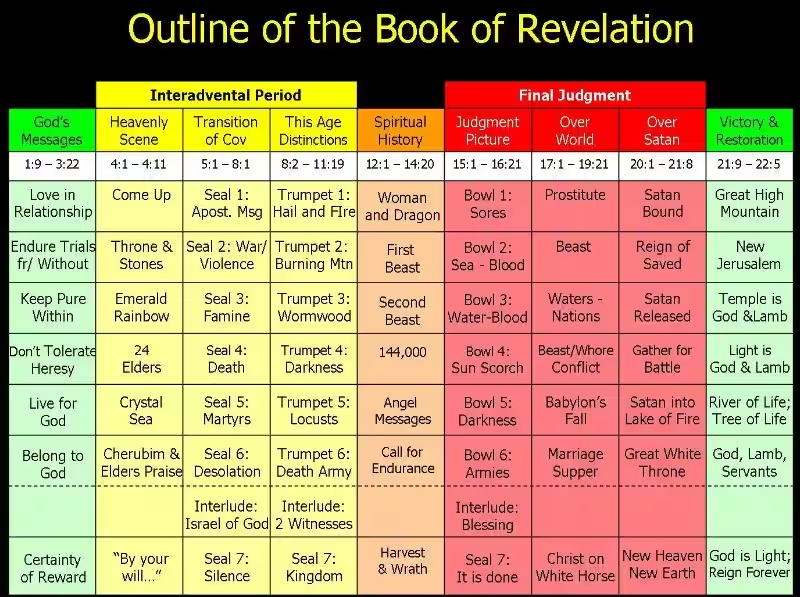
The Book of Daniel and the Book of Revelation are two distinct books found in the Christian Old and New Testaments, respectively. Daniel is an Old Testament prophetic book that tells the story of Daniel and his companions in Babylonian exile, filled with visions and prophecies. Revelation, the final book of the New Testament, is an apocalyptic text attributed to the Apostle John, containing symbolic visions of the end times and God’s ultimate triumph.
How are Daniel and Revelation interpreted within different religious traditions?
Interpretations of Daniel and Revelation vary significantly across religious traditions and even within them.
Christianity: Mainstream Christian denominations generally interpret these books as containing symbolic prophecies about future events, the coming of Christ, and the establishment of God’s kingdom. There are different schools of interpretation, including preterist (events fulfilled in the past), historicist (events unfolding throughout church history), futurist (events primarily in the future, especially the end times), and idealist (symbolic representation of spiritual truths).
Judaism: The Book of Daniel is part of the Hebrew Bible (Ketuvim). While it contains prophetic elements, its interpretation within Judaism often focuses on themes of divine sovereignty, faithfulness in exile, and the eventual restoration of Israel, rather than specific eschatological predictions in the same way as Christian interpretations of Revelation. The Book of Revelation is not part of the Jewish canon.
Other Religions: Generally, these books are not considered canonical or authoritative in religions outside of Judaism and Christianity. Their specific theological content and prophecies are tied to the beliefs and history of these two faiths.
What are some common themes found in Daniel and Revelation?
Both books explore profound theological and eschatological themes, including:
God’s Sovereignty: The ultimate power and control of God over history, nations, and even the future.
Persecution and Faithfulness: The endurance of God’s people through periods of oppression and their unwavering commitment to their faith.
Judgment and Vindication: Divine judgment on evil and the eventual vindication and triumph of God and His followers.
The Coming of the Messiah/Kingdom of God: Prophecies pointing towards a future divine intervention and the establishment of God’s eternal kingdom.
Symbolism and Vision: Both books heavily utilize symbolic language, imagery, and visions to convey their messages, often requiring careful interpretation.
Do these books predict specific historical events?
The extent to which Daniel and Revelation predict specific historical events is a major point of interpretive debate.
Daniel: Some chapters in Daniel are seen by many as having historical antecedents, particularly those dealing with the Babylonian and Persian empires. However, later visions are often interpreted as referring to future empires (like Greece and Rome) or even events in the distant future.
Revelation: This book is rich with symbolic imagery that, throughout history, has been applied to various contemporary events by different interpreters. Some view its prophecies as primarily fulfilled in the first century, while others see them pointing to future events leading up to the Second Coming of Christ.
How has the interpretation of these books influenced religious thought and practice?
The interpretations of Daniel and Revelation have profoundly shaped religious thought and practice in several ways:
Eschatology: They have been central to the development of Christian eschatology (the study of end times), influencing beliefs about the millennium, the Antichrist, and the final judgment.
Apocalyptic Movements: Throughout history, interpretations of these books have fueled various religious movements, some calling for separation from the world and others actively engaging in evangelism or social reform in anticipation of future events.
Art and Literature: The vivid imagery and dramatic narratives in Daniel and Revelation have inspired countless works of art, music, and literature, shaping cultural perceptions of religious themes.
Theological Devotion: For many believers, these books offer comfort, hope, and a framework for understanding God’s ultimate plan for humanity and the universe, encouraging perseverance in faith during difficult times.