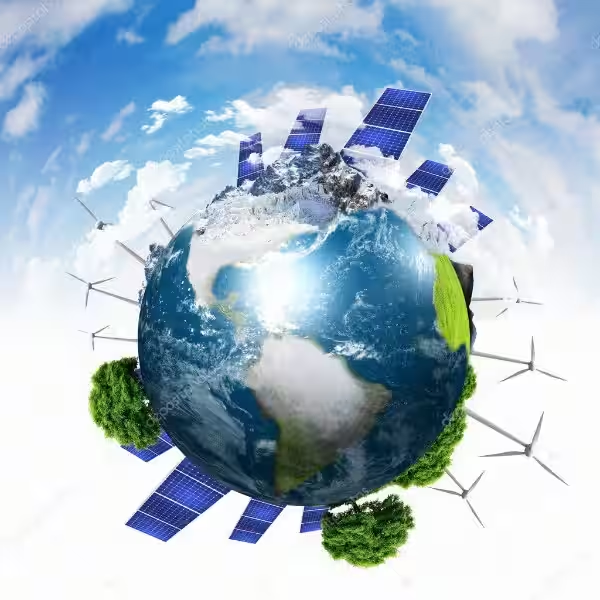
The concept of “planet energy” isn’t a term you’ll find in most scientific textbooks, yet it resonates deeply within the human experience. Imagine the Earth not just as a sphere of rock and water, but as a vibrant, living entity, pulsating with an invisible force. This is the essence of planet energy – the subtle, life-affirming currents that flow through our world, influencing everything from the growth of a single blade of grass to the collective mood of a community. It’s the hum of existence, the silent song of the cosmos that we often feel but struggle to articulate.
Think of it like the electricity that powers our homes. We don’t see the electrons flowing through the wires, but we experience their effect when we flip a switch. Similarly, planet energy is an unseen force, a universal lifeblood that connects us all. Some believe this energy is generated by the Earth’s core, others by the sun’s rays, or even by the vast interconnectedness of all living things. Regardless of its origin, its presence is undeniable, manifesting as seasons that bring renewal, the calming rhythm of ocean tides, and the sheer vitality that bursts forth from nature. Understanding planet energy opens a door to a deeper appreciation of our world and our place within it.
Whispers of the Divine: Religion’s Encounter with Planet Energy
For millennia, religions across the globe have grappled with the profound forces that shape our existence, often interpreting these as manifestations of the divine. The concept of planet energy, in its myriad forms, is woven into the very fabric of spiritual understanding. Many faiths recognize a sacredness in the natural world, seeing it as God’s creation and a conduit for divine connection. This isn’t just about admiring a sunset; it’s about perceiving the inherent spiritual power that emanates from the Earth itself.
Ancient cultures, in particular, had a profound reverence for the energetic pulse of the planet. They observed the cycles of the moon, the fertility of the soil, and the raw power of storms, attributing these phenomena to supernatural forces or deities. These observations formed the bedrock of their spiritual practices, rituals, and creation myths. For example, many indigenous traditions speak of Mother Earth as a living goddess, imbued with immense nurturing and life-giving planet energy. This perspective fosters a deep respect for the environment, recognizing that harming the Earth is akin to harming the divine itself.
The Earth as Sacred Ground: Creation and Sustenance
Many religious narratives begin with the creation of the Earth, imbuing it with an initial potent planet energy that set life in motion. These stories often describe a divine hand shaping the land, breathing life into its inhabitants, and establishing the natural laws that govern the universe. This foundational energy is seen as the primordial force from which all existence springs.
Consider the agricultural societies whose religions were deeply intertwined with the fertility of the land. Festivals celebrating the harvest were not merely about gratitude for food, but about acknowledging and honoring the life-sustaining planet energy that made it all possible. The planting and reaping of crops were seen as sacred acts, participating in the divine cycle of growth and renewal. This deeply ingrained understanding of the Earth’s energetic contribution shaped their entire worldview, emphasizing a harmonious relationship with nature.
Rituals and Reverence: Connecting with Planetary Forces
The way humans have sought to connect with and honor planet energy is through diverse and often beautiful rituals. These acts are designed to align individuals and communities with the natural rhythms and spiritual currents of the Earth. Whether it’s a prayer whispered to the wind, a pilgrimage to a sacred mountain, or a communal dance under the full moon, these rituals are about attuning ourselves to a larger energetic field.
Think of the ancient Celts and their reverence for sacred groves and standing stones, believed to be focal points of planet energy. Their ceremonies, often timed with solstices and equinoxes, were opportunities to tap into this primal power for healing, guidance, and spiritual insight. Similarly, many Buddhist traditions incorporate practices like walking meditation in natural settings, encouraging practitioners to feel the ground beneath their feet and the energy of the surrounding environment. This conscious engagement fosters a sense of interconnectedness and belonging.
Modern Interpretations: Planet Energy in Contemporary Spirituality
In our increasingly secularized world, the concept of planet energy is experiencing a resurgence, often interpreted through lenses that blend ancient wisdom with modern scientific understanding and personal exploration. Many individuals are seeking spiritual fulfillment outside traditional religious structures, finding profound meaning in the observable energies of the Earth.
This contemporary interest goes beyond mere environmentalism; it’s about a felt sense of connection to a living planet. People are exploring practices like ecotherapy, spending time in nature to recharge their own energetic batteries and gain clarity. Others are drawn to concepts like ley lines, invisible energetic pathways said to crisscross the globe, and sacred geometry, the idea that the universe is built on harmonious mathematical patterns that reflect its underlying energy. The goal is often personal empowerment and a deeper understanding of the interconnectedness of all things.
Personal Well-being and Energetic Balance
Many people today are discovering that consciously engaging with planet energy can significantly enhance their personal well-being. This isn’t about dogma; it’s about practical application of a spiritual understanding of our environment. Spending time in nature, for instance, is increasingly recognized for its ability to reduce stress, boost mood, and promote a sense of calm.
Imagine feeling drained and overwhelmed by the demands of modern life. A simple walk in a forest, feeling the ground beneath your feet and breathing in the fresh air, can act as a powerful energetic reset. This experience is a direct interaction with the restorative planet energy that nature offers freely. Many are also finding benefit in practices like grounding, literally connecting with the Earth’s energy by walking barefoot, which is believed to harmonize our own electrical field with that of the planet. This can lead to a feeling of stability, clarity, and increased vitality.
The Future of Belief: Integrating Planet Energy
As we move forward, the understanding and integration of planet energy into our spiritual and personal lives will likely continue to grow. We are witnessing a shift towards a more holistic worldview, one that recognizes the profound impact of our environment on our inner lives and spiritual well-being. This integration promises to foster a more harmonious relationship between humanity and the Earth.
The future of belief may well lie in recognizing the sacredness of our planet not as an abstract concept, but as a tangible source of life-giving planet energy. This understanding can inspire a more profound sense of responsibility towards our environment, leading to sustainable practices and a deeper appreciation of the natural world. By embracing the invisible currents that connect us, we can cultivate a richer, more meaningful existence for ourselves and for generations to come.
Planet Energy is a fictional concept used within this context to represent a collective spiritual or energetic force associated with the planet Earth. It is not a scientifically recognized phenomenon.
Does Planet Energy have any religious significance?
In some belief systems, the Earth itself or a life force within it is considered sacred or divine, which might be analogous to the concept of Planet Energy. These beliefs often involve reverence for nature and the interconnectedness of all living things.
Are there specific religions that worship Planet Energy?
There are no major established religions that have a deity or core doctrine explicitly named “Planet Energy.” However, many indigenous spiritual traditions, pantheistic beliefs, and some New Age philosophies hold deep reverence for the Earth as a living entity or a source of divine energy. These traditions may view natural phenomena and the planet itself as manifestations of the sacred.
How does Planet Energy relate to religious practices?
Practices that align with the concept of Planet Energy might include environmental stewardship, rituals honoring the Earth’s cycles (like solstices or equinoxes), meditation on nature, or the belief in Earth as a source of healing or spiritual power.
Can people have different religious views on Planet Energy?
Yes, interpretations of Planet Energy or similar concepts vary widely. Some may see it as a literal spiritual force, while others might view it metaphorically as the interconnectedness of life or the vital life force of the planet. Religious and spiritual beliefs are diverse, and individuals may integrate such concepts into their existing frameworks or develop personal understandings.