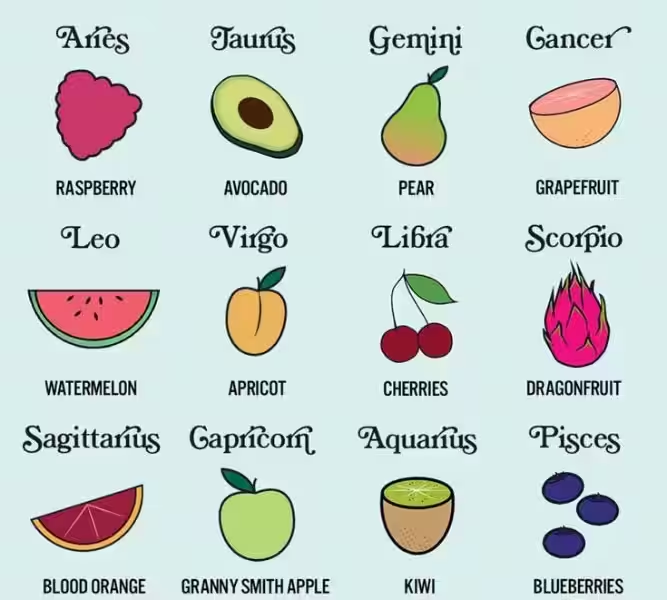
The concept of a birth fruit, a symbolic representation of a person’s birth based on the season or calendar, often intertwines with deeply held religious beliefs and practices across various cultures. While not a universally recognized term, the idea of a birth fruit resonates with the ancient human tendency to find meaning and connection in the natural world, especially as it relates to our origins and spiritual journeys. This article will explore how the notion of a birth fruit manifests in religious contexts, offering insights into its symbolism, its practical applications in traditions, and the enduring human desire to connect the earthly harvest with the divine.
For many, the understanding of a birth fruit isn’t about a literal fruit that magically appears at birth, but rather a symbolic association. Think of it like an astrological sign, but rooted in the agricultural cycles and the bounty of the earth that sustains us. This connection between our arrival in the world and the fruits available at that time has, historically and presently, found its way into spiritual narratives and practices, imbuing these natural gifts with profound significance. The very act of birth, a profound mystery and a gift of life, is often mirrored in the cyclical abundance and nourishment provided by the earth’s produce, making the concept of a birth fruit a natural extension of this observation.
The reverence for fruits and their connection to life and divinity is as old as civilization itself. Ancient agricultural societies, deeply dependent on the success of their harvests, naturally attributed spiritual significance to the crops that sustained them. The cycles of planting, growing, and reaping were not just economic activities but sacred rituals, often overseen by deities associated with fertility, abundance, and the earth. In this context, the appearance of certain fruits during specific times of the year, including the time of one’s birth, could easily be seen as a divine blessing or a sign of a particular spiritual affinity.
Consider the ancient Egyptians, who held figs in high regard, associating them with life and regeneration. The fig tree, with its continuous fruiting, was a potent symbol of immortality. Similarly, the Greeks revered grapes and pomegranates, linking them to Dionysus, the god of wine and revelry, and Persephone, the queen of the underworld, respectively. These fruits were not merely food; they were sacred offerings, woven into religious ceremonies and mythology, further solidifying their spiritual importance and potentially influencing how individuals might perceive a birth fruit associated with their own existence.
Fruits of Fertility and Divine Favor
In many agrarian societies, the harvest was intrinsically linked to the concept of fertility, both agricultural and human. The abundance of crops was seen as a direct reflection of divine favor and the land’s ability to nurture life. Therefore, specific fruits that ripened during the traditional birthing seasons were often considered particularly auspicious, carrying with them blessings of health, prosperity, and strong lineage. This belief system naturally led to the idea that a person’s birth fruit might bestow particular qualities or destinies upon them, reflecting the very properties of that fruit.
For example, in some indigenous cultures, the ripening of berries during the summer months coincided with a period of high birth rates. These sweet and nourishing berries could have been seen as a birth fruit for those born during that time, symbolizing the sweetness of life, the abundance of nature, and the vital energy of the season. Such associations provided a tangible connection between the intangible – the miracle of birth – and the visible, tangible bounty of the earth, making spiritual concepts more accessible and relatable.
Birth Fruit in Religious Symbolism and Practice
Across various religious traditions, specific fruits have been imbued with profound spiritual meaning, often serving as powerful symbols within sacred texts, rituals, and iconography. While the direct concept of a “birth fruit” might not always be explicitly stated, the symbolic weight of certain fruits during specific times of the year or in relation to birth events offers a compelling parallel. These fruits become more than just sustenance; they are carriers of divine messages and markers of spiritual significance.
The apple, for instance, carries a complex history in Judeo-Christian traditions, often associated with temptation and knowledge in the Garden of Eden. However, in other interpretations and cultural contexts, it can also symbolize love, beauty, and fertility. If one’s birth falls during the apple harvest season, this could be interpreted in various spiritual frameworks as a connection to themes of growth, the blossoming of potential, and even the ongoing cycle of life and renewal, making the apple a potential birth fruit with layered meanings.
The Pomegranate: A Symbol of Abundance and Continuity
The pomegranate, with its myriad seeds, stands out as a particularly rich symbol in several religions, most notably in Judaism and Islam. In Judaism, the pomegranate is often considered one of the seven sacred fruits of the Land of Israel, representing fertility, abundance, and righteousness. It is said to contain 613 commandments, a number that resonates deeply within Jewish law. For someone born during the pomegranate season, this birth fruit could be seen as a blessing of spiritual depth and a connection to the rich tapestry of religious observance.
In Islam, the Quran mentions pomegranates as one of the fruits of paradise, symbolizing divine creation and sustenance. The intricate structure of the fruit, with its seeds held together by a protective rind, can be interpreted as a metaphor for unity and community. A person whose birth fruit is the pomegranate might be seen as blessed with a spirit of togetherness, a deep appreciation for divine gifts, and an inherent sense of belonging within their spiritual community.
The Fig: A Fruit of Enlightenment and Divine Connection
The fig tree holds a special place in the spiritual histories of both Judaism and Islam. In Judaism, it is mentioned as one of the sacred fruits, symbolizing peace and prosperity. In Islam, the Quran opens with an oath by the fig and the olive, highlighting their blessed nature. The fig is also associated with the Prophet Muhammad, who is said to have valued its nutritious and healing properties. For an individual whose birth fruit is the fig, this could signify a connection to enlightenment, spiritual nourishment, and divine wisdom.
Imagine a person born in late summer when figs are at their peak. Their spiritual journey might be symbolically linked to the fig’s ability to ripen and offer its sweet, yielding flesh. This could translate into a life path characterized by inner peace, spiritual growth, and a deep, perhaps intuitive, connection to the divine. The soft texture and rich flavor of the fig can be seen as reflecting a gentle, nurturing spirit, blessed by the earth’s generosity.
Modern Interpretations and Personal Spiritual Journeys
While the concept of a birth fruit might seem rooted in ancient traditions, its essence continues to resonate in modern spiritual explorations and personal belief systems. In a world often disconnected from agricultural cycles, the idea of a birth fruit offers a grounding and tangible link to nature and to our own origins. It serves as a reminder that we are part of a larger, interconnected web of life, and that even the simplest of fruits can carry profound spiritual meaning.
Many individuals today, even without adherence to a specific organized religion, find personal significance in the notion of a birth fruit. They might explore the fruits that ripen during their birth month or season, researching their historical symbolism and their association with different cultures and spiritual practices. This personal quest for meaning can lead to a deeper understanding of oneself and one’s place in the world, as well as an appreciation for the natural cycles that govern life.
Finding Your Birth Fruit and Its Significance
The process of identifying one’s birth fruit can be a deeply personal and insightful journey. It doesn’t require adherence to a strict calendar or a rigid belief system. Instead, it’s about exploring the fruits that are naturally abundant during the time of your birth, considering their historical and cultural symbolism, and reflecting on how those meanings might align with your own life experiences and spiritual aspirations. This exploration can be as simple as choosing a fruit that you’ve always felt drawn to, or researching the produce that was harvestable during your birth year in your region.
For instance, if you were born in the autumn, when apples and pears are plentiful, your birth fruit might be the apple, symbolizing knowledge and vitality, or the pear, representing longevity and comfort. Consider the gentle sweetness of a ripe pear and how that might reflect a nurturing or comforting aspect of your personality. Or perhaps you were born in the spring, when berries begin to emerge. The small, vibrant berry could symbolize new beginnings, blossoming potential, and the joy of emergent life.
The Birth Fruit as a Personal Blessing
Ultimately, the concept of a birth fruit can serve as a personal blessing, a unique connection to the earth’s gifts and the spiritual currents that flow through them. It is a reminder that our arrival into this world is celebrated by nature itself, marked by the abundance and beauty of the fruits that ripen around us. By embracing the idea of a birth fruit, we can foster a deeper sense of gratitude, mindfulness, and spiritual connection to the world and to ourselves.
Think of it as a gentle nudge from the universe, a whisper in the rustling leaves and the ripening boughs. Your birth fruit is not a predetermined destiny, but a symbol, a touchstone, a reminder of the inherent goodness and richness that exist within and around you, waiting to be discovered and cherished. It is a testament to the beautiful and enduring relationship between humanity, nature, and the divine.
Frequently Asked Questions About Birth Fruit
What is “birth fruit”?
“Birth fruit” is a term that refers to a specific fruit that is associated with the month of a person’s birth. This concept is not tied to any major religious doctrine or scripture.
Is “birth fruit” a religious practice?
No, the concept of “birth fruit” is not a religious practice. It is a cultural or folkloric association, often found in some traditions or modern lifestyle interpretations, but it does not originate from or have significance within any recognized religion.
Are there religious interpretations of “birth fruit”?
There are no established or widespread religious interpretations of “birth fruit.” While individuals might personally connect certain fruits to their faith or spiritual beliefs, the idea of a specific “birth fruit” for each month does not hold religious significance in major world religions like Christianity, Islam, Judaism, Hinduism, or Buddhism.
Where does the idea of “birth fruit” come from?
The idea of “birth fruit” is generally considered a more modern concept, often seen in astrology, seasonal eating guides, or as a fun way to personalize celebrations. It is not rooted in ancient religious texts or traditions.