The human heart has always grappled with profound questions: Who are we? Why are we here? What does it mean to live a meaningful life? For billions across the globe, these existential inquiries find their answers, or at least their framework, within the realm of religion. This pursuit of understanding, this desire to connect with the divine, is as old as humanity itself. It’s a journey filled with wonder, challenge, and the constant invitation to grow. Within this spiritual landscape, good theology books serve as invaluable companions, illuminating paths, offering wisdom, and deepening our appreciation for the complexities and beauty of our faith traditions.
Whether you’re a seasoned believer seeking to articulate your convictions more clearly, a curious inquirer on the fringes of faith, or simply someone fascinated by the impact of religion on human history and culture, engaging with theological literature can be a profoundly enriching experience. These books are not merely academic exercises; they are windows into the hearts and minds of those who have wrestled with the greatest mysteries of existence, offering insights that can resonate deeply with our own personal journeys. They provide a structured way to explore doctrines, historical developments, and the practical implications of believing.
Why Engage with Theology? Beyond Mere Doctrine
The word “theology” might conjure images of dusty libraries and obscure debates, but at its core, theology is simply “the study of God” or, more broadly, the study of religious belief and practice. It’s about making sense of our faith, not just accepting it blindly, but understanding its foundations, its nuances, and its relevance to our lives today. Engaging with good theology books is about moving beyond a superficial understanding to a more robust, informed, and personal faith. It equips us with the language and concepts to articulate our beliefs, to engage in meaningful dialogue with others, and to navigate the inevitable doubts and questions that arise on any spiritual path.
Think of it like learning a new language. You can pick up a few phrases and get by, but to truly understand a culture and its people, you need to delve deeper into its grammar, its idioms, and its literature. Similarly, while a simple prayer or a basic creed can be the starting point of faith, engaging with theological texts allows us to grasp the rich tapestry of thought that has shaped religious traditions for centuries. This deeper understanding doesn’t diminish the mystery; rather, it can enhance our awe by revealing the intricate architecture of belief that has sustained so many.
Foundational Texts for a Deeper Dive
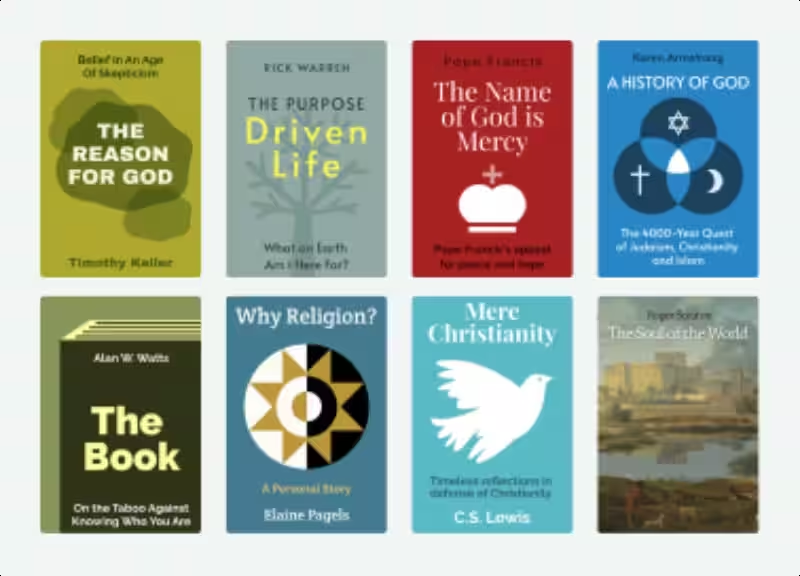
When beginning to explore the vast world of theological literature, it’s wise to start with works that offer a solid foundation. These are books that, while accessible, tackle fundamental concepts with clarity and depth. For many in the Christian tradition, N.T. Wright’s works, such as Simply Christian or The New Testament and the People of God, offer a compelling and intellectually rigorous exploration of faith’s historical context and its contemporary relevance. Wright has a remarkable ability to make complex historical and theological arguments understandable, connecting ancient texts to modern life with engaging prose. Another classic, C.S. Lewis’s Mere Christianity, remains a perennial favorite for its clear articulation of core Christian doctrines, presented in a logical and persuasive manner that has resonated with countless readers for generations.
Beyond these widely recognized figures, exploring the historical roots of theological thought is also incredibly beneficial. Works that delve into the early church fathers or the reformers provide crucial context for understanding how Christian beliefs have evolved. Similarly, in other religious traditions, foundational texts and commentaries that explain their core tenets are essential starting points. For instance, in Islam, understanding the Quran and the Hadith, along with scholarly interpretations, is paramount. For those interested in Judaism, engaging with the Torah and its commentaries, such as the Talmud, offers deep insights. The key is to find authors and texts that present these complex ideas in a way that sparks curiosity and fosters understanding, rather than overwhelming the reader.
Navigating Different Traditions and Perspectives
The beauty of religious study lies in its diversity. Exploring good theology books from various traditions can broaden our understanding of the human quest for meaning and the myriad ways people have sought to connect with the divine. Consider the profound philosophical and spiritual insights found in the Buddhist tradition, often explored in works like Thich Nhat Hanh’s The Heart of the Buddha’s Teaching. This book, like many in Buddhist literature, emphasizes mindfulness, compassion, and the interconnectedness of all things, offering a perspective that often complements or challenges Western theological frameworks. In Hinduism, texts like the Bhagavad Gita, accompanied by insightful commentaries, offer a rich tapestry of philosophical and devotional teachings that have shaped a civilization.
It’s also crucial to recognize that within any single religious tradition, there exists a spectrum of theological thought. Some books might focus on systematic theology, which aims to organize beliefs into a coherent system. Others might be historical, tracing the development of doctrines over time. Still others are practical or devotional, focusing on how to live out one’s faith. For example, within Christianity, someone interested in the social justice implications of faith might find Karen Armstrong’s The Great Transformation: The Beginning of Our Religious Traditions invaluable for its sweeping historical overview, while another might gravitate towards Gustavo Gutiérrez’s A Theology of Liberation for a more focused approach on faith and social action. The diversity of these approaches highlights that theology is not a monolithic entity but a dynamic and evolving field.
The Practical Impact: Theology in Everyday Life
Theology isn’t just an academic or intellectual pursuit; it has a profound and tangible impact on how we live our lives. Understanding the theological underpinnings of our faith can inform our ethical decisions, shape our relationships, and provide a framework for confronting suffering and injustice. For instance, a deep understanding of Christian concepts like grace and forgiveness can empower individuals to extend compassion to others and to themselves, transforming personal struggles and interpersonal conflicts. Likewise, the Buddhist emphasis on impermanence can offer solace in times of loss, helping us to accept change and find peace amidst life’s inevitable flux.
Exploring good theology books can also empower us to be more active participants in our communities and in the world. When we understand the theological motivations behind acts of service, social justice movements, or charitable giving, our engagement becomes more purposeful and impactful. For example, understanding the biblical mandate to care for the poor, as articulated in books that explore prophetic traditions, can inspire concrete action. Similarly, the Islamic concept of zakat (charity) is not merely an act of generosity but a theological imperative, underscoring the importance of wealth redistribution and social responsibility. These theological insights provide the ‘why’ behind the ‘what’ of religious practice.
Building a Personal Library of Wisdom
Creating a personal library of theological works is a journey of discovery, one that should be tailored to your individual interests and spiritual path. Don’t feel pressured to read every major theological text ever written. Instead, start with authors and topics that genuinely pique your curiosity. Look for books that are recommended by trusted spiritual leaders, friends, or online communities. Websites and journals dedicated to religious scholarship often feature reviews and recommendations of good theology books that can guide your selections. Consider starting with introductory texts before diving into more specialized or challenging works.
As you build your collection, remember that reading theology is an active process. Take notes, highlight passages that resonate with you, and most importantly, discuss what you’re reading with others. Engaging in conversations about theological ideas can solidify your understanding, expose you to new perspectives, and deepen your appreciation for the material. A well-curated collection of theological resources can become a lifelong source of inspiration, guidance, and intellectual stimulation, enriching your understanding of your faith and your place in the world.
Continuing the Conversation: Dialogue and Discernment
Theological study is rarely a solitary endeavor. It thrives on dialogue, discussion, and the willingness to engage with different viewpoints. When you encounter a challenging idea in a theology book, don’t dismiss it immediately. Instead, try to understand the author’s perspective and the reasoning behind their argument. Seek out other books or articles that offer alternative viewpoints or engage in critical analysis of the topic. This process of discernment is crucial for developing a mature and nuanced understanding of religious belief.
Ultimately, the pursuit of theological understanding is a lifelong journey. The good theology books we encounter along the way are not just sources of information; they are catalysts for transformation. They challenge us to think more deeply, to question more honestly, and to live more fully in accordance with our deepest convictions. By engaging with these profound works, we can not only deepen our personal faith but also contribute to a more informed, compassionate, and understanding world, one where religion continues to inspire and guide humanity in its endless quest for meaning.
This section addresses common questions about theology books, religion, and how to approach theological study.
What is theology?
Theology is the systematic study of the nature of the divine and, more broadly, of religious belief. It often involves examining religious texts, traditions, and doctrines to understand God, humanity’s relationship with God, and the meaning of existence.
What makes a good theology book?
A good theology book is typically one that is well-researched, clearly written, intellectually rigorous, and offers insightful perspectives. It should engage with relevant theological concepts and traditions faithfully, while also being accessible to its intended audience. The best books often encourage critical thinking and personal reflection.
Where should I start if I’m new to theology?
If you’re new to theology, it’s often recommended to start with introductory texts that provide a broad overview of key concepts and historical developments. Look for books that explain complex ideas in an accessible way. Reading works by respected theologians who are known for their clarity and foundational contributions can be a good starting point.
Are there specific theological traditions or denominations that have “better” books?
The concept of “better” is subjective and depends on your personal interests and theological journey. Different traditions have rich bodies of theological literature. It’s valuable to explore books from various perspectives to gain a comprehensive understanding, rather than focusing solely on one tradition.
How can I find reliable theology books?
You can find reliable theology books through several avenues:
Recommendations from trusted sources: Ask professors, pastors, or theologians you respect for their favorite or most influential books.
University and seminary syllabi: These often list essential readings for theological study.
Reputable publishers: Look for books from academic presses or well-known religious publishers that have a track record of quality.
Book reviews: Consult reviews in academic journals or reputable religious publications.
Online resources: Websites dedicated to theological study or book recommendations from established scholars can be helpful.
Do I need to be religious to read theology books?
No, you do not need to be religious to read theology books. Theology can be studied from an academic or philosophical perspective, exploring its historical, cultural, and intellectual impact. Many people engage with theology out of curiosity, for interfaith dialogue, or to better understand different belief systems.
How can I approach reading theology critically?
To approach theology critically, consider the author’s background, the historical context of the text, the underlying assumptions, and the arguments presented. Ask yourself:
What is the author’s main point?
What evidence or reasoning is used to support their claims?
Are there alternative interpretations or perspectives?
How does this text relate to other theological ideas or traditions?
Does it resonate with your own understanding or experience?
Engaging in discussion or seeking different viewpoints can also enhance critical engagement.