The Unseen Messengers: More Than Just Pretty Wings
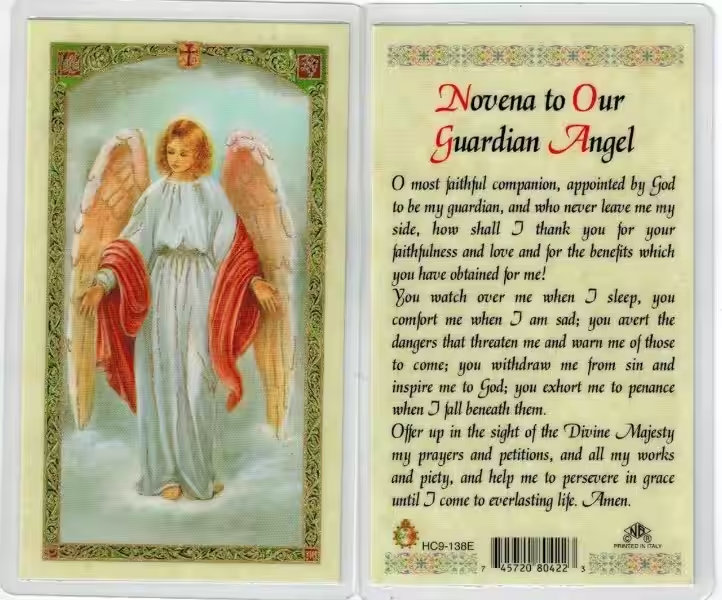
When we hear the word “angel,” our minds often conjure images of cherubic figures with fluffy white wings, harps, and gentle smiles. This popular depiction, heavily influenced by Renaissance art and later cultural interpretations, is a far cry from the awe-inspiring and sometimes terrifying beings described in the Bible. Understanding biblical angel descriptions isn’t just an academic exercise; it’s a journey into the very nature of the divine and its interaction with humanity. These celestial beings, far from being mere decorative elements in religious narratives, are active participants in God’s plan, acting as messengers, warriors, and guardians, their very presence often signaling a moment of immense spiritual significance.
The Bible presents angels not as ethereal spirits detached from reality, but as powerful entities with distinct forms and roles. They are described as celestial beings created by God, distinct from humanity and sharing in His divine nature. Their primary function is often to convey God’s messages to humans, hence the very meaning of the word “angel” (from the Greek angelos and Hebrew mal’akh, both meaning “messenger”). However, their descriptions go far beyond simple pronouncements of divine will. From the fiery sword-wielding cherubim guarding Eden to the four-faced beings described in Ezekiel’s vision, the biblical accounts offer a spectrum of imagery that emphasizes their power, holiness, and direct connection to the Almighty.
Seraphim: The Fiery Ones of God’s Throne
Perhaps one of the most striking biblical angel descriptions comes from the prophet Isaiah in chapter 6. He describes seeing the Lord seated on a lofty throne, and attending Him were seraphim. These beings are depicted with six wings: with two they covered their faces, with two they covered their feet, and with two they flew. Their primary activity seems to be unceasing worship, crying out to each other, “Holy, holy, holy is the Lord Almighty; the whole earth is full of his glory.” This intense focus on God’s holiness and glory is a recurring theme in angelic encounters, highlighting their unwavering devotion and pure adoration.
The seraphim’s name itself, derived from the Hebrew word seraph, meaning “burning ones,” suggests a fiery, intense nature. This imagery isn’t meant to evoke mere physical heat, but rather a radiant holiness and consuming passion for God. Imagine standing in the presence of such beings, their very essence a manifestation of divine purity and power. Their act of covering their faces and feet signifies a profound reverence and an acknowledgment of their own incomparable insignificance in the face of God’s absolute majesty. This encounter with the seraphim profoundly impacts Isaiah, leading him to confess his own sinfulness and then to be purified, ready to serve as a prophet.
Cherubim: Guardians of the Sacred and Symbols of Divine Presence
Cherubim also feature prominently in biblical narratives, often associated with guarding sacred spaces and objects. The most well-known instance is their placement at the east of the Garden of Eden after Adam and Eve’s expulsion, armed with a flaming sword that turned every way, to guard the way to the tree of life (Genesis 3:24). This image paints a picture of powerful guardians, not to be trifled with, ensuring that humanity, in its fallen state, could not access the source of eternal life. They are not depicted as passive onlookers but as active enforcers of divine decree.
Beyond guarding Eden, cherubim were intricately woven into the design of the Tabernacle and the Temple, appearing as embroidered figures on the curtains and as golden statues over the Ark of the Covenant. These representations weren’t merely decorative; they were believed to be symbols of God’s presence dwelling among His people. The Ark, containing the stone tablets of the Ten Commandments, was the holiest object in Israel, and the cherubim positioned above it, with wings outstretched, seemed to form a divine chariot or throne, emphasizing God’s sovereign rule and His covenantal relationship with Israel.
The “Living Creatures” of Ezekiel: A Vision of Utter Otherworldliness
The prophet Ezekiel’s vision in chapter 1 presents perhaps the most complex and bizarre biblical angel descriptions. He encounters four living creatures, each with the face of a man, and the face of a lion on the right, the face of an ox on the left, and the face of an eagle. What makes these beings even more extraordinary is the presence of wheels beside them, full of eyes, and the fact that they moved in any direction without turning. They also had wings, and when they moved, their wings made a sound like the roaring of a great voice, like the sound of an army. This is a far cry from the gentle, winged figures of popular imagination.
Ezekiel’s vision is often interpreted as representing the fullness of God’s creation and His omnipresence. The various faces can be seen as symbolizing different aspects of creation and the creatures’ ability to go anywhere signifies God’s unrestricted power and dominion. The “eyes” in the wheels suggest all-seeing knowledge and constant vigilance. This description serves to overwhelm the human mind with the sheer majesty and incomprehensibility of the divine realm. It reminds us that God’s messengers can be powerful, multifaceted, and utterly beyond human understanding, designed to inspire both awe and a deep sense of humility.
While many angelic encounters are associated with peace and divine reassurance, biblical angel descriptions also portray them as fierce warriors acting on God’s behalf. In the book of Exodus, during the Israelites’ escape from Egypt, we read about God’s angel going before the camp of Israel, then moving to stand behind them, blocking the path of the pursuing Egyptians. This angel of the Lord is depicted as a powerful force that brought darkness to the Egyptians and light to the Israelites, ultimately leading to the miraculous parting of the Red Sea. This showcases angels as active agents of divine intervention and protection.
Furthermore, angels are sometimes depicted as instruments of divine judgment. The account in 2 Samuel 24 describes a plague sent upon Israel after David’s census, and an angel is seen with a drawn sword over Jerusalem, poised to strike. It is only when the angel sees the repentance of the people and the plea of David that God commands the angel to sheathe his sword, halting the devastation. This highlights the dual nature of angelic involvement: they can be agents of both blessing and wrath, always acting under the direct command and authority of God, carrying out His righteous decrees.
The Enduring Relevance of Angelic Descriptions in Religion
The diverse and often startling biblical angel descriptions are not merely ancient literary devices; they hold profound theological and spiritual significance for believers today. They serve as constant reminders of the reality of the spiritual realm, a dimension that exists alongside our physical world, filled with beings dedicated to God’s purposes. These descriptions help us to grasp the immense power and holiness of God by showcasing the nature of His closest attendants. They also offer comfort, assurance, and a sense of divine presence and protection in times of need, reinforcing the idea that we are not alone in our spiritual journey.
Ultimately, understanding biblical angel descriptions encourages a deeper appreciation for God’s intricate plan and His unfathomable majesty. Whether it’s the seraphim’s ceaseless worship, the cherubim’s vigilant guardianship, Ezekiel’s awe-inspiring vision, or the warrior angels defending God’s people, these accounts paint a picture of a vibrant, active, and divinely ordered cosmos. They call us to reverence, faith, and a recognition that the spiritual warfare and divine intervention described in scripture are not mere stories, but powerful truths that continue to shape our understanding of God and His relationship with humanity.
In the Bible, angels are spiritual beings created by God to serve Him and act as His messengers. They are described as heavenly servants, warriors, and messengers who carry out God’s will.
Biblical descriptions of angels vary. They are often depicted as radiant, powerful beings with human-like forms, sometimes possessing wings. Specific types of angels, like Cherubim and Seraphim, have more detailed and sometimes fearsome appearances, with multiple faces and wings. However, the Bible doesn’t provide a singular, consistent physical description for all angels.
Are there different kinds of angels?
Yes, the Bible mentions different orders or types of angelic beings. These include Cherubim, Seraphim, Archangels, Thrones, Dominions, Authorities, and Powers. Each is understood to have a distinct role and position in the heavenly hierarchy.
Do angels have wings?
While angels are often depicted with wings in art and popular culture, the Bible’s descriptions are not always consistent on this. Some angelic beings, like Seraphim, are explicitly described as having wings (six wings to cover their faces and feet, and two to fly). Other angelic appearances do not mention wings.
What is the role of angels in the Bible?
Angels serve a variety of roles in the Bible, including:
* Messengers: Delivering messages from God to humans (e.g., the Annunciation to Mary).
* Worshippers: Praising and glorifying God in heaven.
* Protectors: Guarding people and places (e.g., guarding the Garden of Eden, protecting individuals).
* Warriors: Fighting against spiritual evil.
* Executors of God’s judgment: Carrying out divine pronouncements.
Can angels be seen by humans?
Yes, there are instances in the Bible where humans have seen or interacted with angels. These encounters are often significant and carry divine messages or interventions. However, these appearances are typically presented as divine revelations, not as everyday occurrences.
Are angels male or female?
The Bible generally refers to angels using masculine pronouns and titles. They are presented as spiritual beings without physical gender as understood by humans. They do not marry or procreate.
What is the difference between an angel and an archangel?
An archangel is considered a chief or principal angel, often having a position of authority among other angels. The Bible specifically names Michael as an archangel, and sometimes Gabriel is considered one, though not explicitly stated as such in Scripture.