The name Sant’Andrea Apostolo resonates with a profound sense of history and spiritual significance. More than just a historical figure, Sant’Andrea Apostolo represents a cornerstone of Christian faith, a testament to unwavering devotion, and a powerful symbol of the early Church’s foundation. His journey, from a humble fisherman to a devoted follower of Christ, offers a compelling narrative for anyone seeking to understand the roots of their religious beliefs. The very essence of Sant’Andrea Apostolo’s legacy is inextricably linked to the core tenets of religion: faith in the divine, the power of witness, and the transformative nature of a life dedicated to a higher purpose.
Exploring Sant’Andrea Apostolo allows us to delve into the vibrant tapestry of early Christianity, understanding not just the doctrines but the human stories that shaped them. His life serves as an enduring inspiration, reminding us that even ordinary individuals can be called to extraordinary service. The stories and traditions surrounding Sant’Andrea Apostolo provide a rich ground for reflection on our own spiritual journeys and the universal call to faith and fellowship.
Who Was Sant’Andrea Apostolo? The Humble Beginnings of a Devoted Disciple
Sant’Andrea Apostolo, known to us in English as Saint Andrew the Apostle, was not born into a life of privilege or religious prominence. He hailed from Bethsaida, a bustling fishing town on the Sea of Galilee, where he lived and worked alongside his brother, Simon Peter. Imagine the rhythmic pull of the nets, the salty spray of the sea, and the simple, honest labor of a fisherman’s life – this was the world of Sant’Andrea Apostolo before his life took a dramatic and eternal turn. His background as a fisherman imbued him with a practical, grounded perspective, a quality that would later inform his approach to spreading the Gospel.
The pivotal moment in the life of Sant’Andrea Apostolo arrived when he encountered Jesus. The Gospel of John vividly describes this encounter: Jesus looks at Andrew and says, “Follow me, and I will make you fishers of men.” This call was not a suggestion; it was a direct invitation to abandon his former life and embrace a radical new path. Sant’Andrea Apostolo’s immediate response, leaving his net and following Jesus, is a powerful testament to his responsiveness to the divine call. This act of unhesitating faith sets him apart and marks the beginning of his extraordinary journey as an apostle.
The Ministry of Sant’Andrea Apostolo: Witnessing Miracles and Spreading the Word
As one of the twelve apostles, Sant’Andrea Apostolo was a close companion of Jesus, witnessing firsthand His miracles, teachings, and eventual crucifixion and resurrection. He was present for some of the most significant events in Christian history, from the feeding of the multitudes to the Sermon on the Mount. His role was not merely that of an observer; he was an active participant, learning from the Master and preparing to carry His message to others. The experiences of Sant’Andrea Apostolo provided him with a deep understanding of Jesus’ teachings and the transformative power of His love. He saw the blind healed, the lame walk, and the dead raised – tangible proof of God’s intervention in the world.
Following Jesus’ ascension, Sant’Andrea Apostolo embarked on a mission to spread the Gospel. Tradition holds that his evangelistic efforts took him far and wide, with accounts placing him in regions like Greece, Asia Minor, and even as far north as Scythia. This extensive missionary work showcases the dedication and courage of Sant’Andrea Apostolo. He faced challenges, persecution, and the immense task of communicating a revolutionary message to diverse cultures. His unwavering commitment to sharing the good news is a defining characteristic of his post-resurrection ministry, solidifying his place as a foundational pillar of global religion.
The Martyrdom of Sant’Andrea Apostolo: A Sacrifice of Profound Significance
The life of Sant’Andrea Apostolo, like many of his fellow apostles, was ultimately marked by martyrdom. According to tradition, he was crucified in Patras, Greece, on a saltire cross (an X-shaped cross, now often referred to as the Cross of Saint Andrew). This form of execution, while brutal, is seen by believers as a final, profound act of devotion. The enduring image of Sant’Andrea Apostolo on the cross has become a potent symbol of Christian sacrifice and steadfast faith in the face of extreme adversity. His willingness to die for his beliefs underscores the depth of his conviction.
The story of Sant’Andrea Apostolo’s martyrdom is not just about a painful end; it is about a life lived with unwavering adherence to his faith. His refusal to renounce Jesus, even under threat of death, speaks volumes about the power of his spiritual conviction. This ultimate sacrifice has resonated through centuries, inspiring countless individuals to re-examine their own commitments and the true meaning of religious devotion. The legacy of Sant’Andrea Apostolo is thus intertwined with the concept of martyrdom as a witness to the truth of the Gospel.
Sant’Andrea Apostolo’s Enduring Influence on Religion and Culture
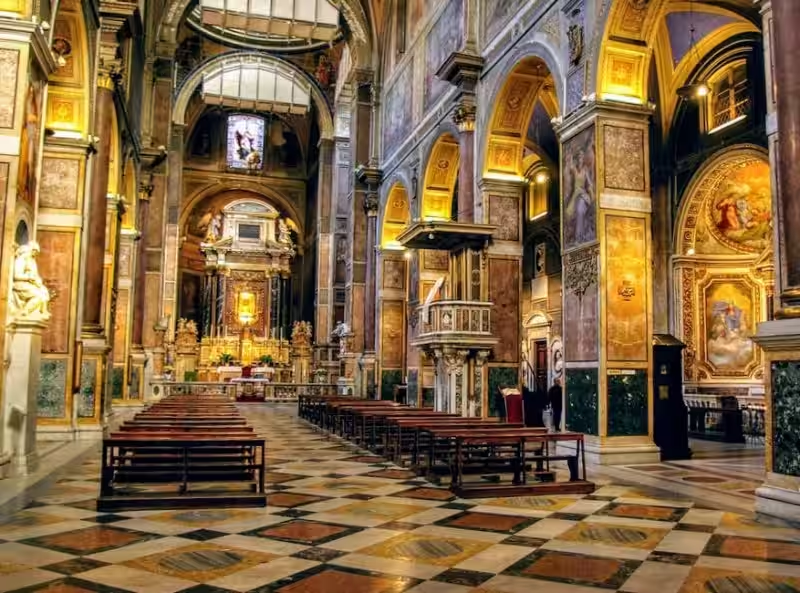
The influence of Sant’Andrea Apostolo extends far beyond his historical presence. He is venerated as a major saint in both the Eastern Orthodox and Roman Catholic Churches, and his feast day, November 30th, is widely observed. Churches, chapels, and religious orders are dedicated in his name across the globe, serving as tangible reminders of his spiritual significance. The very act of naming a place of worship after Sant’Andrea Apostolo is an acknowledgment of his role in the foundational narrative of Christianity and a desire to connect with his spirit of apostolic mission and devotion.
Beyond the direct religious sphere, Sant’Andrea Apostolo has also left an indelible mark on culture and iconography. The Cross of Saint Andrew, his symbol of martyrdom, is a widely recognized emblem, appearing on flags, coats of arms, and various artistic representations. This visual representation of Sant’Andrea Apostolo serves as a constant, albeit sometimes unconscious, reminder of his enduring legacy and the foundational principles of faith, sacrifice, and the spread of religious ideals. His story continues to inspire and inform our understanding of religion and its impact on human history.
Frequently Asked Questions about Sant’Andrea Apostolo (Saint Andrew the Apostle)
Who was Sant’Andrea Apostolo?
Sant’Andrea Apostolo, known in English as Saint Andrew the Apostle, was one of the twelve apostles of Jesus Christ. He is believed to have been the brother of Saint Peter.
What is Saint Andrew known for?
Saint Andrew is known for being one of the first disciples to be called by Jesus. He is also traditionally credited with evangelizing in Scythia and Greece, and according to legend, he was martyred by crucifixion on an X-shaped cross in Patras, Greece.
What is Saint Andrew’s religious significance?
In Christianity, Saint Andrew is venerated as a significant apostle and a martyr. He is the patron saint of several countries, including Scotland, Russia, and Greece, as well as various professions and groups.
When is Saint Andrew’s feast day?
Saint Andrew’s feast day is celebrated annually on November 30th.
What is the symbol associated with Saint Andrew?
The primary symbol associated with Saint Andrew is the saltire, or X-shaped cross, also known as the St. Andrew’s Cross. This is believed to be the shape of the cross on which he was crucified.