The book of Revelation, the final testament in the Christian Bible, often evokes images of fire, brimstone, and apocalyptic pronouncements. For many, it’s a text shrouded in mystery and foreboding, a subject best left to theologians and scholars. However, a Revelations study, when approached with an open mind and a desire for understanding, can offer profound insights that resonate deeply with our everyday lives, illuminating our faith and providing practical wisdom for navigating the complexities of the modern world. Far from being an academic exercise, delving into Revelation can be a transformative spiritual journey, connecting us to a narrative of hope and ultimate redemption.
This exploration isn’t about predicting the end times or deciphering obscure codes. Instead, a Revelations study invites us to consider the enduring themes of good versus evil, the perseverance of the faithful, and the ultimate triumph of God’s plan. It’s a call to examine our own spiritual lives, encouraging us to be vigilant in our faith and to remain steadfast in the face of adversity and temptation. By understanding the symbolic language and historical context, we can begin to grasp the timeless messages that Revelation continues to offer, making it remarkably relevant for believers today.
The Power of Symbolism: Decoding the Language of Revelation
One of the most striking aspects of the book of Revelation is its rich tapestry of symbolic language. From the four horsemen to the seven seals and the beast, these images are not meant to be literal historical accounts but rather powerful metaphors conveying profound spiritual truths. Understanding this symbolic nature is crucial for any meaningful Revelations study. It’s like learning a new language; without the key, the text remains impenetrable.
For example, the numerous mentions of numbers in Revelation – seven, twelve, forty-two – are not arbitrary. These numbers often carry significant symbolic weight within biblical tradition. The number seven, frequently appearing, often signifies completeness or perfection. The number twelve can represent God’s people or divine authority, as seen in the twelve tribes of Israel and the twelve apostles. Recognizing these patterns unlocks deeper layers of meaning, transforming abstract descriptions into powerful theological statements.
The visions presented in Revelation can be overwhelming. We encounter beasts rising from the sea and earth, angels with trumpets, and celestial events. A key aspect of a Revelations study is to approach these visions with a focus on their underlying messages rather than getting bogged down in literal interpretations. Consider the depiction of the Dragon, often identified with Satan. This isn’t a literal reptilian creature but a symbol of ultimate evil, the adversary who seeks to oppose God’s will and pervert truth.
Similarly, the Lamb who is slain but ultimately victorious is a central figure. This powerful symbol of Christ represents sacrifice, redemption, and ultimate authority. When we see the Lamb opening the seals, it signifies Christ’s control over history and his progressive unfolding of God’s plan. A Revelations study helps us to see these symbols not as isolated images but as interconnected elements in a grand narrative of cosmic conflict and divine victory, offering a message of hope and reassurance to believers facing difficult times.
Relevance for Today: Applying Ancient Wisdom to Modern Life
Despite its ancient origins, the book of Revelation speaks profoundly to the challenges and anxieties of our contemporary world. A Revelations study can provide a spiritual compass for navigating the complexities of modern life, offering perspective and encouragement when faced with the pervasive influence of materialism, injustice, and spiritual confusion. The struggles depicted in Revelation – the temptation to compromise faith, the persecution of believers, the allure of worldly power – are remarkably familiar.
Think about the constant pressure in today’s society to conform to certain ideals, to chase after fleeting pleasures, or to prioritize material possessions above all else. Revelation warns against these very temptations, highlighting the ultimate emptiness of worldly pursuits when compared to the eternal promises of God. A Revelations study can serve as a powerful reminder to stay grounded in our spiritual values and to resist the siren calls of a culture that often elevates the temporary over the eternal.
The Call to Perseverance: Standing Firm in Faith
One of the most prominent themes throughout Revelation is the call to perseverance. The early Christians to whom this book was written faced intense persecution and pressure to renounce their faith. The message of Revelation was one of encouragement and endurance, assuring them that their suffering was not in vain and that ultimate victory awaited. This message remains incredibly relevant for believers today, who may face different forms of opposition or internal spiritual struggles.
In our own lives, we might experience discouragement, doubt, or temptation that makes it difficult to maintain our spiritual footing. A Revelations study can equip us with the understanding and conviction to stand firm. It reminds us that even in the darkest moments, God is sovereign and his promises are sure. By studying the examples of faithfulness within Revelation, we can draw strength and inspiration to endure our own trials, knowing that our faith journey is part of a larger, unfolding divine plan.
Finding Hope in the Unfolding Narrative: The Ultimate Triumph
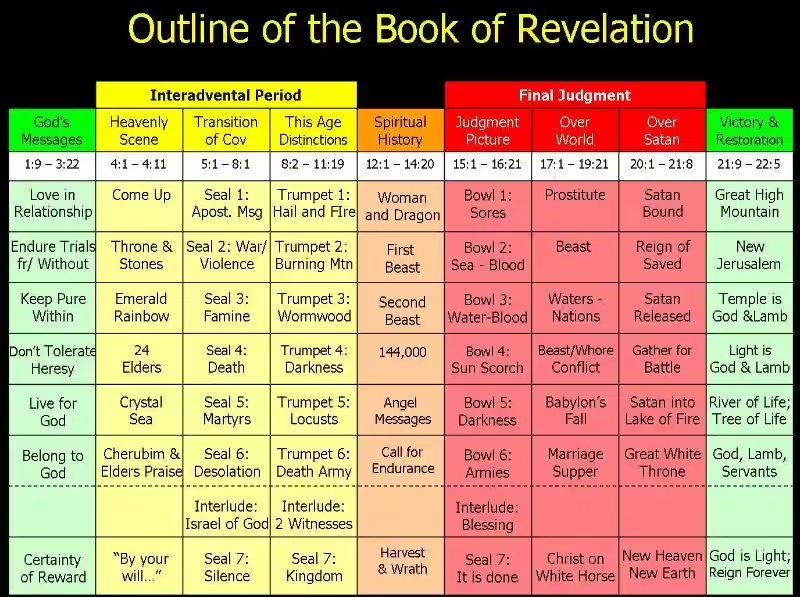
Perhaps the most vital takeaway from any Revelations study is the overarching message of hope and ultimate triumph. While Revelation graphically depicts the struggles against evil, its ultimate trajectory is one of divine victory and restoration. The book concludes not with despair, but with a vision of a new heaven and a new earth, a place where sorrow and pain are no more, and where God’s people live in eternal fellowship with Him. This eschatological hope is a cornerstone of Christian faith.
This vision of the future provides a powerful antidote to the despair and cynicism that can so easily creep into our thinking. It reminds us that the current struggles and injustices we witness are not the final word. A Revelations study can help us to look beyond the immediate circumstances and focus on the eternal perspective. It’s a call to live with anticipation, knowing that the kingdom of God will ultimately prevail, and that our faith and faithfulness have eternal significance. This promise offers a deep wellspring of comfort and motivation for all who believe.
The Book of Revelation is the final book of the New Testament in the Christian Bible. It is an apocalyptic text, meaning it describes a vision of the end times, the final judgment, and the establishment of a new heaven and new earth. It is attributed to the Apostle John.
What are the main themes in the Book of Revelation?
Key themes include the struggle between good and evil, the sovereignty of God, the persecution of believers, the ultimate triumph of Christ, judgment, redemption, and the hope of a new, perfected creation.
How should one approach studying the Book of Revelation?
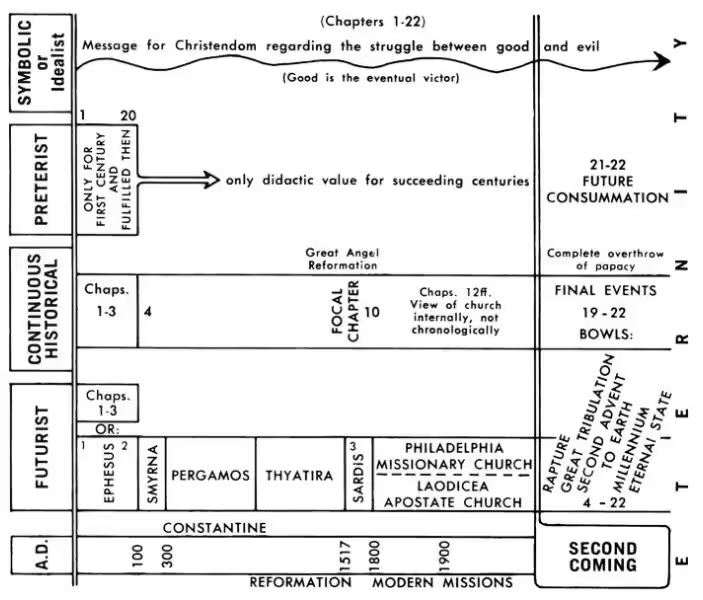
Studying Revelation often involves considering historical context, symbolic language, different interpretive approaches (such as preterist, historicist, futurist, and idealist), and prayerful reflection to understand its message for faith and life.
Is the Book of Revelation a literal prediction of future events?
Interpretations vary widely. Some view it as a literal prediction of future events, while others see its symbols as representing principles, historical eras, or spiritual realities that are ongoing. Many scholars suggest it held immediate meaning for its original audience.
What is the “beast” mentioned in Revelation?
The “beast” is a complex symbol in Revelation, often interpreted as representing political powers, empires, or individuals that oppose God and persecute His people. Its specific identification is a subject of much debate among scholars and theologians.
What is the significance of the number 666?
The number 666 is often associated with evil or antichrist. In its original context, it is widely believed to be a coded reference to Emperor Nero or another persecuting Roman authority, symbolizing imperfect humanity that falls short of God’s perfection (represented by the number 7).
How does Revelation relate to other religions?
Revelation’s primary context is within Christianity. While it speaks of universal judgment and the ultimate reign of God, its specific narrative and theology are deeply rooted in Jewish and early Christian beliefs. It doesn’t directly describe or engage with other religions in detail, but rather presents a worldview centered on the God of Israel and Jesus Christ.
Can Revelation be used to criticize or condemn other religions?
While Revelation speaks of judgment and the ultimate triumph of Christ, its application to condemning specific contemporary religions is a matter of theological interpretation and is not universally agreed upon. Many find its message more focused on spiritual realities and the faithfulness of believers than on detailed critique of other faith systems.
What is the ultimate message of hope in Revelation?
Despite its descriptions of conflict and judgment, Revelation concludes with a powerful message of hope: the ultimate victory of God, the redemption of humanity, and the creation of a new heaven and a new earth where there will be no more suffering, death, or tears.