In the tapestry of Christian art and devotion, certain images resonate across centuries, offering solace, inspiration, and a tangible connection to the divine. Among these, the St. Benedict icon stands out as a particularly potent symbol, interwoven with tales of faith, resilience, and spiritual warfare. This article will explore the rich history, profound symbolism, and enduring relevance of the St. Benedict icon, demonstrating how this powerful image continues to guide and protect countless individuals in their religious journeys.
For many, encountering a St. Benedict icon is more than just an aesthetic appreciation of religious art; it’s an invitation into a centuries-old tradition of prayer and intercession. These icons serve as visual reminders of the virtues embodied by St. Benedict of Nursia, the revered monk who founded the Benedictine Order and authored the foundational Rule that has shaped monastic life for over fifteen hundred years. Understanding the icon is understanding a visual sermon, a condensed narrative of faith in action.
Who Was St. Benedict? The Father of Western Monasticism
To truly grasp the significance of the St. Benedict icon, we must first understand the man himself. Born in Nursia, Italy, around 480 AD, Benedict’s life was marked by a profound turning away from the secular world and a deep commitment to a life of prayer and service. Dissatisfied with the moral laxity he witnessed in Rome, he sought solitude and a more rigorous spiritual path, retreating to a cave in Subiaco.
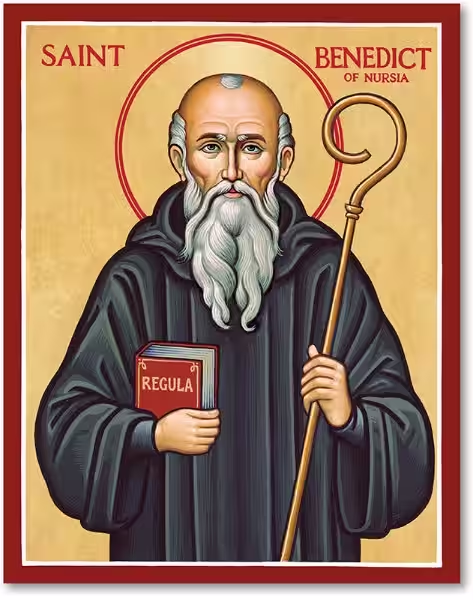
His reputation for sanctity and wisdom soon attracted followers, leading him to establish twelve monasteries in the region. Eventually, he founded the monastery of Monte Cassino, a pivotal moment that cemented his legacy. Here, he drafted his famous Regula Benedicti (Rule of St. Benedict), a balanced and practical guide for monastic living that emphasized prayer, work, and community. This Rule became the cornerstone of Western monasticism, influencing not only monks and nuns but also shaping the very structure of Christian life and spirituality for generations. The St. Benedict icon often depicts him with symbols that allude to this foundational work and his spiritual authority.
The Genesis of the St. Benedict Icon: A Visual Legacy
While St. Benedict lived and was revered long before the widespread use of iconic imagery in the West as we understand it today, the development of the St. Benedict icon as a distinct devotional object evolved over time. Early depictions focused on his saintly visage, often accompanied by symbols of his monastic leadership and miracles. The iconography we recognize today, particularly the famous medal of St. Benedict, gained prominence in the 17th century, solidifying his image as a protector against evil.
The visual language of the St. Benedict icon is rich with meaning. Typically, he is portrayed as an elderly, bearded monk, often holding a crosier, a symbol of his abbatial authority, and the Benedictine Rule. In his hands, or nearby, one might find other significant elements such as a raven, representing his protection of food from poisoning, or a broken cup, signifying his overcoming of a similar attempt on his life. These visual cues are not merely decorative; they are deeply embedded narratives that speak of divine providence and the saint’s intercessory power.
Unpacking the Symbolism: What the St. Benedict Icon Reveals
The St. Benedict icon is a veritable treasure trove of spiritual symbolism, offering layers of meaning for the devout. Beyond the specific elements, the overall impression of the icon conveys a sense of serenity, wisdom, and unwavering faith. St. Benedict’s countenance is often depicted as peaceful, even in the face of adversity, a testament to his deep reliance on God.
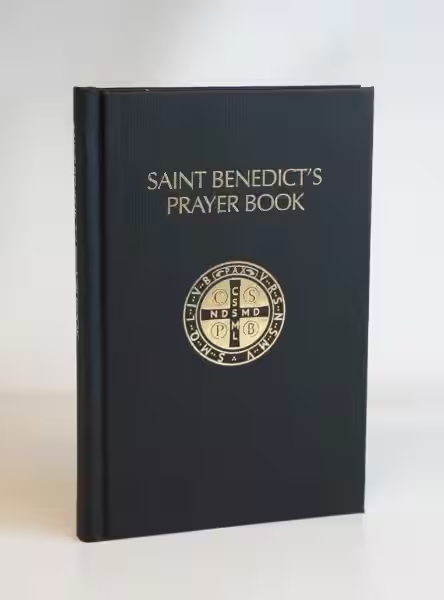
The most universally recognized element associated with St. Benedict is the Medal of St. Benedict. While not always depicted as a standalone icon, it is frequently incorporated into larger representations or is the focal point of devotion. This medal, often found on pendants or integrated into larger St. Benedict icons, bears a powerful set of inscriptions and symbols designed for spiritual protection. These include:
The crucifix, at the top, representing Christ’s sacrifice and victory over sin and death.
The letters V.R.S.N.S.M.V. (“Vade retro Satana, non suasore mihi Vana”) meaning “Begone Satan, do not persuade me with your vanities.”
The letters S.M.L. (“Sanctus Michael Archangelus”) and S.N.D. (“Sanctus N D”).
The letters I.N.R.I. (“Iesus Nazarenus Rex Iudaeorum” – Jesus of Nazareth, King of the Jews).
The letters C.S.P.B. (“Crux Sancti Patris Benedicti” – The Cross of the Holy Father Benedict).
The letters P.A.P.A. and A.G.B., whose exact meaning is debated but often linked to the Benedictine Rule and St. Benedict’s spiritual battles.
The St. Benedict icon, particularly when it features the medal, is thus understood as a potent tool for spiritual defense, a visual prayer that invokes divine protection against temptations, worldly distractions, and the insidious influence of evil. The very act of gazing upon such an icon, or wearing its representation, is an affirmation of one’s faith and a request for heavenly intercession.
The St. Benedict Icon in Practice: Devotion and Protection
The St. Benedict icon is not merely an artifact of historical or artistic interest; it plays a vital role in the practical spiritual lives of believers. Many individuals place these icons in their homes, chapels, or even carry them as a source of comfort and a constant reminder of God’s presence and St. Benedict’s intercession.
The use of the St. Benedict icon often extends to prayers for protection and deliverance. People turn to it during times of personal struggle, family difficulties, or when facing temptations. The belief is that through the intercession of St. Benedict, who himself faced and overcame numerous spiritual battles, the faithful can find the strength and grace to navigate their own challenges. This devotion is rooted in the understanding that the saints, united with Christ, continue to intercede for us in the heavenly realm. The St. Benedict icon serves as a tangible link to this spiritual communion.
A Source of Strength in Daily Life
For those seeking to live a more ordered and God-centered life, the St. Benedict icon offers a visual embodiment of the principles he espoused. His Rule, with its emphasis on balance, discipline, and a healthy rhythm of prayer and work, remains remarkably relevant today. The icon serves as an inspiration to cultivate these virtues, to find holiness in the ordinary, and to approach daily tasks with a spirit of devotion.
Consider the simple act of placing a St. Benedict icon on your desk or in your workspace. It can be a subtle yet powerful reminder to approach your work with integrity, to resist the allure of idleness or distraction, and to seek God’s guidance in all your endeavors. This is a practical application of faith, where a religious image becomes a catalyst for living a more virtuous and purposeful life. The St. Benedict icon thus bridges the gap between the sacred and the secular, sanctifying our daily experiences.
The Enduring Relevance of the St. Benedict Icon Today
In an age often characterized by rapid change, digital distractions, and spiritual uncertainty, the St. Benedict icon offers a grounded and enduring symbol of faith. Its message of steadfastness, wisdom, and protection continues to resonate with people from all walks of life.
The St. Benedict icon reminds us that true strength comes not from worldly power, but from a deep connection with God. It speaks to the timeless human need for guidance, for protection against the forces that seek to pull us away from our spiritual path. Whether one is a seasoned practitioner of the faith or a seeker exploring its depths, the St. Benedict icon provides a visual anchor, a beacon of hope, and a tangible connection to a rich spiritual heritage. Its enduring presence in churches, homes, and hearts across the globe is a testament to its profound and lasting impact.
Frequently Asked Questions About the St. Benedict Icon
What is the St. Benedict icon?
The St. Benedict icon, also known as the Medal of St. Benedict, is a powerful sacramental and a symbol of faith. It features an image of Saint Benedict of Nursia and is inscribed with specific Latin phrases and symbols believed to offer spiritual protection and blessings.
What is the religious significance of the St. Benedict icon?
The icon is deeply significant in Catholicism. It is used as a prayer aid, a focus for devotion, and is believed to invoke Saint Benedict’s intercession for protection against evil, spiritual attacks, temptations, and physical harm. It is often blessed by a priest and can be worn as a medal, placed in homes, or used in other devotional practices.
What do the symbols on the St. Benedict icon mean?
The icon is rich with symbolism. Key elements include:
* The Cross: At the top, representing Christ’s sacrifice and redemption.
* St. Benedict’s Image: Holding a crucifix in one hand and his Rule in the other, signifying his role as a spiritual father and leader.
* Latin Inscriptions:
* C.S.P.B. (Crux Sancti Patris Benedicti): “The Cross of our Holy Father Benedict.”
* C.S.S.M.L. (Crux Sacra Sit Mihi Lux): “May the Holy Cross be my light.”
* N.D.S.M.D. (Non Draco Sit Mihi Dux): “May the dragon never be my guide.”
* V.R.S. (Vade Retro Satana): “Begone, Satan!” (often repeated).
* N.T. R. (Non Tuum, R(ex)): “Not yours, O King.” (referring to Satan).
* I.V.B. (Iesus Vivat, Benedictus): “May Jesus live, [through] Benedict.”
* P.S.P.B. (Pax Sancti Patris Benedicti): “The Peace of our Holy Father Benedict.”
* The letters in the circle around the image of St. Benedict represent the exorcism formula against Satan.
How is the St. Benedict icon used in prayer?
The icon serves as a focal point for prayer. Devotees may meditate on the life and virtues of Saint Benedict, recite prayers invoking his intercession, or use the inscribed phrases as part of their spiritual warfare prayers against evil. It can be used privately or incorporated into communal prayer.
Can anyone use the St. Benedict icon?
While the icon is a Catholic sacramental, its spiritual power is understood to be a gift from God, invoked through the faith of the user and the intercession of Saint Benedict. Many people of various Christian denominations find comfort and protection through its use, based on their personal faith and understanding. It is generally recommended to have it blessed by a Catholic priest for its full sacramental efficacy within the Church’s tradition.