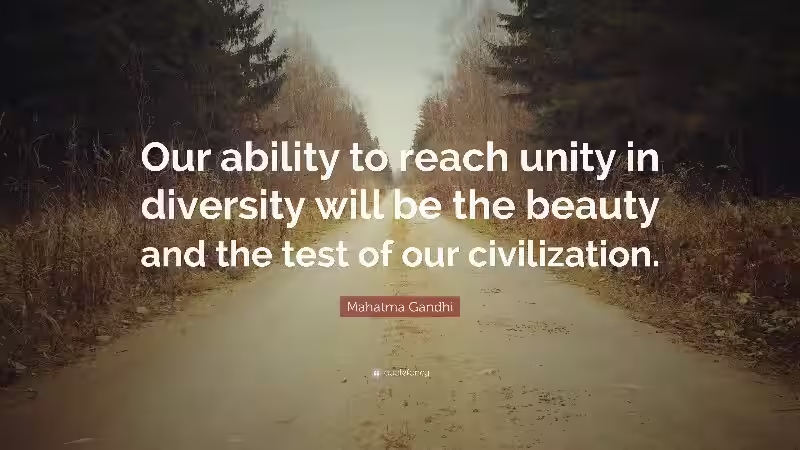
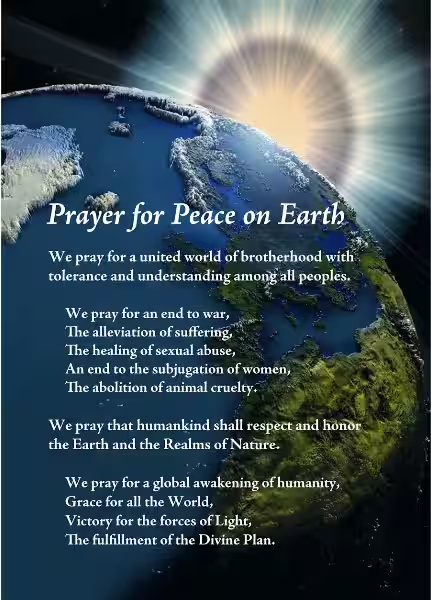
For millennia, humanity has grappled with the profound questions of existence: where do we come from, what is our purpose, and what happens after we die? Across diverse cultures and continents, a common thread has emerged, a deep-seated yearning for meaning and connection that often finds expression in religious traditions. While the outward forms of these beliefs can seem vastly different – from the chanting monks in saffron robes to the quiet contemplation in a synagogue, or the fervent prayers in a mosque – at their heart, most religions share a universal message. This inherent universality isn’t about erasing differences, but about recognizing the shared human experience that binds us all.
The concept of a universal message within religion can be initially perplexing. We are bombarded with stories of religious conflict and division, leading many to believe that religion is inherently divisive. However, digging beneath the surface of dogma and ritual reveals a powerful undercurrent of shared values and aspirations. It’s akin to looking at different languages: while the words and grammar differ, the fundamental human need to communicate thoughts and feelings remains the same. Similarly, the universal message of religion speaks to these primal human needs, offering solace, guidance, and a framework for understanding our place in the cosmos.
At its core, religion is a deeply human response to the quest for meaning. We are not content with mere biological existence; we crave understanding, purpose, and a sense of belonging. This inherent drive is the fertile ground upon which the universal message of religion takes root. Whether it’s the ancient hunter-gatherer gazing at the stars and attributing cosmic significance to them, or the modern scientist seeking the “theory of everything,” the underlying impulse is the same: to make sense of the world and our role within it.
Think about a child asking “why?” endlessly. This insatiable curiosity is a nascent form of our innate desire for meaning. Religions provide narrative structures that answer these fundamental “why” questions. They offer explanations for the origins of the universe, the nature of good and evil, and the ultimate destiny of humanity. While the specific stories might differ – the creation myths of Genesis, the cyclical nature of existence in Hinduism, or the emergence from the void in some indigenous traditions – the universal message is about providing a coherent worldview, a map for navigating the complexities of life and death.
Love, Compassion, and Ethical Living
One of the most potent and consistently present aspects of the universal message across religions is the emphasis on love, compassion, and ethical living. While the theological underpinnings might be varied, the practical application often converges on the importance of treating others well. This isn’t simply about avoiding bad deeds, but about actively cultivating virtues that foster harmony and well-being within communities and between individuals.
Consider the Golden Rule, a principle found in remarkably similar forms across numerous religious and philosophical traditions. In Christianity, it’s “Do unto others as you would have them do unto you.” In Buddhism, it’s often articulated as “Hurt not others in ways that you yourself would find hurtful.” In Judaism, it’s paraphrased as “What is hateful to you, do not do to your fellow.” This universal message of reciprocity and empathy is a cornerstone of civilization, providing the ethical scaffolding upon which societies are built. It calls us to recognize the inherent dignity in every human being, regardless of their background or beliefs, and to act with kindness and understanding.
Finding Connection: The Divine and the Transcendent
Beyond ethical guidelines, the universal message of religion often centers on establishing a connection with something larger than ourselves. This “something” can be understood as God, the Divine, the Absolute, Brahman, or the Tao, depending on the tradition. The specific terminology is less important than the shared human experience of sensing a reality that transcends the material world and offers a sense of ultimate meaning and purpose.
This yearning for connection is often expressed through prayer, meditation, ritual, and spiritual practices. These activities are not merely symbolic gestures; they are intended to foster a sense of communion, to bridge the gap between the individual self and the cosmic whole. For many, this connection provides immense comfort during times of suffering and a profound sense of belonging to something eternal. It’s like finding a vast, welcoming ocean after feeling adrift in a small pond; the sense of scale and interconnectedness is overwhelming and deeply reassuring.
The Nature of the Divine and its Manifestations
While the concept of the Divine as a singular, omnipotent being is prevalent in Abrahamic religions, other traditions understand the divine in more diverse ways. Hinduism, for instance, often speaks of Brahman as the ultimate, formless reality, which manifests in countless gods and goddesses. Buddhism, in its more atheistic interpretations, focuses on the potential for enlightenment within every individual, a kind of inner divinity. Yet, despite these differences, the universal message remains: there is a fundamental reality that is the source of all existence and that can be experienced or apprehended.
This universal message can be seen in how different cultures interpret the divine. A person facing a life-threatening illness might pray to a specific healing deity, finding solace and hope in that intercession. Another might engage in deep meditation, seeking to connect with an inner peace that they believe is divinely inspired. Both are seeking a connection to the transcendent, a source of strength and guidance that goes beyond their immediate circumstances. The universal message is that this connection is possible and that it can profoundly impact our lives.
The Journey of Transformation: Personal Growth and Spiritual Awakening
A significant aspect of the universal message woven through religious traditions is the emphasis on personal transformation and spiritual awakening. Religions are not static doctrines; they are living paths that encourage individuals to evolve, to shed negative traits, and to cultivate positive ones. This journey of self-improvement is often framed as a spiritual ascent, a process of becoming closer to the divine or achieving a higher state of consciousness.
This transformative aspect is relatable to anyone who has ever strived to be a better version of themselves. Whether it’s overcoming anger, practicing patience, or developing greater empathy, the desire for personal growth is a universal human aspiration. Religions provide a framework and a set of tools to facilitate this process. They offer teachings on mindfulness, self-discipline, and the pursuit of wisdom, all aimed at helping individuals realize their full potential.
The Path to Enlightenment and Salvation
The ultimate goal of this transformative journey varies between religions. In some, it’s achieving salvation and eternal life in a heavenly realm. In others, it’s reaching enlightenment and liberation from the cycle of suffering, as in Buddhism. Yet, the underlying universal message is one of hope and the possibility of transcending our current limitations. It assures us that we are not condemned to remain as we are, but that we have the capacity for profound change and for achieving a state of peace and fulfillment.
Consider the concept of “beginner’s mind” in Zen Buddhism. It’s about approaching every experience with fresh curiosity and openness, shedding preconceived notions and judgments. This simple yet powerful idea fosters continuous learning and growth, a universal message of embracing the present moment and remaining open to new insights. Similarly, the Christian concept of repentance and seeking forgiveness is a powerful call to acknowledge past mistakes and to commit to a new, more virtuous path, demonstrating the universal message of redemption and the opportunity for a fresh start.
In conclusion, while the myriad expressions of religion are diverse and sometimes seemingly contradictory, the universal message that underpins them all speaks to our fundamental humanity. It is a message of meaning and purpose, of love and compassion, of connection to the transcendent, and of the potential for personal transformation. By looking beyond superficial differences and focusing on these shared aspirations, we can begin to understand the enduring power and relevance of religion in the human story.
Frequently Asked Questions about Universal Message and Religion
What is the “universal message” in the context of religion?
The “universal message” in religion generally refers to the core ethical, spiritual, and moral teachings that are believed to be common across various faiths or to be the fundamental truth that all religions aim to convey. This often includes themes like love, compassion, justice, peace, and the interconnectedness of all beings.
Are all religions inherently universal?
While many religions aspire to offer universal truths or a path to universal understanding and salvation, their specific doctrines, rituals, and cultural expressions can vary significantly. Therefore, whether a religion is perceived as universal often depends on whether its core message resonates beyond its original cultural or historical context.
How do different religions interpret the concept of a universal message?
Different religions interpret this concept in diverse ways. Some may see their own faith as the sole embodiment of the universal message. Others may believe that different religions are different paths leading to the same universal truth, or that a universal message is an underlying principle that can be found in varying degrees within all spiritual traditions.
Can a universal message exist independently of organized religion?
Many philosophers and spiritual thinkers argue that a universal message, often centered on universally recognizable ethical principles like kindness and empathy, can indeed exist and be understood independently of any specific religious dogma or institution. These principles are seen as inherent to human nature or discoverable through reason and experience.
What are the challenges in identifying a truly “universal message” across all religions?
The primary challenges lie in reconciling differing theological beliefs, moral codes, and historical narratives. Literal interpretations, cultural specificities, and the emphasis on unique salvific paths within individual religions can create significant divergences that make a single, universally agreed-upon message difficult to pinpoint.
Is there a common ground in the teachings of major religions that could be considered a universal message?
Yes, there is considerable common ground. Most major religions share core ethical teachings such as the Golden Rule (treating others as you wish to be treated), the importance of compassion, forgiveness, humility, and the pursuit of peace. Many also emphasize the existence of a higher power or ultimate reality and the importance of spiritual growth.