Beyond the gilded domes and echoing basilicas, a world of Vatican treasures lies waiting, a testament to centuries of faith, artistry, and human endeavor. These aren’t just dusty relics; they are tangible threads connecting us to a profound spiritual heritage, whispering stories of popes, saints, and the very evolution of religious thought. Imagine walking through halls where Michelangelo’s genius is not confined to a ceiling, but extends to sculptural masterpieces, or where ancient manuscripts, penned by hands long gone, still hold the power to illuminate our understanding of history and belief. The sheer scale of the Vatican’s collection is staggering, encompassing everything from priceless religious artifacts to masterpieces of classical and Renaissance art, each piece carefully preserved and imbued with a sacred significance that transcends mere monetary value.
For many, the word “Vatican” conjures images of grand ceremonies and architectural marvels. However, a deeper dive into the Vatican treasures reveals a more intimate and multifaceted narrative. It’s a story of devotion manifested in stone, pigment, and precious metal; a narrative woven through generations of artistic patronage and a deep-seated commitment to preserving the legacy of the Catholic Church. Understanding these treasures isn’t just an exercise in appreciating art; it’s an invitation to engage with the core tenets of religion, to witness the material embodiment of spiritual journeys, and to marvel at the enduring human capacity for both faith and creative expression. These are not simply objects; they are windows into the soul of a global faith, offering profound insights to anyone willing to look.
A Tapestry of Faith: Religious Artifacts of Profound Significance
The heart of the Vatican treasures beats with the rhythm of religious devotion. Foremost among these are the sacred relics, objects directly connected to Jesus Christ, the Virgin Mary, and the saints. These items, from fragments of the True Cross to the veil of Veronica, are not just historical curiosities; for believers, they are powerful conduits of divine grace and touchstones of faith. Imagine holding a piece of wood believed to have been part of the cross on which Christ was crucified – the weight of such a relic transcends the physical, carrying with it the immense spiritual gravity of that pivotal moment in religion. These artifacts serve as a constant reminder of the sacrifices and teachings that form the bedrock of Christianity, offering solace and inspiration to millions.
Beyond individual relics, the Vatican houses an unparalleled collection of liturgical objects that have been used in papal ceremonies and religious services for centuries. These include ornate chalices, embroidered vestments, and exquisitely crafted reliquaries, each a testament to the artistry and devotion poured into the practice of religion. Consider a papal tiara, encrusted with jewels, not merely as a symbol of earthly power, but as a representation of the spiritual authority vested in the Pope, meant to guide and shepherd the faithful. The meticulous craftsmanship and the choice of precious materials in these objects underscore the sacredness of the rituals they adorn, transforming everyday actions into profound acts of worship.
The Pantheon of Artistry: Masterpieces that Illuminate Faith
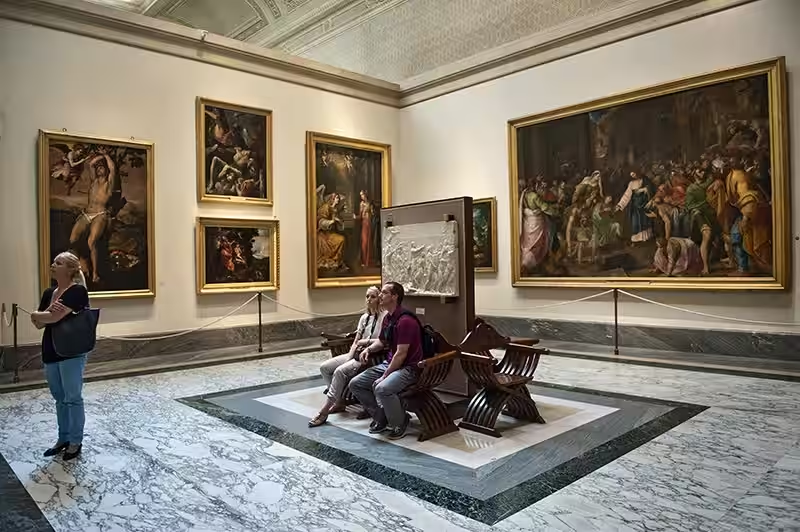
While the sacred relics speak directly to the spiritual core of religion, the Vatican treasures also encompass an extraordinary collection of art that has been commissioned, collected, and preserved by the Church. This artistic heritage is not incidental; it has always been intrinsically linked to the expression and dissemination of religious narratives and teachings. The Vatican Museums, with their vast halls, are a testament to this, showcasing an unparalleled breadth of artistic achievement spanning millennia. From the awe-inspiring frescoes of the Sistine Chapel, depicting biblical scenes with breathtaking drama, to the intricate carvings that adorn altars, art here serves as a visual sermon, making complex theological ideas accessible and emotionally resonant.
The beauty and power of these masterpieces are undeniable, offering a profound aesthetic experience that complements the spiritual. Think of Raphael’s “School of Athens,” a fresco that, while celebrating classical philosophy, also implicitly acknowledges the intellectual foundations upon which much of Christian thought was built. This demonstrates how Vatican treasures often engage in a dialogue between different streams of human knowledge and belief. Each sculpture, painting, and mosaic is more than just an object of beauty; it is a deliberate act of religious communication, designed to inspire awe, encourage contemplation, and reinforce the enduring messages of faith. The artistic legacy within the Vatican is a vital component of its spiritual narrative, making the divine tangible through human creativity.
Echoes of Empire: Antiquities and the Foundations of Belief
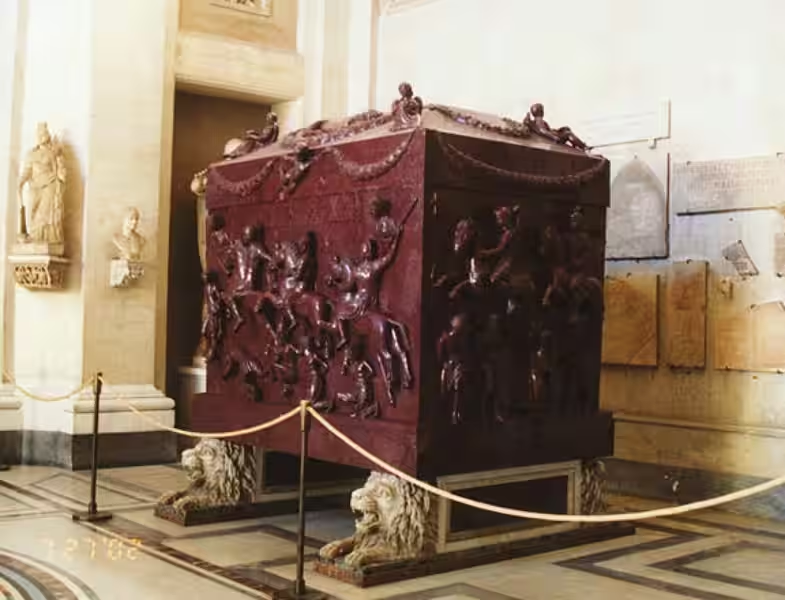
The Vatican treasures extend beyond the Christian era, delving into the classical world that profoundly influenced the development of early Christianity and the Roman Empire. The Gregorian Egyptian Museum and the Gregorian Etruscan Museum, for instance, house an astonishing array of ancient artifacts, including Egyptian sarcophagi, Roman sculptures, and Etruscan bronzes. These collections are not merely academic curiosities; they reveal the cultural and religious landscape in which Christianity emerged and eventually thrived. Understanding these ancient treasures provides crucial context for the evolution of religious practices and the syncretic influences that shaped early religion.
Exploring these antiquities offers a fascinating glimpse into the diverse belief systems and societal structures that preceded and coexisted with early Christianity. Imagine encountering an intricately carved Roman sarcophagus, once holding a pagan dignitary, now housed within the Vatican’s walls. This juxtaposition highlights the historical journey of faith and the ways in which new beliefs often absorbed and reinterpreted existing cultural elements. The historical depth of the Vatican’s collections underscores that religion is not static but a dynamic force that evolves through interaction with the world around it, drawing upon and transforming the heritage of civilizations past. These ancient artifacts are silent witnesses to a world grappling with fundamental questions of life, death, and the divine, much as we do today.
The Unseen Archives: Manuscripts and the Written Word of Faith
Beneath the splendor of the Vatican’s art and artifacts lies another treasure trove, perhaps less visible but equally profound: its vast collection of manuscripts and rare books. The Vatican Apostolic Library is a sanctuary for some of the most important historical and religious documents in existence, preserving texts that have shaped the course of human thought and religion. These include ancient biblical manuscripts, early Christian theological treatises, and historical records that offer unparalleled insights into the development of Church doctrine and practice. The sheer act of preservation in these Vatican treasures is an act of faith in itself, a commitment to safeguarding knowledge for future generations.
The importance of these written Vatican treasures cannot be overstated. Imagine a scholar poring over a parchment penned by a saint, deciphering theological arguments centuries old, or examining an illuminated manuscript adorned with intricate detail, a testament to the devotion of its scribe. These documents are not mere historical records; they are the very building blocks of theological understanding and the bedrock upon which much of our knowledge of religion is built. The Vatican library’s collections offer a direct connection to the intellectual and spiritual debates that have characterized religious history, providing a tangible link to the thinkers and mystics who have guided faith through the ages. They represent a commitment to the enduring power of the written word to transmit, preserve, and evolve spiritual understanding.
A Legacy of Stewardship: Preserving the Treasures for the World
The Vatican treasures are not hoarded away; they represent a profound responsibility of stewardship. The sheer volume and historical significance of these collections necessitate ongoing efforts in conservation and preservation. Teams of experts meticulously work to protect fragile manuscripts, restore delicate frescoes, and safeguard precious artifacts from the ravages of time and environmental factors. This dedication to preservation ensures that these Vatican treasures remain accessible, not just to scholars and theologians, but to anyone seeking to understand the rich tapestry of religion and human history.
The Vatican’s commitment to accessibility is evident in its extensive museum operations and its growing digital initiatives. While not all Vatican treasures can be displayed publicly at any given time, the ongoing work of conservation and research ensures their continued existence and study. This dedication to sharing these invaluable resources with the global community underscores the universal nature of the narratives they embody, transcending geographical and denominational boundaries. The enduring legacy of the Vatican treasures lies not only in their intrinsic value but in the continuous effort to protect and share them, offering a luminous window into the multifaceted world of faith and human expression.
Vatican Treasures – Frequently Asked Questions
What are the Vatican Treasures?
The Vatican Treasures refers to the vast and diverse collection of art, artifacts, and historical objects housed within the Vatican City State. These treasures are primarily displayed in the Vatican Museums, which include iconic sites like the Sistine Chapel, Raphael Rooms, and numerous galleries filled with masterpieces from antiquity to the Renaissance and beyond.
What kind of religious items are kept in the Vatican Treasures?
The Vatican Treasures contain an immense array of religious items. These include sacred relics of saints, liturgical vestments, illuminated manuscripts of religious texts, ancient Christian sarcophagi, devotional art such as paintings and sculptures depicting biblical scenes and figures, and objects used in religious ceremonies throughout history.
Are the Vatican Treasures solely religious in nature?
While religion is a central theme and the primary reason for the existence of many of the Vatican Treasures, the collections extend far beyond purely religious objects. They encompass a broad spectrum of human history and artistic achievement, including significant Roman, Greek, and Egyptian antiquities, historical maps, ethnographic artifacts, and a vast library. The Vatican has been a center of power and patronage for centuries, attracting and commissioning works of art that reflect both faith and worldly accomplishments.
Who owns the Vatican Treasures?
The Vatican Treasures are owned by the Holy See, which is the universal government of the Catholic Church. The collections are maintained and preserved for the benefit of humanity, serving as a testament to faith, history, and artistic endeavor.