The Book of Revelation, a cornerstone of Christian eschatology, is rife with symbolic language and prophetic imagery that has captivated and perplexed believers for centuries. Among its most intriguing passages is Revelation 11:3, which introduces a pair of enigmatic figures: “And I will give power to my two witnesses, and they will prophesy for 1,260 days, clothed in sackcloth.” This cryptic statement begs a fundamental question that has echoed through theological halls and personal study alike: who are the two witnesses in Revelation 11:3? Their identity remains one of the most debated topics within religious discourse, spurring countless interpretations, from the literal to the allegorical, each seeking to unlock the profound meaning behind their divinely appointed ministry.
For many, the immediate impulse is to seek a concrete identification, a name or a specific historical group that perfectly aligns with the prophetic description. This desire for certainty is understandable, especially when dealing with a text that speaks of immense spiritual authority and a pivotal role in end-times events. However, the very nature of Revelation’s symbolism often resists such straightforward labeling. The two witnesses are presented not just as individuals, but as embodiments of divine power and prophetic voice, serving a crucial function during a tumultuous period of world history. Understanding their role requires delving into the context of their prophesying and the unique characteristics attributed to them.
The passage in Revelation 11:3 isn’t just about who they are, but also about what they are empowered to do. The divine power bestowed upon them is central to their mission. It’s not a power they generate themselves, but a gift from God designed to equip them for an extraordinary task. This power manifests in various ways throughout the chapter, including the ability to perform miraculous signs, to prevent rain, and to turn rivers into blood, mirroring the plagues inflicted upon Egypt in the Old Testament. These actions are not mere spectacles; they are divine pronouncements, warnings, and judgments intended to shake the complacency of a world seemingly resistant to God’s truth.
Their prophesying for 1,260 days is a specific timeframe, often interpreted as a literal 3.5 years during the latter half of the tribulation period. This extended period of public witness underscores the endurance and perseverance required of these figures. They are not fleeting messengers but steadfast proclaimers of God’s will amidst opposition and hostility. The instruction for them to be clothed in sackcloth further emphasizes the somber and often difficult nature of their ministry. Sackcloth was a symbol of mourning, repentance, and humility, suggesting that their message, while powerful, would be delivered in a context of spiritual distress and societal upheaval.
Exploring Potential Identities: From Individuals to Institutions
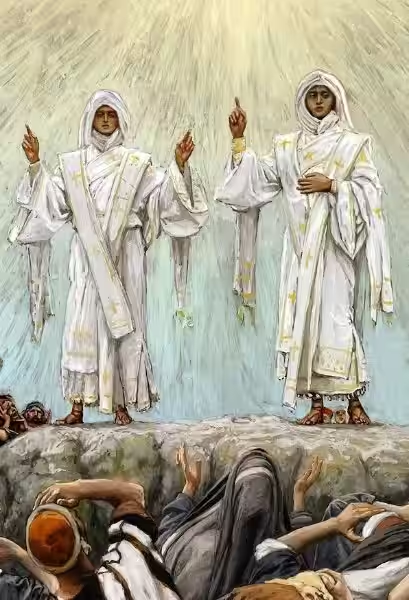
The quest to identify who are the two witnesses in Revelation 11:3 has led to a wide array of interpretations, each with its own merits and challenges. Some scholars and believers propose they represent specific, named individuals from biblical history, resurrected or divinely appointed for this end-time role. The most frequently cited candidates for this interpretation are Enoch and Elijah. Both figures were unique in their earthly departures; Enoch was taken by God without dying (Genesis 5:24), and Elijah was carried to heaven in a whirlwind (2 Kings 2:11). Their presumed undefeated status against the finality of death makes them plausible contenders for returning to confront the forces of evil before the ultimate resolution.
Another significant interpretive lens views the two witnesses not as individuals, but as symbolic representations of the Church. In this view, the “two” could represent the Old and New Testaments, or perhaps the Jewish and Gentile believers united in Christ. The Church, as the body of Christ on earth, is called to prophesy, to bear witness to the Gospel, and to stand firm against spiritual opposition. The miraculous powers attributed to the witnesses could then be understood as the spiritual authority and divine protection granted to the faithful during times of persecution. This interpretation emphasizes the collective, ongoing witness of God’s people throughout history, culminating in a powerful final testimony.
When considering the two witnesses as the Church, the concept of their ministry becomes a powerful metaphor for the prophetic voice of God’s people. Throughout history, the Church has been called to speak truth to power, to denounce injustice, and to proclaim the coming Kingdom of God. The 1,260 days of prophesying can then be seen as the entire period of the Church’s earthly mission, a time marked by both spiritual victories and intense persecution. The sackcloth attire resonates with the suffering and sacrifice often endured by believers as they stand for their faith in a hostile world.
The miraculous powers, in this allegorical understanding, are not necessarily literal physical phenomena but represent the supernatural enablement of the Holy Spirit. The Church is empowered to heal the sick, cast out demons, and preach the Gospel with boldness, signs that accompany believers as promised in scripture (Mark 16:17-18). The ability to “strike the earth with all the plagues” could symbolize the Church’s role in exposing the sinfulness of the world and declaring God’s coming judgment through their righteous living and prophetic pronouncements. This perspective shifts the focus from a specific pair of individuals to the enduring mission and spiritual potency of the entire redeemed community.
A Ministry of Divine Judgment and Testimony
Regardless of whether one leans towards individual identification or a symbolic representation, the core purpose of the two witnesses as described in Revelation 11:3 revolves around their divine mandate to testify and their authority to execute judgment. They are instruments of God’s justice, appointed to challenge the corrupt systems and spiritual deception that will characterize the final days. Their prophesying is an act of unwavering truth-telling in the face of overwhelming darkness, a beacon of hope and a terrifying warning to those who oppose God.
The ultimate fate of the two witnesses – their defeat, death, and subsequent resurrection – further amplifies their symbolic significance. This dramatic narrative arc, culminating in their ascension, serves as a powerful testament to God’s ultimate victory over death and evil. It underscores the assurance that no opposition, however fierce, can ultimately thwart God’s plan. For believers, their story is a source of encouragement and a profound reminder of the faithfulness of God and the eventual triumph of His kingdom, solidifying their place as central figures in the unfolding divine drama.
Frequently Asked Questions: The Two Witnesses in Revelation 11:3
Who are the two witnesses mentioned in Revelation 11:3?
The identity of the two witnesses in Revelation 11:3 is a subject of much theological debate and interpretation within Christianity. No single, universally agreed-upon answer exists. Various interpretations suggest they could represent:
Moses and Elijah: This interpretation is popular due to their historical roles as prophets who performed miracles and contended with opposing spiritual forces. Moses is associated with the Law and Elijah with the Prophets, representing the entirety of the Old Testament.
Two individuals: Some believe they are two specific, yet unnamed, individuals who will appear in the end times, empowered by God to prophesy and perform miracles.
A symbolic representation of the Church: Another viewpoint is that the “two witnesses” are not literal individuals but represent the collective witness of God’s people throughout history, or specifically the persecuted Church in the end times. Their prophecy and suffering symbolize the Church’s testimony and trials.
Two distinct prophetic ministries: It’s also suggested they represent two different types of prophetic ministry, perhaps one focused on judgment and the other on salvation or repentance.
Ultimately, the text itself does not explicitly name them, leaving room for diverse theological understanding.