The words “brother” evoke a complex tapestry of emotions. It’s a bond often forged in shared laughter, whispered secrets, and the sometimes tumultuous journey of growing up. Yet, this very closeness can also be the breeding ground for profound hurt. When betrayal, disappointment, or repeated offenses enter this sacred relationship, a question gnaws at the heart: how many times shall I forgive my brother? This isn’t just a matter of personal endurance; it delves into the very core of our spiritual beliefs and how we understand compassion, justice, and the path to healing.
The easy answer, often parroted in casual conversation, might be an arbitrary number – seven, seventy times seven. But the true depth of this question lies not in a numerical limit, but in the spiritual principles that guide our interactions. Our faith traditions, across the spectrum, offer guidance, not always in the form of a simple equation, but in a framework for understanding the transformative power of forgiveness. It’s about discerning when and how to extend grace, not just for our brother’s sake, but for the peace and integrity of our own soul.
The Divine Mandate: Understanding Forgiveness in Religious Teachings
Across major religious texts, the concept of forgiveness is not a suggestion but a cornerstone of faith. These teachings often highlight the unconditional nature of divine love and mercy, setting a high bar for human interaction. The question of how many times shall I forgive my brother is consistently met with an emphasis on boundless grace, reflecting God’s own boundless forgiveness towards humanity.
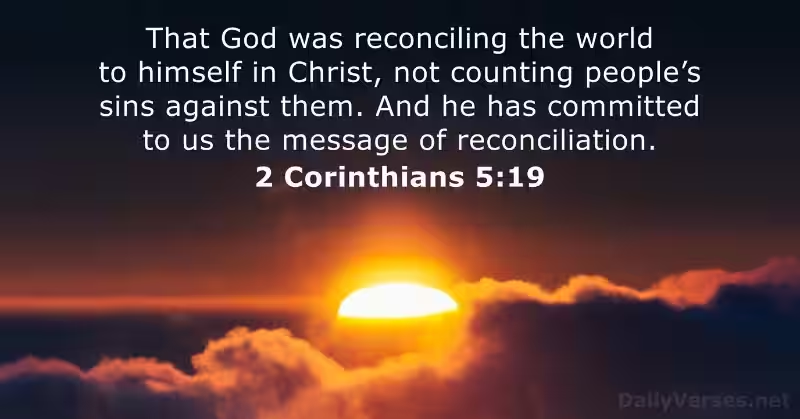
In Christianity, the words of Jesus in Matthew 18:21-22 are particularly striking: “Then Peter came to him and said, ‘Lord, how many times shall I forgive my brother who sins against me? Up to seven times?’ Jesus answered, ‘I tell you, not seven times, but seventy-seven times.'” This biblical injunction isn’t meant to be a mathematical puzzle, but a profound statement on the limitless capacity for forgiveness. It implies a spirit of continuous reconciliation, a willingness to offer grace repeatedly, much like a parent forgives a child. It’s a call to embody Christ-like love, which is characterized by unending mercy.
The Essence of Mercy: More Than Just Letting Go
The spiritual imperative to forgive transcends a mere transactional exchange where we “let go” of a grievance. It’s about cultivating a deep well of mercy within ourselves, mirroring the divine attribute of mercy. This mercy isn’t about condoning harmful behavior, but about releasing the hold that resentment and anger have on our own spirit. When we continuously ask, how many times shall I forgive my brother, we are, in essence, inquiring about the endurance of our own capacity for love and compassion.
In Islam, the concept of Rahmah (mercy) is central to God’s nature and is a virtue that believers are encouraged to emulate. The Quran repeatedly emphasizes God’s all-encompassing mercy and instructs believers to be merciful to one another. While there isn’t a specific verse that answers how many times shall I forgive my brother with a number, the overarching message is one of generosity in forgiveness. The Prophet Muhammad (peace be upon him) stated, “The merciful are shown mercy by the Most Merciful. Be merciful to those on earth, and the One in the heavens will show mercy to you.” This underscores that our capacity for forgiveness is intrinsically linked to receiving divine mercy.
The Golden Rule’s Echo: Treating Others as We Wish to Be Treated
Across various faiths, the Golden Rule serves as a universal ethical principle, and its application to forgiveness is profound. If we desire to be forgiven for our own failings, both by God and by our fellow humans, then we are morally and spiritually obligated to extend that same grace to others, including our brothers. This principle directly informs the answer to how many times shall I forgive my brother.
In Judaism, the concept of teshuvah (repentance) is central, emphasizing the possibility of returning to a righteous path. While forgiveness is often seen as a process that requires repentance from the offender, the emphasis is on making amends and seeking reconciliation. The idea of repeatedly offering the opportunity for repentance and reconciliation aligns with the spirit of unlimited forgiveness. It’s about creating space for change and growth, rather than shutting the door permanently.
When Forgiveness Becomes Difficult: Navigating Hurt and Boundaries
The spiritual ideal of boundless forgiveness is often tested by the harsh realities of repeated offenses and profound hurt. When our brother’s actions cause us pain, especially over and over, the question how many times shall I forgive my brother becomes laced with weariness and a sense of self-preservation. It’s crucial to understand that religious teachings on forgiveness do not advocate for unconditional self-destruction or the sanctioning of abuse.
The nuance lies in distinguishing between forgiving the person and condoning their actions. We can forgive our brother for the hurt they have caused, releasing our own anger and desire for retribution, while still establishing healthy boundaries. Forgiveness, in a practical spiritual sense, is about freeing ourselves from the emotional burden of the offense, not about inviting further harm. For example, if a brother repeatedly borrows money and fails to repay it, leading to financial strain, one can forgive him for the past transgressions, but that doesn’t mean they must lend him money again without a clear plan for repayment. This is a crucial aspect of the discernment required when asking how many times shall I forgive my brother.
The Importance of Boundaries: Protecting Your Well-being
Religious teachings, while emphasizing forgiveness, also acknowledge the importance of wisdom and discernment. This means understanding that while we are called to forgive, we are not called to be perpetually exploited or harmed. Setting healthy boundaries is not un-forgiving; it is a responsible act of self-care, aligned with spiritual principles of stewardship over our own lives.
When grappling with how many times shall I forgive my brother, consider the nature of the offense and its impact. Is it a minor lapse in judgment, or a pattern of behavior that systematically erodes trust and causes significant pain? Spiritual wisdom often guides us to extend grace for genuine mistakes and to encourage repentance, but it also recognizes the need to protect ourselves from ongoing harm. This might involve creating physical or emotional distance, or clearly communicating expectations and consequences.
The Role of Repentance and Reconciliation
True reconciliation, in a spiritual context, often involves repentance and a desire from the offender to change their ways. While we are called to forgive even without immediate repentance, the path towards restoring the relationship is significantly smoother when the offender acknowledges their wrongdoing and demonstrates a commitment to making amends. This is a vital consideration when pondering how many times shall I forgive my brother.
If a brother consistently repeats the same hurtful actions, despite being forgiven, it raises questions about their willingness to change. In such cases, forgiveness becomes an act of releasing our own emotional attachment to the outcome, rather than a guarantee of restored intimacy. The spiritual journey is about our own growth, and sometimes that growth involves acknowledging that a relationship, while deeply loved, may need to exist at a different capacity for our own well-being. This is a challenging but necessary part of understanding how many times shall I forgive my brother.
The Journey of Inner Peace: Forgiveness as a Gift to Yourself
Ultimately, the question of how many times shall I forgive my brother is less about a quantifiable number and more about cultivating a state of inner peace and spiritual maturity. The prolonged holding onto anger and resentment is a heavy spiritual burden, hindering our own connection to the divine and our ability to experience joy. Forgiveness, in this light, is not an act of weakness, but an act of profound strength and self-liberation.
When we choose to forgive, we are not necessarily excusing the behavior, but we are choosing not to let the past define our present or future. We are reclaiming our emotional and spiritual energy, which can then be directed towards positive growth, healing, and deeper connection with God. This is the transformative power that lies at the heart of religious teachings on forgiveness.
The spiritual ideal is to strive for a continuous spirit of grace, understanding that we, too, are in constant need of divine mercy. While there may be times when setting boundaries is necessary, the underlying intention should always be rooted in a desire for healing and eventual reconciliation, if possible. The question, how many times shall I forgive my brother, is best answered by continuously cultivating a heart that is open to offering grace, while also being wise enough to protect its own well-being.
Consider the parable of the prodigal son. The father’s unconditional embrace upon the son’s return, regardless of the son’s past transgressions, is a powerful illustration of divine forgiveness. This doesn’t mean the son didn’t face consequences or learn from his mistakes, but his father’s loving reception paved the way for healing and restoration. This is the spirit we are called to embody when we ask ourselves how many times shall I forgive my brother.
The Path of Spiritual Growth
The journey of forgiveness is an ongoing one, a testament to our spiritual growth and our commitment to living a life guided by love and compassion. By continually seeking to understand and apply the principles of forgiveness found in our religious traditions, we not only bring healing to our relationships but also foster a deeper connection with the divine and discover a profound sense of inner peace and lasting fulfillment. The answer to how many times shall I forgive my brother is found not in a number, but in the unwavering commitment to a heart that seeks to love and be loved.
Frequently Asked Questions: Forgiveness and Religion
How many times shall I forgive my brother?
In the realm of religion, the concept of forgiveness is often presented as boundless. Many faiths emphasize the importance of extending forgiveness repeatedly, mirroring divine mercy. While specific numbers might not be prescribed, the underlying principle is that forgiveness should be an ongoing practice, reflecting a commitment to love, reconciliation, and spiritual growth. The act of persistent forgiveness is seen as a virtue that benefits both the forgiver and the forgiven, fostering peace and understanding.