At the heart of every major religion lies a profound concept: revelation. This isn’t merely a philosophical musing or a historical account; it’s the belief that a divine entity, a higher power, or the ultimate truth has actively communicated with humanity. Think of it as a cosmic download, a truth that transcends ordinary human understanding and is gifted to us from beyond. This divine whisper can manifest in a myriad of ways: through sacred texts, the pronouncements of prophets, visions, dreams, or even a deep, intuitive inner knowing. The very foundation of religious belief often rests on the conviction that these revelations are authentic, carrying a weight and authority that ordinary knowledge cannot possess. Without the initial act of revelation, the subsequent edifice of religious doctrine, practice, and community would have no origin.
Consider, for instance, the story of Moses receiving the Ten Commandments on Mount Sinai. This is a classic example of divine revelation – a direct communication from God to humankind, delivered through a chosen messenger. Similarly, the Quran, for Muslims, is understood as the literal word of God revealed to the Prophet Muhammad. These are not stories made up by humans; they are believed to be blueprints from the divine, offering guidance, moral frameworks, and a path towards salvation or enlightenment. The immensity of this concept, the idea that the infinite has spoken to the finite, is a cornerstone that shapes the lived experience of billions across the globe, providing purpose, meaning, and a connection to something far greater than themselves.
Bridging the Gap: The Crucial Role of Interpretation
The moment a revelation is received, however, it doesn’t always come with a user manual. This is where interpretation enters the picture, and it’s a process as old as religion itself. Revelation, by its very nature, can be profound, symbolic, paradoxical, and even challenging to grasp in its entirety. Therefore, human minds, with their unique perspectives, cultural backgrounds, and intellectual capacities, must grapple with its meaning. Interpretation is the bridge that connects the divine message to the human experience, translating the ineffable into actionable wisdom and relatable narratives. Without interpretation, a sacred text could remain a collection of mysterious symbols, a prophet’s words a series of enigmatic pronouncements, leaving followers adrift without a clear understanding of their faith’s core tenets.
Imagine receiving a complex philosophical treatise written in an ancient, unfamiliar language. While the original text might hold profound truths, its accessibility to you would depend entirely on skilled translators and commentators to unlock its meaning. Religious revelation often functions similarly. The interpretation process involves theologians, scholars, mystics, and ordinary believers engaging in deep study, contemplation, and dialogue. They wrestle with ambiguous passages, historical contexts, and the ethical implications of the divine message. This ongoing dialogue is what keeps religious traditions alive and relevant, allowing them to adapt to changing times while remaining anchored in their foundational truths. It’s a continuous effort to understand what the divine is truly communicating and how it applies to our lives today.
Navigating the Sacred Texts: Literal vs. Figurative Interpretations
One of the most significant areas of religious interpretation revolves around how we approach sacred texts. Should they be taken literally, word for word, as a factual historical or scientific account? Or are they often figurative, employing metaphors, parables, and symbolic language to convey deeper spiritual truths? This distinction is crucial and has led to countless theological debates and diverse religious movements throughout history. For some, a literal reading of scripture offers certainty and an unwavering adherence to divine command. For others, a figurative approach allows for a more nuanced understanding, recognizing that the text’s power lies not in its historical accuracy but in its ability to inspire moral growth and spiritual insight.
Consider the creation narratives found in many religions. A strictly literal interpretation might see the world created in seven days, as described in the Book of Genesis. However, a figurative interpretation might view these “days” as symbolic periods of divine activity, emphasizing the ordered and purposeful nature of creation rather than a literal chronological account. This latter approach allows for harmony with scientific understandings of the universe’s vast age and evolutionary processes, without necessarily discarding the spiritual significance of the creation story. The art of interpretation lies in discerning the author’s intent and the message’s ultimate purpose, whether it’s to inform about cosmology or to reveal the divine relationship with the created world.
The Human Element: Culture, Context, and Community in Interpretation
It’s impossible to discuss revelation interpretation without acknowledging the profoundly human element involved. No revelation is received in a vacuum. It is always filtered through the lens of the interpreter’s culture, their historical context, and the wisdom of their religious community. This means that interpretations can vary significantly across different cultures and time periods, even for the same divine revelation. What might be a straightforward command in one cultural setting could be understood very differently in another, due to differing societal norms, values, and understandings of the world.
For example, ancient laws found in religious texts might be interpreted as timeless moral principles when applied to modern ethical dilemmas, or they might be understood as specific regulations for a particular historical society, requiring adaptation or re-evaluation in our current context. The community of faith plays a vital role in shaping and refining interpretations. Through shared prayer, discussion, and communal study, a consensus can emerge, guiding believers on how to best understand and live out their faith. This collective wisdom, built over generations, acts as a safeguard against extreme or idiosyncratic interpretations, ensuring that the core message of revelation remains accessible and relevant to the faithful.
Living the Revelation: From Ancient Wisdom to Modern Life
Ultimately, the revelation interpretation journey is not an abstract intellectual exercise; it is about how individuals and communities live out their faith. The divine whispers that form the basis of religious traditions are meant to guide, inspire, and transform human lives. This means taking the interpreted meanings of revelation and applying them to the everyday challenges and joys of existence. It’s about translating divine principles into acts of compassion, justice, and love, shaping not only personal character but also the broader social fabric.
The enduring power of religious revelation lies in its potential for personal and societal transformation. When individuals genuinely engage with the interpreted messages of their faith, they can find solace in times of suffering, purpose in the face of uncertainty, and a deep sense of belonging. The ongoing process of interpretation ensures that these ancient revelations remain vibrant, offering fresh insights and renewed relevance to each new generation, allowing the divine tapestry to continue unfolding in ever more meaningful ways for all who seek to understand.
What is the primary purpose of interpreting religious texts like the Book of Revelation?
The primary purpose of interpreting religious texts is to understand their meaning within their original historical and cultural context, and to extract enduring spiritual, ethical, and theological lessons relevant to contemporary believers. It aims to deepen faith, guide practice, and foster a more profound relationship with the divine.
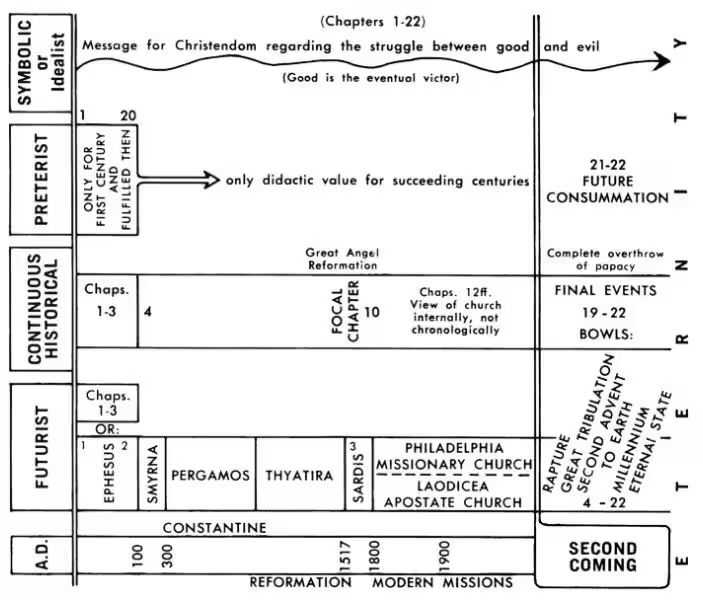
What are some common approaches to interpreting the Book of Revelation?
Common approaches include:
* Preterist: Views most prophecies as fulfilled in the past, often during the 1st century AD.
* Historicist: Interprets Revelation as a symbolic depiction of church history from the apostolic age to the second coming.
* Futurist: Believes that most of Revelation’s prophecies refer to future events, particularly the end times.
* Idealist/Spiritual: Sees Revelation as a timeless allegory of the ongoing spiritual battle between good and evil, and God’s ultimate triumph.
* Eclectic: Combines elements from multiple interpretive approaches.
How does one’s religious tradition influence their interpretation of Revelation?
Different religious traditions have established theological frameworks, doctrinal commitments, and historical understandings that shape how they approach Scripture. For example, a tradition emphasizing literal prophecy fulfillment might lean towards futurist interpretations, while one focused on symbolic meaning and spiritual allegory might favor an idealist approach.
Are there universally accepted “correct” interpretations of religious texts?
No, there are generally no universally accepted “correct” interpretations of complex religious texts. While core tenets and foundational meanings are often agreed upon within a tradition, nuanced interpretations of prophetic passages, theological concepts, and ethical directives can vary widely based on historical context, philosophical perspectives, and individual or communal faith experiences.
How can I ensure my interpretation of religious texts is responsible and respectful?
Responsible interpretation involves:
* Contextual understanding: Studying the historical, cultural, and linguistic background of the text.
* Humility: Recognizing the limitations of one’s own understanding and being open to diverse perspectives.
* Adherence to tradition: Consulting established commentaries and scholarly works within one’s religious tradition.
* Focus on application: Seeking wisdom and guidance for living a faithful life rather than solely engaging in speculative prediction.
* Respect for others: Engaging in dialogue with those who hold different interpretations with charity and intellectual honesty.