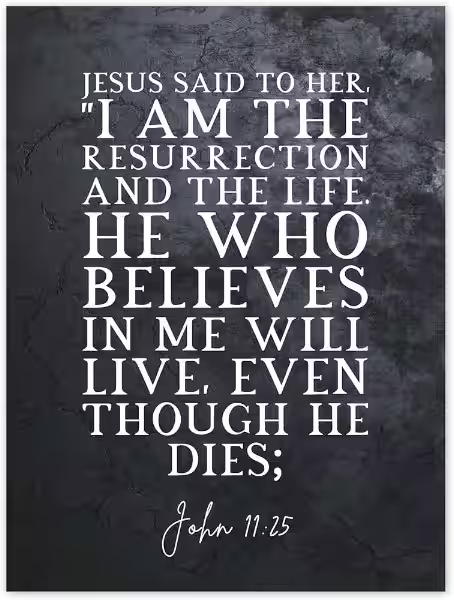
The resurrection of Jesus Christ is not merely an event; it is the bedrock upon which Christianity is built. Without the resurrection, the teachings of Jesus, his sacrifice, and his promises would lose their ultimate significance. The Bible presents a compelling narrative of this pivotal moment, offering verses that have resonated with believers for millennia. Consider the words found in 1 Corinthians 15:3-4, which succinctly summarizes the core message: “For what I received I passed on to you as of first importance: that Christ died for our sins according to the Scriptures, that he was buried, that he was raised to the third day according to the Scriptures, and that he appeared to Peter, and then to the Twelve.” This passage isn’t just a historical account; it’s a theological declaration, emphasizing that Jesus’ death and subsequent resurrection were not accidental but foretold and integral to God’s plan for humanity’s salvation.
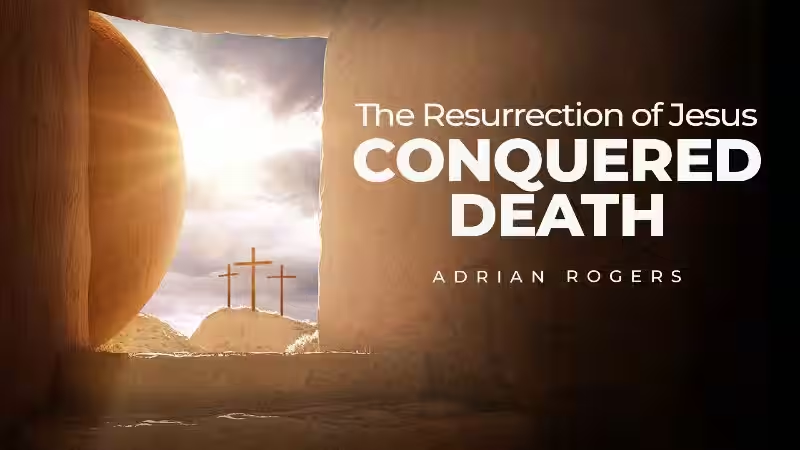
The very existence of the empty tomb is a powerful testament. The Gospels, particularly Matthew 28:1-10, recount the bewildered disciples encountering a stone rolled away and an empty tomb, guarded by angels who declared, “He is not here; he has risen, just as he said.” This miraculous absence of Jesus’ body served as the initial, undeniable proof. Imagine a precious artifact that was tragically lost, only to be found, not just recovered, but fundamentally transformed. The resurrection is akin to that, a transformation that defied the finality of death and offered a new beginning for all who believe. This event, supported by numerous eyewitness accounts detailed in the New Testament, forms the unshakeable foundation of the Christian faith, providing hope and meaning in a world often characterized by suffering and loss.
Eyewitness Accounts: Testimonies of a Risen Lord
The Bible doesn’t shy away from detailing the encounters the resurrected Jesus had with his followers. These are not vague apparitions but vivid, tangible interactions that served to confirm his victory over death. The Apostle Paul, in a powerful passage in 1 Corinthians 15:5-8, lists many of these appearances: “And that he appeared to James, then to all the apostles, and last of all, as to one untimely born, he appeared also to me.” This extensive list of witnesses – Peter, the Twelve, James, and a multitude of others – provides a cumulative weight of evidence. It’s like having multiple credible witnesses to a crime, each independently corroborating the same essential facts, making the event undeniably real.
Think of the story of Mary Magdalene in John 20:11-18. Her initial encounter with Jesus outside the tomb, mistaking him for the gardener, highlights the shock and awe of the resurrection. Her transformation from grief-stricken mourner to ecstatic herald of the good news demonstrates the profound impact of seeing and interacting with the risen Christ. Similarly, the account of the disciples on the road to Emmaus in Luke 24:13-35 showcases Jesus revealing himself to them after they had discussed the recent events, their hearts burning within them, illustrating how the resurrection brought clarity and renewed understanding to their faith. These interactions were not designed to be easily dismissed; they were meant to convince and transform, leaving no room for doubt in the minds of those who experienced them.
Theological Significance: Hope, Forgiveness, and Eternal Life
The theological implications of the Jesus resurrection Bible verses are vast and life-altering. The resurrection is not just about Jesus conquering death; it’s about what that victory means for us. As Romans 6:4 states, “We were therefore buried with him through baptism into death in order that, just as Christ was raised from the dead through the glory of the Father, we too may live a new life.” This verse speaks to the transformative power of the resurrection, offering believers the opportunity to experience a spiritual rebirth, leaving behind the old self and embracing a life lived in alignment with God’s will. It connects our own lives to that of Christ, offering a pattern for our own journey of spiritual renewal.
The resurrection is the ultimate confirmation of Jesus’ divine identity and the efficacy of his atoning sacrifice. It assures us that our sins have been paid for and forgiven. 1 Peter 1:3 beautifully articulates this: “Praise be to the God and Father of our Lord Jesus Christ! In his great mercy he has given us new birth into a living hope through the resurrection of Jesus Christ from the dead.” This “living hope” is not a passive wish but an active expectation of eternal life. It means that death is not the end of the story; rather, it is a doorway to an unending relationship with God. The resurrection provides the promise of eternal life, a future filled with joy, peace, and communion with our Creator, offering a profound sense of purpose and security in the present.
The Resurrection’s Impact on Religion and Daily Life
The belief in the Jesus resurrection Bible verses has shaped the very fabric of religion and continues to influence the lives of billions. It forms the central tenet of Christian worship, celebrated every week on the Lord’s Day, a direct commemoration of the day Jesus rose. The celebration of Easter is the most significant annual reminder of this event, a festival of joy, renewal, and ultimate victory. This core belief fuels the mission of the church, inspiring evangelism and discipleship as believers share the message of hope found in the resurrection. The sacraments of baptism and communion are also deeply rooted in the resurrection, symbolizing death to sin and new life in Christ, and the ongoing remembrance of his sacrifice and victory.
The practical implications of the resurrection extend far beyond religious services and holidays. It offers comfort in times of grief, assuring believers that death is not the final word. It provides strength in times of trial, knowing that the same power that raised Jesus from the dead is available to us. It inspires acts of love and service, motivated by the boundless love demonstrated through Christ’s sacrifice and resurrection. For many, the resurrection is the source of their moral compass, guiding their decisions and shaping their character. It fosters a sense of community among believers, united by their shared faith in a risen Savior and looking forward to a future where all things will be made new.
Living in the Light of the Resurrection
Understanding the Jesus resurrection Bible verses is not just an academic exercise; it’s an invitation to live differently. The empty tomb and the appearances of the risen Christ are not just historical footnotes; they are powerful declarations of God’s love and power. The resurrection challenges us to confront our own doubts and fears, offering us the assurance of a future beyond this life. It calls us to a life of faith, hope, and love, reflecting the very nature of the God who raised Jesus from the dead.
The message of the resurrection is one of unending hope. It reminds us that even in the darkest of times, there is always the possibility of a new dawn, a fresh start, a victory over despair. As we reflect on the profound truth of Christ’s resurrection, let it inspire us to live boldly, love unconditionally, and serve faithfully, all in the glorious light of the risen King. The promise of our own resurrection, as mentioned in verses like 1 Thessalonians 4:16-17, offers the ultimate comfort and anticipation for those who have placed their faith in him, ensuring that our hope is not in vain but is anchored in the eternal reality of a living God.
Frequently Asked Questions: Jesus’ Resurrection and Bible Verses
What are the main Bible verses that describe Jesus’ resurrection?
The primary accounts of Jesus’ resurrection are found in the Gospels:
Matthew 28:1-10: Describes the appearance of an angel at the empty tomb and Jesus’ appearance to the women.
Mark 16:1-8: Details the discovery of the empty tomb by the women and the young man’s message.
Luke 24:1-12: Recounts the disciples’ discovery of the empty tomb and their initial disbelief.
John 20:1-29: Provides a detailed account of Mary Magdalene’s encounter with Jesus and his appearance to the disciples.
Additionally, the Apostle Paul discusses the resurrection extensively in his letters, notably in:
1 Corinthians 15:3-8: Outlines the core message of the Gospel, including Jesus’ death, burial, and resurrection, and lists witnesses to his resurrection.
1 Corinthians 15:12-20: Argues for the necessity of the resurrection for Christian faith.
What is the theological significance of Jesus’ resurrection in Christianity?
The resurrection of Jesus is the cornerstone of the Christian faith. It is seen as:
Proof of Jesus’ divine nature: Demonstrating that he is the Son of God and has power over death.
Victory over sin and death: Offering believers the hope of eternal life and redemption from sin.
Foundation of Christian hope: Assuring followers that they too will be resurrected to new life.
Empowerment for mission: Enabling Jesus’ followers to spread the Gospel with confidence.
How do different Christian denominations interpret the resurrection accounts?
While the core belief in Jesus’ resurrection is universal across Christian denominations, there can be nuanced interpretations regarding the literalness of the accounts, the nature of the resurrected body, and the precise sequence of events. However, the fundamental truth that Jesus physically rose from the dead is a shared tenet of orthodox Christianity.
Are there other religions that have beliefs about resurrection?
Yes, the concept of resurrection or a form of afterlife with a renewed existence appears in various forms across different religions and mythologies. For example:
Judaism: Holds a belief in the resurrection of the dead, though the specifics and timing can vary.
Zoroastrianism: Features a doctrine of a final resurrection and a judgment day.
Ancient Egyptian religion: Believed in an afterlife and the possibility of spiritual rebirth.
However, the Christian understanding of Jesus’ unique, bodily resurrection as a historical event and the foundation of salvation is distinct.