From the dawn of human consciousness, we have been driven by an insatiable curiosity, a yearning to understand our place in the grand tapestry of existence. This inherent drive manifests most profoundly in the realm of religious questions. These are not mere intellectual puzzles; they are the deep, often unspoken, inquiries that shape our lives, our values, and our communities. They are the whispers of the soul, seeking meaning in the face of the unknown, grappling with the mysteries that lie beyond our immediate perception.
Think about the child who, gazing up at the vast expanse of stars, innocently asks, “Where does it all come from?” Or the adult wrestling with loss, pondering, “Is there something more than this?” These fundamental religious questions have echoed through millennia, forming the bedrock of diverse faiths and spiritual traditions. They are the universal language of humanity, a shared quest for answers that transcend the mundane.
The Unfolding Tapestry of Spirituality: Why We Ask
The impulse to explore religious questions is deeply ingrained in our human nature. It stems from our capacity for self-awareness, our ability to contemplate our own mortality, and our innate desire for connection. We are not content to simply exist; we want to understand the why behind it all. This pursuit can be fueled by awe at the natural world, by moments of profound personal experience, or by the simple, persistent human need for a guiding framework.
Consider the sheer wonder of a sunrise, the intricate beauty of a snowflake, or the inexplicable bond we feel with loved ones. These moments often spark contemplation: What is the nature of beauty? Does love have a divine origin? Is there a purpose to suffering? These are the seeds of religious inquiry, blossoming into a lifelong journey of exploration for many. The human mind is wired to seek patterns, to find meaning, and to understand the forces that shape our reality, and religious questions are the most potent expression of this drive.
The Big Ones: Core Religious Questions Explored
At the heart of every religion lie certain universal, profound religious questions. These are the foundational inquiries that have been debated, contemplated, and answered in myriad ways across cultures and epochs. They are the tentpoles that support the vast structures of belief systems worldwide, offering frameworks for understanding life, death, and everything in between.
Some of the most persistent religious questions include:
Does God exist? This is perhaps the most fundamental question, the gateway to theological exploration. The answer, for believers, often shapes their entire worldview.
What is the meaning of life? Are we here by chance, or is there a divine plan? This question drives our search for purpose and fulfillment.
What happens after we die? The fear of annihilation and the hope for an afterlife are powerful motivators in religious thought.
What is good and evil? Understanding morality and discerning right from wrong are central to ethical frameworks within religion.
How should we live our lives? Religious teachings often provide guidelines for conduct, offering paths to righteousness and spiritual growth.
These are not simple questions with easy answers, but their very asking invites us to engage with the deepest aspects of our existence.
The Divine Spark: Questions of Existence and Creation
The question of “Does God exist?” is a monumental one, touching the very core of our understanding of reality. For billions, the answer is a resounding yes, and this belief informs their every action. It is the foundational premise for many religious traditions, leading to a cascade of further religious questions. If God exists, then what is God like? Is God benevolent, all-powerful, all-knowing? These inquiries lead us to the myriad descriptions of the divine found in scriptures, from the transcendent oneness of monotheism to the multifaceted pantheons of polytheistic faiths.
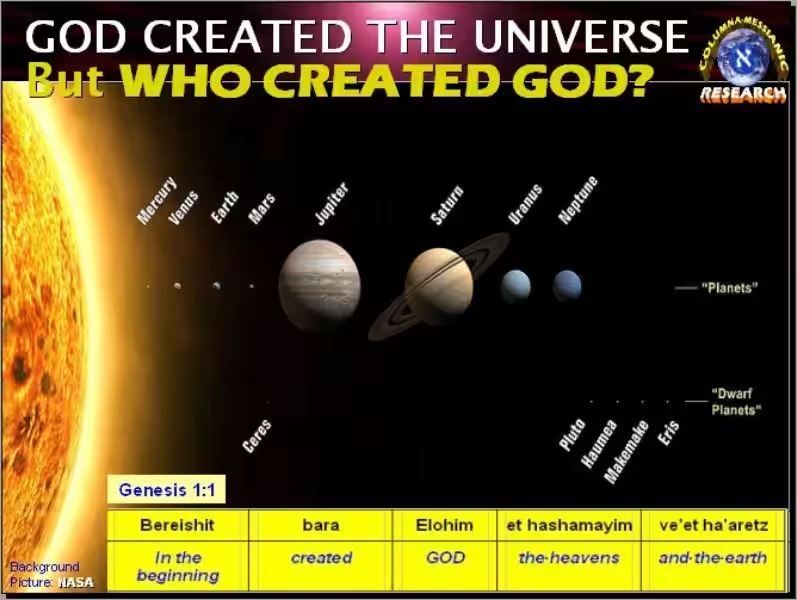
This leads naturally to the question of “Where did everything come from?” The creation narratives found in religions offer profound explanations, often involving a divine act. Whether it’s a singular divine utterance bringing forth the cosmos, or a more complex unfolding of divine will, these stories attempt to satisfy our innate need to understand origins. For example, the Genesis account of God speaking the universe into existence provides a powerful, albeit metaphorical, answer to this fundamental human query. Even those who do not subscribe to a literal interpretation of these narratives often find spiritual resonance in the underlying awe and mystery they convey.
The Human Condition: Questions of Purpose and Morality
Beyond the grand questions of origins, religious questions delve deeply into the human experience itself. The quest for the “meaning of life” is a universal human endeavor. Religion offers frameworks for understanding our purpose, suggesting that our lives are not random occurrences but part of a larger, divine narrative. This can manifest as serving God, achieving enlightenment, or contributing to the well-being of humanity. For instance, many religious traditions emphasize compassion and service as central to a meaningful life, providing concrete actions to align with abstract ideals.
Hand in hand with purpose comes the exploration of morality: “What is good and evil?” Religions provide ethical codes, commandments, and parables that guide individuals on how to navigate the complexities of human behavior. These teachings often distinguish between actions that are divinely favored and those that are considered transgressions. The Ten Commandments in Judaism and Christianity, for example, offer clear guidelines for righteous living, addressing issues of honesty, respect, and worship. Understanding these moral frameworks helps individuals make choices that they believe align with their faith and contribute to a harmonious society, addressing the deeply felt need for a moral compass in a sometimes chaotic world.
The Great Unknown: Questions of Life, Death, and the Beyond
Perhaps one of the most profound and universally pondered religious questions is “What happens after we die?” The human mind struggles with the finality of death, leading to diverse beliefs about an afterlife, reincarnation, or spiritual continuation. These beliefs offer solace, hope, and a sense of continuity that transcends physical existence. The Christian concept of heaven and hell, the Buddhist idea of rebirth, or the Hindu belief in moksha (liberation) all provide different answers to this ultimate human mystery.
These contemplations on death are inextricably linked to the question of “how should we live our lives?” If there is an afterlife, or a cycle of rebirth, then our actions in this life carry significant weight. Religious teachings often emphasize the importance of living virtuously, cultivating spiritual qualities, and preparing for what lies beyond. The Buddhist concept of karma, where actions in this life influence future lives, is a powerful example of how beliefs about the afterlife directly shape present-day behavior. Ultimately, these religious questions about life and death encourage us to live more intentionally, thoughtfully, and with a greater sense of our place in the eternal scheme of things.
Navigating the Spiritual Landscape: Finding Your Answers
Engaging with religious questions is not about finding definitive, universally accepted answers. Instead, it is about the journey of exploration. For some, this journey involves dedicated study of sacred texts, participation in communal worship, and dialogue with spiritual leaders. Others find their answers through personal reflection, meditation, or profound experiences in nature. The beauty of the religious landscape lies in its diversity, offering a myriad of paths for individuals to connect with the divine and to grapple with life’s most profound mysteries.
It is essential to approach these religious questions with an open mind and a humble heart. Acknowledging that we may not have all the answers, but that the pursuit itself is valuable, can be incredibly liberating. Whether you lean towards a specific religion, a more generalized spirituality, or even agnosticism, the act of questioning is an affirmation of our humanity and our deep-seated desire for understanding. The religious questions we ask are not a sign of weakness, but a testament to the strength of our spirit and our enduring quest for meaning.
Religion is a system of faith and worship, often including a set of beliefs about the nature of the universe, the purpose of life, and moral principles. It typically involves practices, rituals, and a community of followers.
Are there different types of religions?
Yes, there are thousands of different religions practiced worldwide. They can be broadly categorized into monotheistic (belief in one God), polytheistic (belief in multiple gods), and non-theistic (not centered on the concept of a god). Major world religions include Christianity, Islam, Hinduism, Buddhism, and Judaism, among many others.
Why do people follow a religion?
People follow religions for a variety of reasons. These can include seeking meaning and purpose in life, finding comfort and guidance, connecting with a community, adhering to moral or ethical frameworks, and understanding the spiritual or divine.
Is religion the same as spirituality?
While often intertwined, religion and spirituality are not always the same. Spirituality generally refers to a personal search for meaning and connection, which may or may not be within the framework of an organized religion. One can be spiritual without being religious, and one can be religious without necessarily feeling deeply spiritual.
Can different religions coexist peacefully?
Yes, many societies and individuals demonstrate the peaceful coexistence of different religions. This often involves mutual respect, understanding, and dialogue between people of various faiths, recognizing shared values and celebrating diversity.
What are common themes found in many religions?
Despite their differences, many religions share common themes such as the existence of a higher power or ultimate reality, the importance of love and compassion, concepts of morality and ethics, the idea of life after death or reincarnation, and the quest for enlightenment or salvation.
Is it possible to be religious and scientific at the same time?
Many people find no conflict between their religious beliefs and their scientific understanding of the world. They may see science as explaining the “how” of the universe and religion as explaining the “why,” or they may interpret their religious texts in ways that are compatible with scientific findings.