The Timeless Echoes of Power in Religious Narratives
Many of us turn to religion for solace, for a moral compass, and for a sense of belonging. We seek divine guidance, understanding of life’s mysteries, and ways to live a virtuous life. Yet, beneath the surface of prayer and piety, the dynamics of human interaction, ambition, and influence often play out in ways that resonate with the stark pragmatism of Robert Greene’s The 48 Laws of Power. It might seem counterintuitive to link the sacred with the secular pursuit of power, but a closer examination reveals that many religious texts and historical accounts are, in their own way, narratives of influence, strategy, and leadership. Think about the parables of Jesus, the sagas of Old Testament prophets, or the organizational structures of ancient religious institutions. They are, in essence, case studies in human nature and its enduring quest for impact.
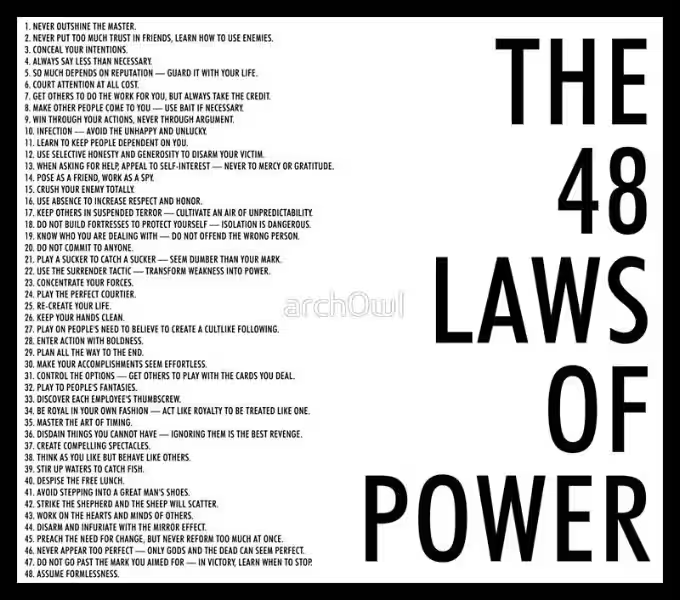
The pursuit of spiritual enlightenment and the acquisition of worldly influence, though seemingly disparate, often intertwine in the complex tapestry of human experience. Religious leaders, from prophets to popes, have wielded immense power, shaping societies and guiding millions. Their methods, while often couched in divine mandate, frequently employ principles that echo the very laws Greene outlines. For instance, Law 1: Never Outshine the Master finds its parallel in the humility often espoused in religious teachings, where subservience to a higher power or a spiritual leader is paramount. Consider the disciples who followed Jesus; their primary role was not to eclipse him but to learn and spread his message. Similarly, in many monastic traditions, the abbot or prior holds authority, and younger monks are expected to show deference and respect, seeking to learn rather than to dominate their superiors. This isn’t just about religious dogma; it’s about understanding the delicate balance of hierarchy and the importance of knowing your place within a system to effectively ascend.
Wisdom Woven into Sacred Stories: Parallels with the 48 Laws Quotes
Religious scriptures are replete with stories that, when viewed through a different lens, offer profound insights into human behavior and the dynamics of power. These narratives, passed down through generations, often serve as cautionary tales or exemplars of successful spiritual and worldly leadership. The very act of conveying moral and ethical principles through storytelling is a powerful form of influence, designed to shape the beliefs and actions of individuals and communities. These stories aren’t just abstract theological discussions; they are often dramatic accounts of individuals navigating complex social, political, and spiritual landscapes, employing strategies that, remarkably, align with the principles outlined in The 48 Laws of Power.
Take, for example, the story of Joseph in the Old Testament. His ability to interpret Pharaoh’s dreams, a seemingly divine gift, catapulted him from a slave to the second most powerful man in Egypt. This aligns with Law 2: Never Put Too Much Trust in Friends, Learn How to Use Enemies. While Joseph didn’t necessarily have enemies in the traditional sense to exploit, his rise was facilitated by his unique skill and his ability to navigate a system where trusted advisors might not have possessed his insight. He leveraged his talent to gain favor with the ruler, demonstrating the importance of having something indispensable to offer. Furthermore, his later reconciliation with his brothers, who had sold him into slavery, can be seen as a masterful display of Law 15: Crush Your Enemy Totally, ensuring they could never harm him again, although his motivation was ultimately forgiveness, the outcome was a complete neutralization of past threats.
The Art of Influence in Religious Leadership: Applying the 48 Laws Quotes
The history of religious institutions is a testament to the enduring power of influence. From the early days of Christianity to the vast empires built by the Roman Catholic Church, and the widespread reach of Islam and Buddhism, religious leaders have consistently demonstrated an understanding of how to gain and maintain power. This isn’t to suggest a cynical manipulation of faith, but rather an acknowledgment that spiritual authority, like any form of authority, relies on strategic thinking, persuasive communication, and an astute understanding of human psychology. The dissemination of doctrine, the establishment of hierarchies, and the mobilization of followers all involve intricate processes of influence.
Consider the early apostles and their mission to spread Christianity. They were not merely passive observers; they were active evangelists who employed persuasive rhetoric, organized communities, and established networks. This can be seen as a practical application of Law 11: Learn to Keep People Dependent on You. By offering spiritual salvation and a sense of community, they made themselves indispensable to the spiritual well-being of their followers. The very structure of the Church, with its clergy and hierarchical organization, also reflects principles of power. For instance, Law 3: Conceal Your Intentions might be subtly at play in moments where the true motives behind certain ecclesiastical decisions are not immediately apparent to the wider congregation, fostering an air of mystery and divine purpose.
Navigating the Spiritual Battlefield: Cautionary Tales and Strategic Wisdom from the 48 Laws Quotes
Religious texts are rich with cautionary tales that underscore the perils of pride, ambition, and misplaced trust, mirroring the warnings found within the 48 Laws of Power. These stories often serve as stark reminders of how even those with the best intentions can fall prey to their own weaknesses or the machinations of others. Understanding these narratives can provide valuable lessons not only for spiritual growth but also for navigating the complexities of human relationships and power dynamics in any sphere of life.
The story of the Tower of Babel is a prime example. Humanity, united by a common language, sought to build a tower reaching to heaven, a symbol of their collective ambition and pride. God, seeing this as a potential threat to his dominion, confused their languages, scattering them across the earth. This illustrates Law 4: Always Say Less Than Necessary. Had the people been less boastful and more restrained in their declarations of intent, perhaps the outcome would have been different. Their hubris, their open display of ambition, ultimately led to their downfall. Similarly, the fall of Lucifer, traditionally depicted as an angel who rebelled against God due to pride, is a timeless narrative of Law 12: Use Selective Honesty and Generosity to Disarm Your Victim. Lucifer, once favored, tried to usurp God’s authority, ultimately leading to his eternal damnation. These biblical narratives, though theological in nature, offer profound psychological insights into the dangers of unchecked ambition and the importance of knowing your limitations.
The Enduring Relevance of 48 Laws Quotes in Understanding Religious Dynamics
The 48 Laws of Power offers a framework for understanding the dynamics of influence that are not confined to the secular realm. When we examine religious history and texts through this lens, we gain a deeper appreciation for the human element that has always been present, even in the most sacred traditions. It allows us to see how principles of strategy, persuasion, and the management of human relationships have been employed, consciously or unconsciously, to shape beliefs, build communities, and wield authority. This understanding doesn’t diminish the spiritual significance of religion; rather, it enriches our comprehension of its practical implementation and enduring impact on the world.
Ultimately, the exploration of 48 Laws quotes in the context of religion is an invitation to a more nuanced understanding of both. It encourages us to look beyond the surface-level doctrines and appreciate the complex interplay of human nature, power, and faith that has shaped our world for millennia. Whether we are seeking spiritual guidance or simply trying to navigate the intricate social landscapes of our lives, the wisdom embedded in these ancient stories and the sharp insights of Greene’s laws offer a powerful, albeit sometimes unsettling, guide. The key lies in discerning when these principles are employed for noble ends and when they are used to manipulate or dominate, always remembering Law 28: Enter Action with Boldness, but also Law 48: Assume Formlessness, adapting to circumstances with wisdom and foresight.
Frequently Asked Questions: The 48 Laws of Power and Religion
Are any of the 48 Laws of Power directly related to religious practices or beliefs?
While the 48 Laws of Power do not explicitly endorse or condemn any specific religion, many of the laws can be interpreted through a lens of religious or spiritual thought. For example, understanding human nature and motivations, which is central to many laws, is also a core aspect of religious teachings. Additionally, concepts of influence, persuasion, and the management of perception can be observed in the narratives and teachings of various religions throughout history.
Can the 48 Laws of Power be used to manipulate religious followers?
The 48 Laws of Power describe tactics of influence and control that, in theory, could be applied to any group, including religious communities. However, the ethical implications of using these laws for manipulation, especially within a religious context where faith and trust are paramount, are significant and widely debated. Many religious traditions emphasize honesty, compassion, and spiritual integrity, which would be antithetical to manipulative practices.
Do any of the 48 Laws of Power contradict religious teachings?
Yes, several laws can be seen as conflicting with the ethical and moral frameworks of many major religions. For instance, laws advocating for deception, ruthlessness, or the exploitation of weakness might directly contradict religious principles that promote truthfulness, mercy, and the protection of the vulnerable. However, interpretations of both the laws and religious texts can vary, leading to different conclusions.
Are there any historical figures in religious history who exemplify the 48 Laws of Power?
Throughout religious history, there are figures whose actions and strategies, when viewed through the framework of the 48 Laws of Power, bear resemblance to certain laws. Leaders who consolidated power, navigated political landscapes, or established influential movements within religious contexts might exhibit traits associated with some of the laws. However, it’s crucial to remember that these historical figures are often viewed through a faith-based perspective, and their actions are typically interpreted within their religious narratives, which may not align with a purely power-centric analysis.
How can someone reconcile the teachings of their religion with the principles of the 48 Laws of Power?
Reconciling them often involves careful interpretation and a prioritization of one’s core religious values. Some individuals may choose to view the 48 Laws as a descriptive analysis of power dynamics in the secular world, separate from their spiritual beliefs. Others might seek to find parallels or cautionary tales, using the laws to understand human behavior in order to better uphold their religious principles. Ultimately, it requires a personal discernment process to determine where the secular pursuit of power might intersect with or diverge from one’s religious or spiritual path.