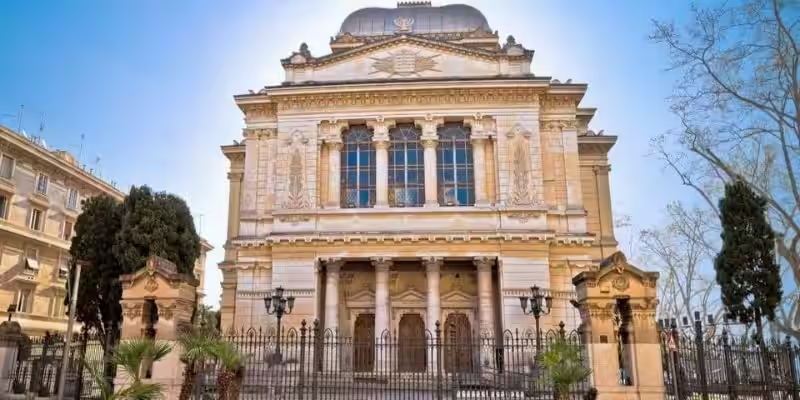
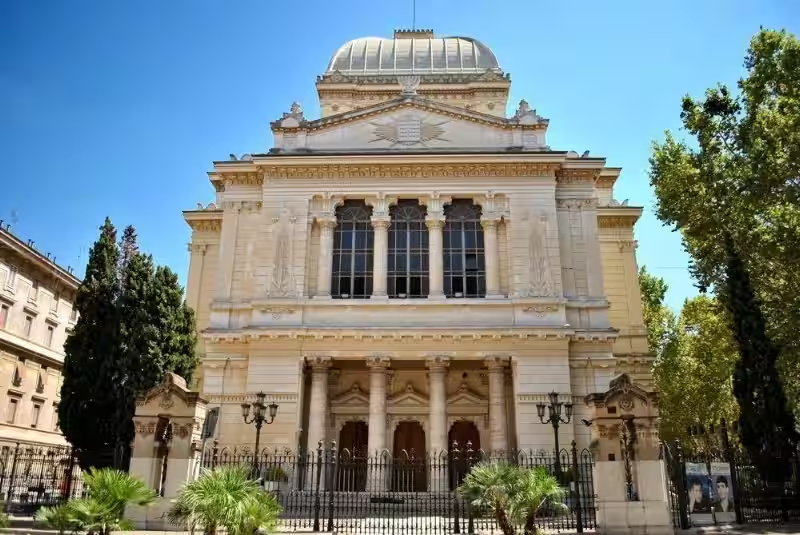
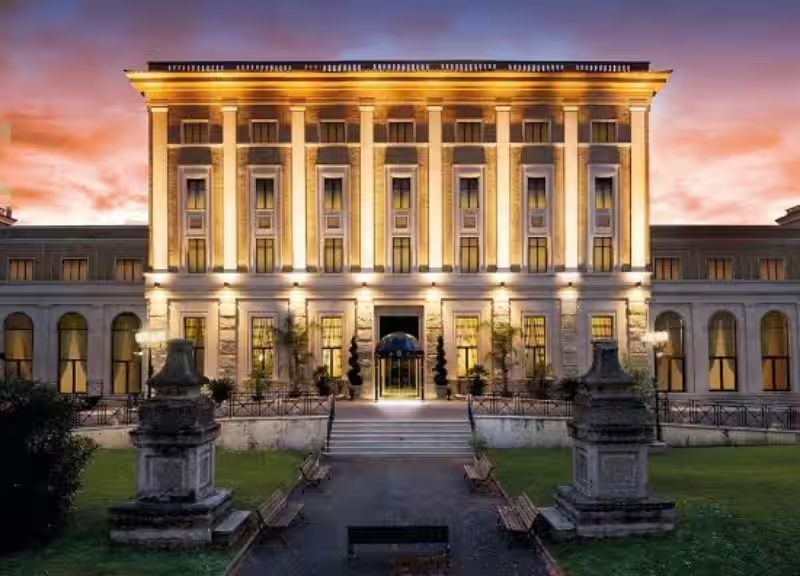
Rome, a city steeped in millennia of history and layered with the echoes of empires and faiths, holds within its heart a profound spiritual and cultural landmark: the Great Synagogue of Rome. More than just a place of worship, this magnificent edifice stands as a testament to the enduring resilience of the Jewish community in Italy, a community with roots stretching back to antiquity. For centuries, the Great Synagogue has been a focal point for Jewish life, a sanctuary for prayer, and a vibrant center for cultural exchange, embodying the intricate tapestry of religion and history that defines the Eternal City.
Understanding the significance of the Great Synagogue requires looking beyond its impressive architecture. It’s a living, breathing monument to a faith that has navigated periods of immense challenge and celebrated moments of profound joy. Its very existence in the heart of Rome is a story in itself, a narrative woven with threads of persecution, liberation, and an unwavering commitment to tradition. Visiting the Great Synagogue offers a unique opportunity to connect with this rich heritage, to witness the vibrant pulse of contemporary Judaism, and to appreciate the profound influence of religion on the cultural landscape of one of the world’s most iconic cities.
A Journey Through Time: The Evolution of Jewish Life in Rome
The presence of Jews in Rome predates the construction of the magnificent edifice we know today as the Great Synagogue. Indeed, it is believed that the first Jewish communities arrived in Rome as early as the 2nd century BCE, possibly as traders or even as captives brought back from Judea. These early settlers, though a minority, began to establish a presence, laying the groundwork for a continuous Jewish presence that has endured through the rise and fall of empires, the pronouncements of popes, and the seismic shifts of history. Imagine, if you will, these early Roman Jews, perhaps gathered in humble homes or small, discreet prayer spaces, their faith a private yet powerful anchor in a vast and often indifferent Roman society. Their resilience is the bedrock upon which the future Great Synagogue would eventually stand.
Over the centuries, the Jewish community in Rome experienced periods of relative tolerance and intense persecution. The establishment of the Roman Ghetto, for instance, in the 16th century, confined Jewish life to a small, walled-off area, a stark reminder of the limitations and hardships faced by the community. Yet, even within these confines, religious life flourished. Synagogues, though often modest and hidden, served as crucial centers for community cohesion and spiritual sustenance. The dream of a grand, communal synagogue, a symbol of pride and belonging, began to take shape over generations, a testament to their enduring spirit and a longing for a more visible and respected place within Roman society. This historical context is essential to truly appreciate the profound statement the Great Synagogue makes.
From Circumstance to Grandeur: The Birth of the Great Synagogue
The late 19th century marked a pivotal moment for Italian Jewry. With the unification of Italy and the subsequent dismantling of the Roman Ghetto in 1870, the Jewish community was granted newfound freedoms and the opportunity to openly express their religious and cultural identity. This liberation sparked a desire for a central, magnificent synagogue that would not only serve as a place of worship but also as a symbol of their integration into modern Italian society. The idea of a “Great Synagogue” was not merely about architectural ambition; it was about embodying a new era of visibility and equality.
The construction of the Great Synagogue of Rome, which began in 1901 and was consecrated in 1904, was a monumental undertaking. It was designed to be a beacon, a structure that would command respect and reflect the dignity of the community. The architectural style, a blend of Assyrian-Babylonian, Egyptian, and Roman influences, was deliberately chosen to evoke ancient grandeur and spiritual depth. This was not just a building; it was a declaration of identity, heritage, and belonging, a tangible manifestation of centuries of prayer and perseverance finally finding a grand and public expression. The selection of the site itself, on the Tiber River, near the former Ghetto, was also deeply symbolic, bridging the past and the present, the struggles and the triumphs of Roman Jewry.
The Great Synagogue Today: A Living Center of Faith and Community
Today, the Great Synagogue of Rome remains a vibrant hub for the Jewish community, far exceeding its function as a mere place of worship. It is a bustling center where religious services are held regularly, from the weekly Sabbath prayers to the solemn High Holy Days. Furthermore, it serves as an educational institution, offering classes, lectures, and programs that delve into Jewish history, philosophy, and tradition. Families gather here for joyous occasions like Bar and Bat Mitzvahs, and the community unites in solemn remembrance during memorial services. The rhythm of life for Roman Jews often revolves around the activities and spiritual guidance offered by the Great Synagogue.
Beyond its religious and educational roles, the Great Synagogue is also a significant cultural and historical landmark that welcomes visitors from around the globe. Guided tours offer invaluable insights into Jewish history in Rome, the symbolism of the synagogue’s architecture, and the ongoing life of the community. It’s a place where one can witness the continuity of ancient traditions in a modern context, understanding how faith shapes daily life and community bonds. For many, a visit to the Great Synagogue is a profound encounter with a living history, a chance to connect with a heritage that has not only survived but thrived in the heart of the Western world. The emphasis on interfaith dialogue and mutual understanding is also a growing aspect of its mission, fostering connections with other communities in Rome.
Experiencing the Essence of Religion and Resilience
Visiting the Great Synagogue of Rome is an experience that transcends mere sightseeing. It is an opportunity to engage with the profound essence of religion – its power to unite, to sustain, and to inspire. You can feel the weight of history in its halls, the whispers of prayers offered by generations past, and the vibrant energy of the community that continues to worship and thrive within its walls. The architectural splendor is undeniable, with its soaring ceilings, intricate detailing, and stained-glass windows that cast a colorful, ethereal light, but it’s the palpable sense of continuity and resilience that truly captivates. It’s a place where the past is not just remembered but is actively lived.
For those seeking to understand the multifaceted nature of religion in a global city like Rome, the Great Synagogue offers a unique perspective. It demonstrates how faith communities adapt and endure through changing times, contributing immeasurably to the cultural richness of their surroundings. It’s a reminder that behind every grand edifice, there are countless individual stories of belief, community, and unwavering hope. Whether you are drawn by its historical significance, its architectural beauty, or its spiritual aura, the Great Synagogue of Rome stands as a powerful symbol of enduring faith and the indomitable human spirit, a must-visit for anyone interested in the intricate interplay of religion, history, and culture.
Frequently Asked Questions about the Great Synagogue of Rome
What is the religion practiced at the Great Synagogue of Rome?
The Great Synagogue of Rome is the main house of worship for the Jewish community in Rome. The religion practiced there is Judaism.
What are the main branches of Judaism represented or observed at the Great Synagogue?
The Great Synagogue of Rome primarily follows the Italian Rite, which is a distinct liturgical tradition within Judaism. While historically it has been a focal point for the Roman Jewish community, it generally aligns with the practices and beliefs of Orthodox Judaism, though it also serves a broader spectrum of the Jewish community in Rome.
Can non-Jews visit the Great Synagogue of Rome?
Yes, non-Jews are generally welcome to visit the Great Synagogue of Rome. It is a significant historical and architectural landmark. Visitors are expected to dress respectfully and adhere to any specific rules or guidelines for visitors, which may include modesty in dress and refraining from photography during services.
What are the prayer services like at the Great Synagogue?
Prayer services at the Great Synagogue follow the Jewish liturgy. The services are often conducted in Hebrew, with some prayers in Italian. The style of prayer and customs are characteristic of the Italian Rite. Services are held on Shabbat (Sabbath) and Jewish holidays, as well as daily.
Is the Great Synagogue of Rome an active place of worship?
Yes, the Great Synagogue of Rome is an active and vibrant center for the Jewish community of Rome, serving as a place for daily prayers, Shabbat services, holiday observances, and various community events.
The question, “Who makes Genesis?” is far more than a simple inquiry about authorship. It delves into the very heart of our understanding of existence, purpose, and the divine. For billions worldwide, Genesis isn’t just an ancient text; it’s the foundational narrative of their faith, a blueprint for life, and a source of profound comfort…
The Nicene Creed stands as a cornerstone of Christian belief, a declaration of faith that has echoed through centuries and continues to be a vital element of worship in the Orthodox Church. For many, the phrase “Nicene Creed Orthodox Church” might conjure images of ancient cathedrals and deeply rooted traditions. But beyond the historical significance,…
In the often chaotic journey of life, every man craves a compass, a guiding light that helps navigate the inherent complexities and profound questions of existence. While the world bombards us with fleeting distractions and immediate gratifications, true and lasting growth often stems from within, nurtured by wisdom distilled over centuries. For men seeking to…
The concept of blessing, in its most profound and spiritual sense, is deeply interwoven with the narrative of Israel throughout religious texts. Far from being a mere passive recipient of good fortune, Israel’s story is one of a divine covenant, a promise of protection, prosperity, and spiritual illumination extended by a higher power. This isn’t…
The concept of the Holy Spirit is one of the most profound and sometimes mystifying elements within many religious traditions, particularly Christianity. We often hear about the Father, the Son, and the Holy Spirit, forming the doctrine of the Trinity. But a question that might naturally arise in the mind of a seeker or a…
In the tapestry of human experience, religion often serves as a guiding thread, offering solace, purpose, and a framework for understanding the world. At its core, any vibrant religious tradition, particularly those rooted in the Judeo-Christian heritage, is defined by a set of profound and enduring biblical characteristics. These aren’t just abstract theological concepts; they…