In the tapestry of Christian devotion, few practices are as universally recognized and deeply cherished as the Rosary. More than just a string of beads, the Rosary is a profound prayer, a meditative journey through the life of Jesus Christ and the Blessed Virgin Mary. When we speak of the Mission Rosary, we are not just referring to a particular style of rosary, but to a renewed emphasis on the Rosary’s evangelical power and its ability to foster spiritual growth in our personal lives and extend that grace outward to the world. This article will explore the essence of the Mission Rosary, its significance within the broader context of religion, and how embracing its practice can enrich your faith journey.
The Mission Rosary is an invitation to engage with these sacred mysteries with a purpose, to pray not only for ourselves but for the propagation of the Gospel and the conversion of souls. It’s about recognizing that our personal prayers have a ripple effect, touching lives and spreading the light of Christ beyond our immediate sphere. Whether you are a lifelong Catholic or someone exploring the depths of Christian spirituality, understanding and participating in the Mission Rosary can unlock a powerful dimension of your religion.
At its core, a Mission Rosary is designed to be a tool for evangelization and personal sanctification. While the physical rosary may have specific colors or devotional medals associated with missionary work, the true mission lies in the intention behind the prayer. It’s about praying with a missionary spirit, a desire to see God’s love and mercy reach every corner of the earth. This isn’t just about reciting prayers; it’s about a contemplative prayer that allows us to enter into the lives of Jesus and Mary, drawing inspiration and strength from their example.
The traditional Rosary consists of meditating on five sets of mysteries: the Joyful, Luminous, Sorrowful, and Glorious. Each set offers a unique perspective on Christ’s life, from his Incarnation to his Resurrection and beyond. When we approach the Mission Rosary, we are encouraged to meditate on these events with a particular focus on their evangelical implications. For instance, meditating on the Nativity might lead us to pray for increased faith among those who have never heard the Gospel, while contemplating the Crucifixion could inspire prayers for healing and reconciliation in a fractured world. The Mission Rosary transforms a personal devotion into a universal intercession.
The Structure of the Rosary and Its Spiritual Fruits
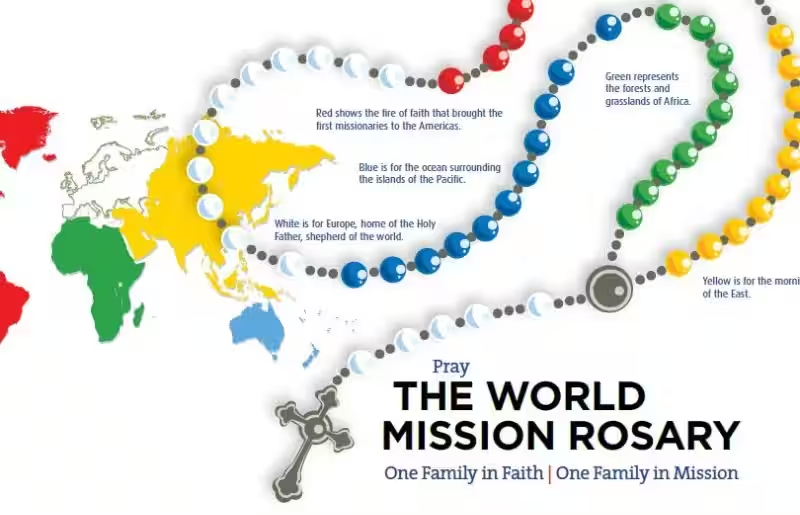
The physical structure of the Rosary, with its beads, is a sacred aid to prayer. It helps us keep track of our prayers, allowing our minds to focus on the spiritual content of each Hail Mary, Our Father, Glory Be, and the central mystery we are contemplating. The Mission Rosary often incorporates specific features, such as a red cord or colors symbolizing different continents, to remind the devout of the global mission of the Church. These outward symbols serve as constant reminders of the broader purpose of our prayer life.
Each bead represents a step in our spiritual journey. The larger beads mark the Our Father, a prayer taught by Jesus himself, while the smaller beads are for the Hail Mary, a prayer of praise and petition directed to Mary. The Mission Rosary encourages us to pray these familiar prayers with renewed intention. Imagine holding a Mission Rosary with a medal depicting St. Christopher, the patron saint of travelers. This serves as a tangible reminder to pray for missionaries who travel to distant lands, facing challenges and sharing the Good News. The Mission Rosary is a complete prayer system, offering both structure and depth.
The Mysteries of the Rosary: A Journey Through Faith
The heart of the Rosary, and by extension the Mission Rosary, lies in meditating upon the Mysteries. These are focal points for prayer and reflection, drawing us closer to the person of Jesus Christ and the actions of the Holy Spirit. Each set of mysteries offers a distinct spiritual lens through which to view our religion.
The Joyful Mysteries: Embracing Humility and Hope
The Joyful Mysteries, traditionally prayed on Mondays and Saturdays, focus on events surrounding Jesus’ birth and childhood. Meditating on the Annunciation, we can pray for openness to God’s will in our own lives, and for those who are hesitant to embrace new beginnings. When contemplating the Visitation, where Mary visits Elizabeth, we can pray for stronger family bonds and for the well-being of expectant mothers and their children, recognizing the profound impact of faith within families. The Nativity invites us to reflect on humility and poverty, and to pray for the homeless and those in need.
The Presentation of Jesus in the Temple calls to mind the dedication of our lives to God. We can offer prayers for young people discerning their vocations and for parents raising their children in the faith. Finally, the Finding of Jesus in the Temple reminds us of the importance of seeking Christ in our everyday lives, and we can pray for those who are searching for meaning and truth. The Mission Rosary amplifies these intentions, extending them to all who need the comfort and joy found in Christ.
The Luminous Mysteries: Christ’s Public Ministry and Light
Introduced by Pope John Paul II, the Luminous Mysteries, prayed on Thursdays, illuminate Christ’s public ministry, highlighting his role as the Light of the World. The Baptism in the Jordan is a powerful moment of divine affirmation, and we can pray for renewal of our baptismal promises and for those undergoing significant life transitions. The Wedding at Cana demonstrates Jesus’ power to transform and bless, prompting prayers for marriages and family celebrations, and for the intercession of Mary in times of need.
The Proclamation of the Kingdom of God and the Call to Conversion is a central theme, and with the Mission Rosary, we pray for a deeper understanding and acceptance of God’s reign in our hearts and in society. The Transfiguration offers a glimpse of divine glory, inspiring us to seek spiritual transformation and to pray for those who are struggling with doubt or despair. Finally, the Institution of the Eucharist centers on Christ’s ultimate gift of himself. Through the Mission Rosary, we pray for reverence and devotion to this holy sacrament, and for the spread of Eucharistic adoration.
The Sorrowful Mysteries: Walking with Christ Through Suffering
The Sorrowful Mysteries, prayed on Tuesdays and Fridays, guide us through the events of Christ’s passion and death. These are the bedrock of our redemption. The Agony in the Garden calls us to pray for strength in times of trial and for peace amidst suffering. The Scourging at the Pillar reminds us of the injustices of the world, and with the Mission Rosary, we can pray for the abolition of torture and violence, and for the healing of victims.
The Crowning with Thorns highlights Christ’s suffering for our sins, and we can pray for humility and repentance, and for those who are persecuted for their faith. The Carrying of the Cross is a profound meditation on sacrifice and perseverance. We can pray for those who bear heavy burdens, and for the strength to carry our own crosses. The Crucifixion is the ultimate act of love, and through the Mission Rosary, we pray for mercy for sinners and for the salvation of all souls.
The Glorious Mysteries: Celebrating Victory and Eternal Life
The Glorious Mysteries, prayed on Wednesdays and Sundays, celebrate Christ’s victory over death and the promise of eternal life. The Resurrection is the cornerstone of our faith, and we pray for renewed hope and new life in Christ. The Ascension signifies Christ’s return to the Father, and we can pray for our own spiritual ascent and for the missionary zeal to bring others to the Father.
The Descent of the Holy Spirit empowers us with divine grace. With the Mission Rosary, we pray for the gifts of the Holy Spirit for ourselves and for the Church throughout the world, especially for those working in challenging missionary fields. The Assumption of Mary into heaven is a beautiful promise of our own future glory, and we can pray for a devotion to Mary and for her intercession on our behalf. Finally, the Coronation of Mary as Queen of Heaven and Earth inspires us to live lives worthy of heaven, and to pray for peace and justice in the world, guided by the example of our Heavenly Mother.
The Mission Rosary in Action: More Than Just Prayer
The Mission Rosary is not meant to be a static devotion but a dynamic force for good. It’s about weaving the practice of the Rosary into the fabric of our daily lives, allowing its meditative power to shape our thoughts, actions, and intentions. This can manifest in various ways, from personal prayer to organized missionary outreach.
Consider how a simple act of praying the Mission Rosary can have far-reaching consequences. When you pray for missionaries, you are actively supporting their efforts through your intercession. This is a tangible way to participate in the Great Commission. Many organizations create and distribute Mission Rosaries to encourage this practice, often linking specific colors or charms to different missionary apostolates or regions. These tangible reminders can ignite a passion for evangelization in those who hold them.
Bringing the Mission Rosary to Your Community
Encouraging the practice of the Mission Rosary within your parish or faith community can foster a stronger sense of shared purpose and missionary identity. Organizing a Rosary group that specifically prays the Mission Rosary with intentions for global evangelization can be incredibly impactful. This communal prayer strengthens bonds among members and amplifies the power of their intentions.
You might also consider participating in or initiating Rosary-making workshops. These events not only provide individuals with their own Mission Rosary but also serve as opportunities for fellowship and discussion about the importance of prayer in missionary work. Sharing the stories of missionaries and the impact of their faith can inspire others to take up the Mission Rosary and contribute in their own unique ways. The Mission Rosary is a versatile tool for fostering both individual and collective faith.
Embracing the Mission Rosary in Your Daily Life
Ultimately, the Mission Rosary is a deeply personal and profoundly communal practice that enriches our religion. It calls us to a deeper engagement with the life of Christ, to a more fervent prayer life, and to a greater awareness of our role in spreading God’s love throughout the world. Whether you choose a rosary with specific missionary symbols or simply approach your traditional rosary with a missionary intention, the power of this prayer remains immense.
Let the Mission Rosary be your constant companion, a reminder to pray for the conversion of hearts, the healing of nations, and the ever-expanding kingdom of God. As you move through the beads, imagine your prayers traveling across continents, touching lives, and planting seeds of faith. The Mission Rosary is not just a prayer; it’s a commitment to love and a dedication to service within the context of our cherished religion.
Frequently Asked Questions about the Mission Rosary
While the name “Mission Rosary” might bring certain images to mind, it’s important to clarify that the Mission Rosary itself is not a specific religious order or denomination but rather a particular devotion or method of praying the Rosary with an evangelistic or missionary focus. The concept and its practice are rooted within the broader Christian faith, specifically Catholicism.
What is the Mission Rosary?
The Mission Rosary is a devotion that encourages individuals to pray the Rosary with the intention of spreading the Gospel and supporting missionary work. It often involves praying for specific intentions related to evangelization, the conversion of souls, and the needs of missionaries and those they serve. The prayers themselves are the standard prayers of the Catholic Rosary (Our Father, Hail Mary, Glory Be, Apostle’s Creed).
Is the Mission Rosary a specific denomination or religion?
No, the Mission Rosary is not a specific denomination or religion. It is a devotional practice within Christianity, primarily associated with the Catholic Church. The concept of praying for missions and evangelization is a common theme across various Christian traditions, but the structured prayer of the Rosary is a distinct Catholic practice.
How does the Mission Rosary relate to Catholicism?
The Mission Rosary is a Catholic devotion. The Rosary, as a prayer, is a central element of Catholic spirituality. The “mission” aspect simply adds a specific intention and focus to the traditional Rosary prayers, aligning with the Church’s call to evangelize and spread the faith.
Can people of other religions participate in the Mission Rosary?
The Mission Rosary, in its traditional form, involves specific Catholic prayers and theological underpinnings. Therefore, it is primarily intended for and practiced by Catholics. While individuals of other faiths may find value in the contemplative or meditative aspects of repetitive prayer, the specific prayers and intentions of the Mission Rosary are rooted in Catholic belief.
What are the benefits of praying the Mission Rosary?
Praying the Mission Rosary can offer several benefits:
* Spiritual Growth: Deepens one’s relationship with God and understanding of the life of Jesus Christ and Mary.
* Intercession: Provides an opportunity to pray for the needs of the Church, missionaries, and the world.
* Unity: Connects the individual prayer to a larger global mission of evangelization.
* Peace and Reflection: Offers a time for quiet contemplation and spiritual focus.
* Fulfillment of a Spiritual Call: Responds to the Christian call to share the faith.